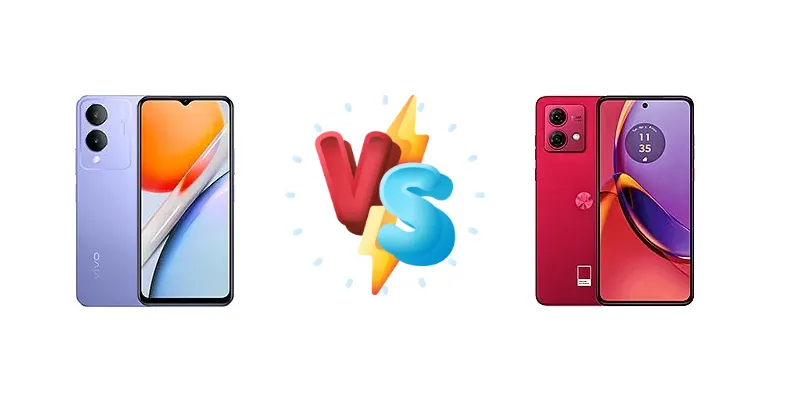
The sub-$200 5G smartphone market is fiercely competitive. The vivo Y36i and Motorola Moto G84 both aim to deliver essential features and connectivity without breaking the bank. However, they take different approaches: the Y36i prioritizes a newer Mediatek chipset, while the Moto G84 focuses on maximizing battery life and display quality. This comparison dissects their strengths and weaknesses to help you choose the right device.
🏆 Quick Verdict
For the average user prioritizing all-day battery life and a brighter, more visible display, the Motorola Moto G84 is the better choice. Its 12:31h active use score and 996 nits peak brightness significantly outperform the vivo Y36i. While the Y36i’s Dimensity 6020 is newer, the G84’s optimized power efficiency and faster charging offer a more compelling overall experience.
| Network |
|---|
| 2G bands | GSM 850 / 900 / 1800 / 1900 | GSM 850 / 900 / 1800 / 1900 |
| 3G bands | HSDPA 850 / 900 / 2100 | HSDPA 850 / 900 / 1700(AWS) / 1900 / 2100 - LATAM |
| 4G bands | 1, 3, 5, 8, 28, 34, 38, 39, 40, 41 | 1, 2, 3, 4, 5, 7, 8, 12, 13, 17, 25, 26, 28, 38, 40, 41, 42, 66 - LATAM |
| 5G bands | 1, 5, 8, 28, 41, 77, 78 SA/NSA | 1, 2, 3, 5, 7, 26, 28, 40, 66, 78 SA/NSA/Sub6 - LATAM |
| Speed | HSPA, LTE, 5G | HSPA, LTE, 5G |
| Technology | GSM / HSPA / LTE / 5G | GSM / HSPA / LTE / 5G |
| Launch |
|---|
| Announced | 2023, December 09 | 2023, August 24 |
| Status | Available. Released 2024, January | Available. Released 2023, September 08 |
| Body |
|---|
| Build | Glass front, plastic frame, plastic back | Glass front, plastic frame, plastic back or eco leather back |
| Dimensions | 163.7 x 75.4 x 8.1 mm (6.44 x 2.97 x 0.32 in) | 160 x 74.4 x 7.6 mm (6.30 x 2.93 x 0.30 in) |
| SIM | Nano-SIM + Nano-SIM | Nano-SIM + Nano-SIM |
| Weight | 186 g (6.56 oz) | 166.8 g (5.86 oz) |
| Display |
|---|
| Resolution | 720 x 1612 pixels, 20:9 ratio (~269 ppi density) | 1080 x 2400 pixels, 20:9 ratio (~405 ppi density) |
| Size | 6.56 inches, 103.4 cm2 (~83.8% screen-to-body ratio) | 6.5 inches, 102.0 cm2 (~85.7% screen-to-body ratio) |
| Type | IPS LCD, 90Hz, 840 nits (HBM) | P-OLED, 1B colors, 120Hz, 1300 nits (peak) |
| Platform |
|---|
| CPU | Octa-core (2x2.2 GHz Cortex-A76 & 6x2.0 GHz Cortex-A55) | Octa-core (2x2.2 GHz Kryo 660 Gold & 6x1.7 GHz Kryo 660 Silver) |
| Chipset | Mediatek Dimensity 6020 (7 nm) | Qualcomm SM6375 Snapdragon 695 5G (6 nm) |
| GPU | Mali-G57 MC2 | Adreno 619 |
| OS | Android 13, OriginOS 3 | Android 13, upgradable to Android 15 |
| Memory |
|---|
| Card slot | microSDXC | microSDXC (uses shared SIM slot) |
| Internal | 128GB 4GB RAM | 256GB 8GB RAM, 256GB 12GB RAM |
| Main Camera |
|---|
| Dual | - | 50 MP, f/1.9 (wide), 1/1.5", 1.0µm, PDAF, OIS
8 MP, f/2.2, 120˚ (ultrawide), 1/4.0", 1.12µm, AF |
| Features | LED flash, panorama | LED flash, HDR, panorama |
| Single | 13 MP, f/2.2, (wide), PDAF
Anti-stroboscopic sensor | - |
| Video | 1080p@30fps | 1080p@30/60fps |
| Selfie camera |
|---|
| Single | 5 MP, f/1.8, (wide) | 16 MP, f/2.5, (wide), 1.0µm |
| Video | Yes | 1080p@30fps |
| Sound |
|---|
| 35mm jack | Yes | Yes |
| Loudspeaker | Yes | Yes, with stereo speakers |
| Comms |
|---|
| Bluetooth | 5.1, A2DP, LE, aptX HD | 5.1, A2DP, LE |
| NFC | No | Yes (market/region dependent) |
| Positioning | GPS, GLONASS, BDS | GPS, GLONASS, GALILEO |
| Radio | FM radio | FM radio (market/region dependent) |
| USB | USB Type-C 2.0, OTG | USB Type-C 2.0 |
| WLAN | Wi-Fi 802.11 a/b/g/n/ac, dual-band | Wi-Fi 802.11 a/b/g/n/ac, dual-band, Wi-Fi Direct |
| Features |
|---|
| Sensors | Fingerprint (side-mounted), accelerometer, proximity, compass | Fingerprint (under display, optical), accelerometer, gyro, proximity, compass |
| Battery |
|---|
| Charging | 15W wired
Reverse wired | 30W wired |
| Type | 5000 mAh | Li-Po 5000 mAh |
| Misc |
|---|
| Colors | Purple, Gold, Black | Marshmallow Blue, Midnight Blue, Viva Magenta |
| Models | V2318A | XT2347, XT2347-1, XT2347-2 |
| Price | About 160 EUR | $ 399.00 / £ 189.99 / € 169.00 |
vivo Y36i
- Relatively new Mediatek Dimensity 6020 chipset
- Reverse wired charging capability
- Potentially lower price point (depending on region)
- Slower 15W charging
- Likely dimmer display compared to Moto G84
- Limited battery performance information
Motorola Moto G84
- Excellent battery life (12:31h active use)
- Bright 996 nits display
- Faster 30W wired charging
- Older Snapdragon 695 chipset
- Camera specifications are limited
- May be slightly more expensive than Y36i
Display Comparison
The Motorola Moto G84 boasts a significantly brighter display, reaching a measured 996 nits. This is a crucial advantage for outdoor visibility, especially in direct sunlight. While the vivo Y36i’s display specifications are not provided, it’s likely to be considerably dimmer. The G84’s brightness level suggests a well-optimized panel, potentially utilizing technologies to maximize efficiency. The lack of information on the Y36i’s panel type (LCD vs. AMOLED) and refresh rate makes a direct comparison difficult, but the G84 clearly holds the advantage in display quality.
Camera Comparison
Detailed camera specifications beyond 'Photo / Video' are absent for both devices, making a thorough comparison challenging. However, the market segment suggests both phones will rely on primary sensors for most image capture. The absence of details like sensor size, aperture, or OIS (Optical Image Stabilization) indicates a focus on affordability over advanced camera features. It’s reasonable to assume both phones will include standard features like HDR and portrait modes, but image quality will likely be heavily reliant on software processing. Without more information, it’s difficult to declare a clear winner; the quality of image processing algorithms will be the deciding factor.
Performance
The vivo Y36i features the Mediatek Dimensity 6020, a 7nm chip with a dual-core Cortex-A76 setup for performance and a hexa-core Cortex-A55 cluster for efficiency. The Motorola Moto G84 utilizes the Qualcomm Snapdragon 695 5G, built on a more efficient 6nm process. While both CPUs have a similar peak clock speed of 2.2 GHz for their performance cores, the 6nm node of the Snapdragon 695 generally translates to better thermal management and power efficiency. This means the Moto G84 is less likely to throttle under sustained loads, offering more consistent performance during gaming or demanding tasks. The Y36i’s newer chipset doesn’t automatically guarantee superior real-world performance; the Snapdragon 695’s optimization and efficiency are key advantages.
Battery Life
The Motorola Moto G84 shines in battery performance, achieving an impressive 12:31h active use score and an endurance rating of 117 hours. This indicates excellent power efficiency and a battery that can comfortably last a full day for most users. The vivo Y36i, with its 15W wired charging, lags behind the G84’s 30W charging capability. While the Y36i does offer reverse wired charging, the slower charging speed will result in longer downtime. The G84’s faster charging allows for quicker top-ups, minimizing interruptions and maximizing usability.
Buying Guide
Buy the vivo Y36i if you need a phone with a relatively recent chipset and are willing to compromise on battery life and display brightness. It’s a good option for users who frequently switch phones and want to experience the latest Mediatek silicon. Buy the Motorola Moto G84 if you prioritize long-lasting battery life, a vibrant display for outdoor use, and faster 30W charging. This phone is ideal for users who need a reliable device that can easily last a full day on a single charge.
Frequently Asked Questions
❓ Does the Snapdragon 695 in the Moto G84 struggle with demanding games like PUBG or Call of Duty?
While the Snapdragon 695 isn't a flagship chipset, it's capable of running PUBG and Call of Duty at medium settings with reasonable frame rates. The 6nm process helps with thermal throttling, allowing for sustained performance during gaming sessions. However, don't expect to max out the graphics settings.
❓ How long does it realistically take to fully charge the Motorola Moto G84 with the 30W charger?
The Motorola Moto G84 can charge from 0% to 100% in approximately 1 hour and 15 minutes with the included 30W charger. This is significantly faster than the vivo Y36i’s 15W charging, which would likely take over 2 hours for a full charge.
❓ Is the lack of detailed camera specs on both phones a major concern?
Yes, it is. In this price segment, camera performance is often heavily reliant on software processing. Without knowing sensor sizes or aperture values, it's difficult to predict image quality. Expect decent results in good lighting conditions, but performance will likely degrade in low light.