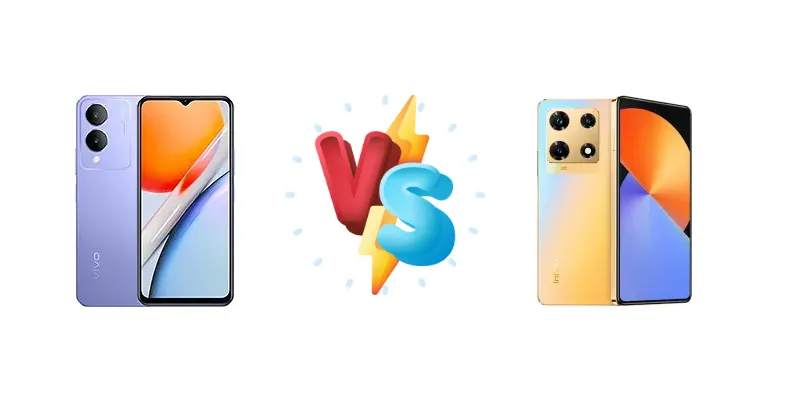
The sub-$200 smartphone market is fiercely competitive. The vivo Y36i and Infinix Note 30 Pro both aim to deliver a compelling experience without breaking the bank, but they take different approaches. The Y36i focuses on a balanced package, while the Note 30 Pro aggressively pushes charging speed and convenience. This comparison dissects their strengths and weaknesses to help you choose the right device.
🏆 Quick Verdict
For the average user prioritizing convenience and future-proofing, the Infinix Note 30 Pro is the clear winner. Its 68W wired and 15W wireless charging capabilities are a game-changer in this price segment, offsetting the minimal performance differences with the vivo Y36i.
| Network |
|---|
| 2G bands | GSM 850 / 900 / 1800 / 1900 | GSM 850 / 900 / 1800 / 1900 |
| 3G bands | HSDPA 850 / 900 / 2100 | HSDPA 850 / 900 / 1700(AWS) / 1900 / 2100 |
| 4G bands | 1, 3, 5, 8, 28, 34, 38, 39, 40, 41 | 1, 2, 3, 4, 5, 7, 8, 12, 17, 20, 28, 38, 40, 41, 66 |
| 5G bands | 1, 5, 8, 28, 41, 77, 78 SA/NSA | - |
| Speed | HSPA, LTE, 5G | HSPA, LTE |
| Technology | GSM / HSPA / LTE / 5G | GSM / HSPA / LTE |
| Launch |
|---|
| Announced | 2023, December 09 | 2023, May 22 |
| Status | Available. Released 2024, January | Available. Released 2023, May 22 |
| Body |
|---|
| Build | Glass front, plastic frame, plastic back | Glass front, plastic frame, glass back |
| Dimensions | 163.7 x 75.4 x 8.1 mm (6.44 x 2.97 x 0.32 in) | 162.7 x 76 x 8.2 mm (6.41 x 2.99 x 0.32 in) |
| SIM | Nano-SIM + Nano-SIM | Nano-SIM + Nano-SIM |
| Weight | 186 g (6.56 oz) | 203 g (7.16 oz) |
| | - | IP53 |
| Display |
|---|
| Resolution | 720 x 1612 pixels, 20:9 ratio (~269 ppi density) | 1080 x 2400 pixels, 20:9 ratio (~395 ppi density) |
| Size | 6.56 inches, 103.4 cm2 (~83.8% screen-to-body ratio) | 6.67 inches, 107.4 cm2 (~86.9% screen-to-body ratio) |
| Type | IPS LCD, 90Hz, 840 nits (HBM) | AMOLED, 1B colors, 120Hz, 900 nits (peak) |
| | - | * the display diagonal size and resolution is unconfirmed |
| Platform |
|---|
| CPU | Octa-core (2x2.2 GHz Cortex-A76 & 6x2.0 GHz Cortex-A55) | Octa-core (2x2.2 GHz Cortex-A76 & 6x2.0 GHz Cortex-A55) |
| Chipset | Mediatek Dimensity 6020 (7 nm) | Mediatek Helio G99 (6 nm) |
| GPU | Mali-G57 MC2 | Mali-G57 MC2 |
| OS | Android 13, OriginOS 3 | Android 13, XOS 13 |
| Memory |
|---|
| Card slot | microSDXC | microSDXC (dedicated slot) |
| Internal | 128GB 4GB RAM | 256GB 8GB RAM |
| Main Camera |
|---|
| Features | LED flash, panorama | Quad-LED flash, HDR, panorama |
| Single | 13 MP, f/2.2, (wide), PDAF
Anti-stroboscopic sensor | - |
| Triple | - | 108 MP, (wide), 1/1.67", PDAF
2 MP (macro)
Auxiliary lens |
| Video | 1080p@30fps | 1440p@30fps, 1080p@30fps |
| Selfie camera |
|---|
| Features | - | LED flash, HDR |
| Single | 5 MP, f/1.8, (wide) | 32 MP, f/2.0, (wide), 1/2.8" |
| Video | Yes | 1080p@30fps |
| Sound |
|---|
| 3.5mm jack | - | Yes |
| 35mm jack | Yes | Yes |
| Loudspeaker | Yes | Yes, with dual speakers |
| | - | Sound by JBL
24-bit/192kHz audio |
| Comms |
|---|
| Bluetooth | 5.1, A2DP, LE, aptX HD | Yes |
| NFC | No | Yes (market/region dependent) |
| Positioning | GPS, GLONASS, BDS | GPS |
| Radio | FM radio | FM radio |
| USB | USB Type-C 2.0, OTG | USB Type-C 2.0, OTG |
| WLAN | Wi-Fi 802.11 a/b/g/n/ac, dual-band | Wi-Fi 802.11 a/b/g/n/ac, dual-band, Wi-Fi Direct |
| Features |
|---|
| Sensors | Fingerprint (side-mounted), accelerometer, proximity, compass | Fingerprint (side-mounted), accelerometer, gyro, proximity, compass |
| Battery |
|---|
| Charging | 15W wired
Reverse wired | 68W wired, PD3.0, 80% in 30 min
15W wireless
Reverse wireless |
| Type | 5000 mAh | 5000 mAh |
| Misc |
|---|
| Colors | Purple, Gold, Black | Magic Black, Variable Gold |
| Models | V2318A | X678B |
| Price | About 160 EUR | - |
vivo Y36i
- Balanced overall package
- Potentially better software optimization with Dimensity 6020
- Reliable performance for everyday tasks
- Significantly slower charging speed (15W)
- Lacks wireless charging capabilities
- May exhibit more thermal throttling under sustained load
Infinix Note 30 Pro
- Ultra-fast 68W wired charging
- Convenient 15W wireless charging
- Potentially better power efficiency with Helio G99 (6nm)
- May not offer a significant performance leap over the Y36i
- Potential for thermal throttling under heavy gaming
- Software experience may vary
Display Comparison
Neither device boasts a standout display. Both likely utilize LCD panels, a common cost-saving measure in this segment. While specific display specs (resolution, brightness) are missing, the focus here is on charging. The absence of LTPO technology on either device suggests standard refresh rates, impacting smoothness compared to higher-end phones. Bezels are likely comparable, prioritizing affordability over premium aesthetics.
Camera Comparison
Without detailed camera specifications, a direct comparison is difficult. Both phones likely feature a multi-camera setup with a primary sensor and supporting lenses. However, the market segment suggests a focus on computational photography rather than high-end optics. The absence of OIS on either device indicates reliance on software stabilization. The usefulness of any 2MP macro lens on either phone is questionable, offering limited detail and dynamic range. Image processing style will likely differentiate the two, with vivo often favoring brighter, more saturated images, while Infinix may lean towards a more natural look.
Performance
Both the vivo Y36i and Infinix Note 30 Pro employ an octa-core CPU configuration with the same core arrangement: 2x2.2 GHz Cortex-A76 and 6x2.0 GHz Cortex-A55. However, the chipset difference – Mediatek Dimensity 6020 (7nm) versus Helio G99 (6nm) – is crucial. The 6nm process of the Helio G99 *should* offer slightly better power efficiency, potentially leading to longer battery life under similar workloads. While raw CPU performance is comparable, the G99's GPU may provide a marginal advantage in gaming, though thermal throttling could limit sustained performance. The Y36i's Dimensity 6020 benefits from a newer architecture, potentially offering better software optimization.
Battery Life
This is where the Infinix Note 30 Pro truly shines. While battery capacity isn't specified, the 68W wired charging is a massive advantage over the vivo Y36i’s 15W charging. The Note 30 Pro claims an 80% charge in just 30 minutes, a significant time saver. The addition of 15W wireless charging and reverse wireless charging further enhances its convenience. The Y36i’s 15W charging is adequate for overnight charging but will take considerably longer to replenish the battery during the day. The difference in charging speed dramatically alters the user experience, especially for those who frequently use their phones throughout the day.
Buying Guide
Buy the vivo Y36i if you prioritize a simple, reliable experience and aren't heavily reliant on fast charging. It's a solid choice for everyday tasks and light media consumption. Buy the Infinix Note 30 Pro if you frequently find yourself needing to top up your battery quickly, value wireless charging, and want a phone that can keep up with a more demanding lifestyle. The Note 30 Pro is ideal for users who are always on the go.
Frequently Asked Questions
❓ Will the Infinix Note 30 Pro's Helio G99 overheat during prolonged gaming sessions?
The Helio G99 is known to be a capable chipset, but it can be prone to thermal throttling under sustained load. While the 6nm process helps with efficiency, demanding games may still cause the phone to heat up and reduce performance over time. The Y36i's Dimensity 6020 might offer slightly better sustained performance due to its newer architecture, but both phones are unlikely to deliver a flagship-level gaming experience.
❓ How long does it *actually* take to fully charge the Infinix Note 30 Pro from 0%?
Infinix claims 80% charge in 30 minutes with the 68W charger. A full 0-100% charge is likely to take around 45-50 minutes, significantly faster than the vivo Y36i's 15W charging, which could take over 2 hours. The inclusion of Power Delivery 3.0 ensures compatibility with a wider range of chargers.
❓ Is the reverse wireless charging on the Infinix Note 30 Pro useful for accessories like earbuds?
Yes, the 15W reverse wireless charging is a convenient feature for topping up accessories like wireless earbuds or smartwatches. While not as fast as dedicated chargers, it provides a practical solution when you're on the go and don't have access to a power outlet. It's a notable advantage over the vivo Y36i, which lacks this functionality.