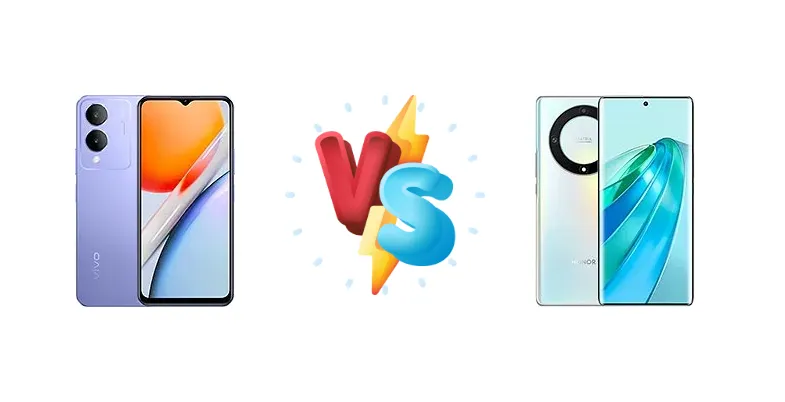
The sub-$200 smartphone market is fiercely competitive, and the vivo Y36i and Honor X9a represent compelling options for users seeking 5G connectivity without breaking the bank. While both aim for affordability, they take different approaches to performance and features, centering around distinct chipsets and charging capabilities. This comparison dissects those differences to determine which device offers the best overall experience.
🏆 Quick Verdict
For the average user prioritizing faster charging and potentially smoother multitasking, the Honor X9a emerges as the better choice. Its 40W charging significantly reduces downtime compared to the Y36i’s 15W, and the Snapdragon 695, built on a 6nm process, offers a slight edge in efficiency and sustained performance.
| Network |
|---|
| 2G bands | GSM 850 / 900 / 1800 / 1900 | GSM 850 / 900 / 1800 / 1900 |
| 3G bands | HSDPA 850 / 900 / 2100 | HSDPA 850 / 900 / 1900 / 2100 |
| 4G bands | 1, 3, 5, 8, 28, 34, 38, 39, 40, 41 | LTE |
| 5G bands | 1, 5, 8, 28, 41, 77, 78 SA/NSA | SA/NSA |
| Speed | HSPA, LTE, 5G | HSPA, LTE, 5G |
| Technology | GSM / HSPA / LTE / 5G | GSM / HSPA / LTE / 5G |
| Launch |
|---|
| Announced | 2023, December 09 | 2023, January 04 |
| Status | Available. Released 2024, January | Available. Released 2023, January 06 |
| Body |
|---|
| Build | Glass front, plastic frame, plastic back | - |
| Dimensions | 163.7 x 75.4 x 8.1 mm (6.44 x 2.97 x 0.32 in) | 161.6 x 73.9 x 7.9 mm (6.36 x 2.91 x 0.31 in) |
| SIM | Nano-SIM + Nano-SIM | Nano-SIM + Nano-SIM |
| Weight | 186 g (6.56 oz) | 175 g (6.17 oz) |
| Display |
|---|
| Resolution | 720 x 1612 pixels, 20:9 ratio (~269 ppi density) | 1080 x 2400 pixels, 20:9 ratio (~395 ppi density) |
| Size | 6.56 inches, 103.4 cm2 (~83.8% screen-to-body ratio) | 6.67 inches, 107.4 cm2 (~89.9% screen-to-body ratio) |
| Type | IPS LCD, 90Hz, 840 nits (HBM) | AMOLED, 1B colors, 120Hz, 800 nits (HBM) |
| Platform |
|---|
| CPU | Octa-core (2x2.2 GHz Cortex-A76 & 6x2.0 GHz Cortex-A55) | Octa-core (2x2.2 GHz Kryo 660 Gold & 6x1.7 GHz Kryo 660 Silver) |
| Chipset | Mediatek Dimensity 6020 (7 nm) | Qualcomm SM6375 Snapdragon 695 5G (6 nm) |
| GPU | Mali-G57 MC2 | Adreno 619 |
| OS | Android 13, OriginOS 3 | Android 12, upgradable to Android 13, MagicOS 7 |
| Memory |
|---|
| Card slot | microSDXC | No |
| Internal | 128GB 4GB RAM | 128GB 6GB RAM, 128GB 8GB RAM, 256GB 8GB RAM |
| Main Camera |
|---|
| Dual | - | 64 MP, f/1.8, (wide), PDAF
5 MP, f/2.2, (ultrawide)
2 MP (macro) |
| Features | LED flash, panorama | LED flash, panorama, HDR |
| Single | 13 MP, f/2.2, (wide), PDAF
Anti-stroboscopic sensor | 16 MP, f/2.5, (wide) |
| Video | 1080p@30fps | 1080p@30fps |
| Selfie camera |
|---|
| Single | 5 MP, f/1.8, (wide) | 16 MP, f/2.5, (wide) |
| Video | Yes | 1080p@30fps |
| Sound |
|---|
| 3.5mm jack | - | No |
| 35mm jack | Yes | No |
| Loudspeaker | Yes | Yes |
| Comms |
|---|
| Bluetooth | 5.1, A2DP, LE, aptX HD | 5.1, A2DP, LE, aptX HD |
| Infrared port | - | Yes |
| NFC | No | Yes |
| Positioning | GPS, GLONASS, BDS | GPS, GLONASS, GALILEO, BDS |
| Radio | FM radio | No |
| USB | USB Type-C 2.0, OTG | USB Type-C 2.0, OTG |
| WLAN | Wi-Fi 802.11 a/b/g/n/ac, dual-band | Wi-Fi 802.11 a/b/g/n/ac, dual-band, Wi-Fi Direct |
| Features |
|---|
| Sensors | Fingerprint (side-mounted), accelerometer, proximity, compass | Fingerprint (under display, optical), accelerometer, gyro, proximity, compass |
| | - | 24-bit/192kHz audio |
| Battery |
|---|
| Charging | 15W wired
Reverse wired | 40W wired |
| Type | 5000 mAh | Li-Po 5100 mAh |
| Misc |
|---|
| Colors | Purple, Gold, Black | Titanium Silver, Emerald Green, Midnight Black |
| Models | V2318A | RMO-NX1 |
| Price | About 160 EUR | $ 212.08 |
vivo Y36i
- Potentially newer software optimizations with Dimensity 6020
- Reverse wired charging for emergency power sharing
- Competitive price point
- Slower 15W charging
- 7nm process less efficient than Snapdragon's 6nm
Honor X9a
- Faster 40W wired charging
- More efficient 6nm Snapdragon 695 chipset
- Established 5G modem for reliable connectivity
- Chipset is a generation older than Dimensity 6020
- May lack reverse wireless charging
Display Comparison
Neither device boasts a standout display. Both likely utilize LCD panels, common in this price bracket. The absence of detailed display specs necessitates focusing on the core performance differences. Bezels are expected to be similar, and color accuracy will likely be tuned for vibrant, rather than accurate, visuals. The real differentiator lies elsewhere.
Camera Comparison
Without detailed camera specs, a direct comparison is difficult. Both phones likely feature a primary camera accompanied by depth or macro sensors of limited utility. The image processing style will likely differ – vivo often leans towards brighter, more saturated images, while Honor tends towards a more natural look. The Snapdragon 695’s ISP (Image Signal Processor) is generally considered more capable, potentially leading to better dynamic range and noise reduction in challenging lighting conditions. However, sensor size and lens aperture are crucial factors missing from the provided data.
Performance
The core of the difference lies in the chipsets. The vivo Y36i features the Mediatek Dimensity 6020, a 7nm chip with a dual-core Cortex-A76 setup paired with six Cortex-A55 cores. The Honor X9a utilizes the Qualcomm Snapdragon 695 5G, fabricated on a more efficient 6nm process. While both CPUs peak at 2.2 GHz, the Snapdragon 695’s Kryo 660 Gold cores generally offer better single-core performance than the Cortex-A76. The 6nm node of the Snapdragon 695 also translates to improved thermal efficiency, potentially reducing throttling during extended gaming sessions. The Y36i’s newer architecture *could* offer some software optimization advantages, but the Snapdragon 695’s established 5G modem is a significant benefit for reliable connectivity.
Battery Life
The battery capacity is not provided for either device, making a direct mAh comparison impossible. However, the charging speed is a clear win for the Honor X9a with its 40W wired charging. This will significantly reduce charging times compared to the vivo Y36i’s 15W charging. Even with a slightly smaller battery, the X9a’s faster charging can offset this, providing more usable uptime throughout the day. The Y36i also offers reverse wired charging, a niche feature that allows it to charge other devices, but this is unlikely to be a deciding factor for most users.
Buying Guide
Buy the vivo Y36i if you prioritize a slightly newer chipset architecture and are comfortable with slower charging speeds. It’s ideal for users who primarily use their phone for basic tasks like calls, messaging, and light social media. Buy the Honor X9a if you value faster charging, potentially better sustained performance during gaming, and a more established 5G modem. This phone suits users who stream videos, play mobile games occasionally, and need their phone to keep up with a moderate workload.
Frequently Asked Questions
❓ Will the Snapdragon 695 in the Honor X9a struggle with demanding games like PUBG Mobile?
While not a flagship chipset, the Snapdragon 695 can handle PUBG Mobile at medium settings with reasonable frame rates. The 6nm process and improved thermal management will help prevent significant throttling during extended gaming sessions, offering a more consistent experience than the Dimensity 6020 might provide.
❓ How much faster is the 40W charging on the Honor X9a compared to the 15W charging on the vivo Y36i?
The 40W charging on the Honor X9a will significantly reduce charging times. Expect a full charge in approximately 60-90 minutes, whereas the vivo Y36i’s 15W charging could take over 2 hours. This difference is substantial for users who need to quickly top up their battery throughout the day.
❓ Does the Dimensity 6020 offer any advantages in terms of 5G connectivity compared to the Snapdragon 695?
The Snapdragon 695 has a more established and widely tested 5G modem. While the Dimensity 6020 supports 5G, Qualcomm’s modems generally offer broader compatibility and potentially more stable connections across different carriers and networks.