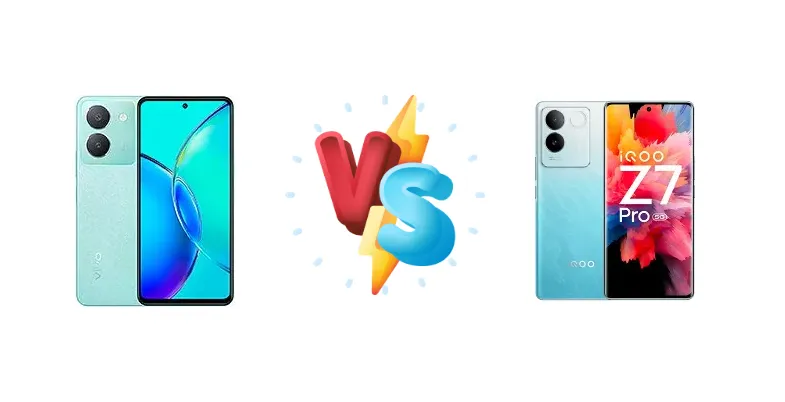
vivo offers a diverse smartphone lineup, and the Y36 and iQOO Z7 Pro represent distinct approaches within the mid-range segment. The Y36 prioritizes affordability and efficiency, while the iQOO Z7 Pro aims for a more performance-focused experience. This comparison dissects their key differences to determine which device best suits your needs.
🏆 Quick Verdict
For the average user prioritizing responsiveness and future-proofing, the iQOO Z7 Pro is the clear winner. Its Mediatek Dimensity 7200 chipset offers a significant performance leap over the Snapdragon 680 in the Y36, and the faster 66W charging is a tangible benefit. However, the Y36 remains a viable option for those on a tighter budget.
| Network |
|---|
| 2G bands | GSM 850 / 900 / 1800 / 1900 | GSM 850 / 900 / 1800 / 1900 |
| 3G bands | HSDPA 850 / 900 / 2100 | HSDPA 850 / 900 / 1700 / 2100 |
| 4G bands | 1, 3, 5, 7, 8, 20, 28, 38, 40, 41 | 1, 3, 4, 5, 8, 28, 34, 38, 39, 40, 41 |
| 5G bands | - | 1, 3, 5, 8, 28, 40, 41, 77, 78 SA/NSA |
| Speed | HSPA, LTE | HSPA, LTE, 5G |
| Technology | GSM / HSPA / LTE | GSM / HSPA / LTE / 5G |
| Launch |
|---|
| Announced | 2023, May 27 | 2023, August 31 |
| Status | Available. Released 2023, May 27 | Available. Released 2023, September 05 |
| Body |
|---|
| Build | Glass front, plastic back, plastic frame | Glass front, plastic frame, glass back |
| Dimensions | 164.1 x 76.2 x 8.1 mm (6.46 x 3.00 x 0.32 in) | 164.1 x 74.8 x 7.4 mm (6.46 x 2.94 x 0.29 in) |
| SIM | Nano-SIM + Nano-SIM | Nano-SIM + Nano-SIM |
| Weight | 202 g (7.13 oz) | 175 g (6.17 oz) |
| Display |
|---|
| Protection | - | Asahi Glass |
| Resolution | 1080 x 2388 pixels (~395 ppi density) | 1080 x 2400 pixels, 20:9 ratio (~388 ppi density) |
| Size | 6.64 inches, 106.8 cm2 (~85.4% screen-to-body ratio) | 6.78 inches, 111.0 cm2 (~90.4% screen-to-body ratio) |
| Type | IPS LCD, 90Hz, 650 nits (peak) | AMOLED, 1B colors, 120Hz, HDR10+, 1300 nits (peak) |
| Platform |
|---|
| CPU | Octa-core (4x2.4 GHz Kryo 265 Gold & 4x1.9 GHz Kryo 265 Silver) | Octa-core (2x2.8 GHz Cortex-A715 & 6x Cortex-A510) |
| Chipset | Qualcomm SM6225 Snapdragon 680 4G (6 nm) | Mediatek Dimensity 7200 (4 nm) |
| GPU | Adreno 610 | Mali-G610 MC4 |
| OS | Android 13, Funtouch 13 | Android 13, planned upgrade to Android 14, Funtouch 14 |
| Memory |
|---|
| Card slot | microSDXC (dedicated slot) | No |
| Internal | 128GB 4GB RAM, 128GB 8GB RAM, 256GB 8GB RAM | 128GB 8GB RAM, 256GB 8GB RAM |
| Main Camera |
|---|
| Dual | - | 64 MP, f/1.8, 26mm (wide), PDAF, OIS
Auxiliary lens |
| Features | LED flash | Ring-LED flash, panorama, HDR |
| Triple | 50 MP, f/1.8, (wide), PDAF
2 MP (macro)
* the macro camera availability is market/region dependent
Auxiliary lens | - |
| Video | 1080p@30fps | 4K@30fps, 1080p@30fps, gyro-EIS |
| Selfie camera |
|---|
| Single | 16 MP, f/2.5, (wide) | 16 MP, f/2.5, (wide) |
| Video | 1080p@30fps | 1080p@30fps |
| Sound |
|---|
| 35mm jack | Yes | No |
| Loudspeaker | Yes | Yes |
| Comms |
|---|
| Bluetooth | 5.1, A2DP, LE | 5.3, A2DP, LE |
| NFC | Yes (market/region dependent) | No |
| Positioning | GPS, GLONASS, GALILEO, BDS, QZSS | GPS, GLONASS, GALILEO, BDS |
| Radio | FM radio | No |
| USB | USB Type-C 2.0, OTG | USB Type-C 2.0, OTG |
| WLAN | Wi-Fi 802.11 a/b/g/n/ac, dual-band | Wi-Fi 802.11 a/b/g/n/ac/6, dual-band, Wi-Fi Direct |
| Features |
|---|
| Sensors | Fingerprint (side-mounted), accelerometer, proximity, gyro, compass | Fingerprint (under display, optical), accelerometer, gyro, proximity, compass |
| Battery |
|---|
| Charging | 44W wired, 30% in 15 min
Reverse wired | 66W wired, 50% in 22 min |
| Type | 5000 mAh | 4600 mAh |
| Misc |
|---|
| Colors | Meteor Black, Gold, Aqua Glitter | Blue Lagoon, Graphite Matte |
| Models | V2247 | - |
| Price | About 200 EUR | About 270 EUR |
vivo Y36
- More affordable price point
- Potentially longer battery life due to efficient chipset
- Reliable performance for basic tasks
- Significantly slower performance compared to the Z7 Pro
- Slower charging speeds
- Less capable for gaming and demanding apps
vivo iQOO Z7 Pro
- Superior performance with the Dimensity 7200
- Faster 66W charging
- Smoother multitasking and gaming experience
- Higher price tag
- Potentially slightly shorter battery life (depending on capacity)
- May run warmer under sustained load
Display Comparison
While both phones likely feature LCD panels (based on their price points), the focus here is on performance. Display specs are not provided, but the iQOO Z7 Pro's more powerful chipset will contribute to smoother scrolling and animations, even if the panel characteristics are similar. The Z7 Pro's processing power will also be beneficial for rendering graphically intensive content.
Camera Comparison
Without detailed camera specifications, it’s difficult to make a definitive judgment. However, the iQOO Z7 Pro’s superior processing power will likely result in better image processing, particularly in low-light conditions. The chipset’s ISP (Image Signal Processor) will be more capable of handling noise reduction and dynamic range optimization. The Y36 will likely rely more heavily on software processing, which can sometimes introduce artifacts. We can assume both phones will have a primary camera and supporting lenses, but the Z7 Pro's chipset will give it an edge in computational photography.
Performance
The core difference lies in the chipsets. The iQOO Z7 Pro’s Mediatek Dimensity 7200, fabricated on a 4nm process, is a substantial upgrade over the vivo Y36’s Qualcomm Snapdragon 680 (6nm). The Dimensity 7200’s octa-core configuration, with 2x 2.8 GHz Cortex-A715 cores, provides significantly more processing power for demanding tasks. The Snapdragon 680’s Kryo cores, while efficient, are geared towards everyday use, not intensive gaming or multitasking. This translates to faster app loading times, smoother gameplay, and a more responsive user experience on the Z7 Pro.
Battery Life
The vivo Y36 supports 44W wired charging, claiming a 30% charge in 15 minutes. The iQOO Z7 Pro steps up to 66W, achieving 50% charge in 22 minutes. While battery capacity isn't specified, the faster charging of the Z7 Pro is a significant advantage, reducing downtime. The more efficient 4nm Dimensity 7200 in the Z7 Pro may also contribute to better overall battery life, despite potentially having a similar capacity to the Y36.
Buying Guide
Buy the vivo Y36 if you need a reliable, long-lasting smartphone for everyday tasks like calling, texting, social media, and light web browsing, and prioritize battery life over raw power. Buy the vivo iQOO Z7 Pro if you prefer a smoother, more responsive experience for gaming, multitasking, and demanding applications, and value faster charging speeds to minimize downtime.
Frequently Asked Questions
❓ Will the iQOO Z7 Pro overheat during prolonged gaming sessions?
The Dimensity 7200 is a relatively efficient chipset, but sustained gaming will inevitably generate heat. The iQOO Z7 Pro likely incorporates thermal management solutions to mitigate throttling, but users should expect some temperature increase during extended gameplay. The 4nm process helps, but it's not a magic bullet.
❓ Is the Snapdragon 680 in the vivo Y36 sufficient for playing popular mobile games like PUBG Mobile or Call of Duty?
The Snapdragon 680 can run PUBG Mobile and Call of Duty, but likely at lower graphics settings and frame rates to maintain a playable experience. Expect occasional stuttering and reduced visual fidelity compared to the iQOO Z7 Pro. It's suitable for casual gaming, but not ideal for competitive play.
❓ Does the iQOO Z7 Pro support 5G connectivity?
The Mediatek Dimensity 7200 chipset *does* support 5G connectivity. This is a significant advantage over the vivo Y36, which uses the 4G-only Snapdragon 680, allowing for faster download and upload speeds where 5G networks are available.
❓ How does the charging speed difference translate to real-world usage? Is 66W *really* that much faster than 44W?
Yes, the difference is noticeable. While both offer fast charging, the iQOO Z7 Pro's 66W charging will replenish the battery significantly quicker. Going from 0% to 50% in 22 minutes is faster than getting to 30% in 15 minutes with the Y36. This is especially useful for users who frequently need to top up their battery quickly.