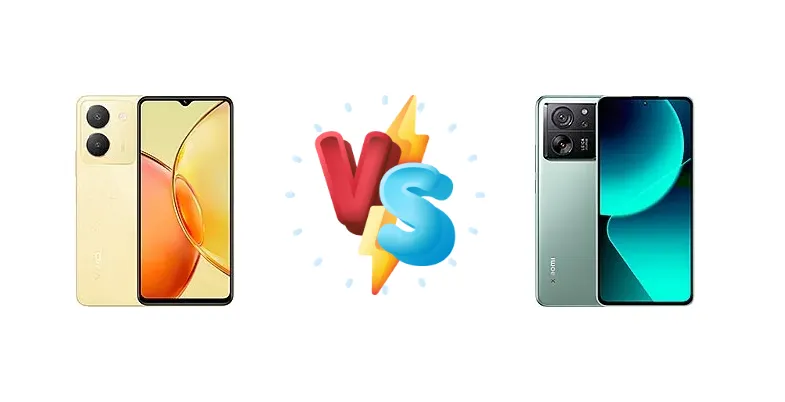
The vivo Y36 (India) represents a value-focused approach to the smartphone market, while the Xiaomi 13T aims for a more balanced experience with a stronger emphasis on performance. This comparison dissects the key differences between these two devices, helping you determine which best suits your needs and budget.
🏆 Quick Verdict
For the average user prioritizing performance and future-proofing, the Xiaomi 13T is the clear winner. Its Dimensity 8200 Ultra chipset delivers a significantly faster experience, complemented by 67W fast charging and a brighter display. The Y36 is a viable option for basic users on a tight budget.
| Network |
|---|
| 2G bands | GSM 850 / 900 / 1800 / 1900 | GSM 850 / 900 / 1800 / 1900 |
| 3G bands | HSDPA 850 / 900 / 2100 | HSDPA 800 / 850 / 900 / 1700(AWS) / 1900 / 2100 |
| 4G bands | 1, 3, 5, 8, 38, 40, 41 | 1, 2, 3, 4, 5, 7, 8, 12, 13, 17, 18, 19, 20, 26, 28, 32, 38, 40, 41, 66 |
| 5G bands | - | 1, 3, 5, 7, 8, 20, 28, 38, 40, 41, 66, 77, 78 SA/NSA |
| Speed | HSPA, LTE | HSPA, LTE, 5G |
| Technology | GSM / HSPA / LTE | GSM / HSPA / LTE / 5G |
| Launch |
|---|
| Announced | 2023, June 22 | 2023, September 26 |
| Status | Available. Released 2023, June 22 | Available. Released 2023, September 26 |
| Body |
|---|
| Build | Glass front, plastic back, plastic frame | Glass front (Gorilla Glass 5), glass back or silicone polymer back, plastic frame |
| Dimensions | 164.1 x 76.2 x 8.2 mm (6.46 x 3.00 x 0.32 in) | 162.2 x 75.7 x 8.5 mm (6.39 x 2.98 x 0.33 in) |
| SIM | Nano-SIM + Nano-SIM | · Nano-SIM + eSIM· Nano-SIM + Nano-SIM |
| Weight | 202 g (7.13 oz) | 193 g or 197 g (6.81 oz) |
| Display |
|---|
| Protection | - | Corning Gorilla Glass 5 |
| Resolution | 1080 x 2388 pixels (~395 ppi density) | 1220 x 2712 pixels, 20:9 ratio (~446 ppi density) |
| Size | 6.64 inches, 106.8 cm2 (~85.4% screen-to-body ratio) | 6.67 inches, 107.4 cm2 (~87.5% screen-to-body ratio) |
| Type | IPS LCD, 90Hz, 650 nits (peak) | AMOLED, 68B colors, 144Hz, Dolby Vision, HDR10+, 1200 nits (HBM), 2600 nits (peak) |
| Platform |
|---|
| CPU | Octa-core (4x2.4 GHz Kryo 265 Gold & 4x1.9 GHz Kryo 265 Silver) | Octa-core (1x3.1 GHz Cortex-A78 & 3x3.0 GHz Cortex-A78 & 4x2.0 GHz Cortex-A55) |
| Chipset | Qualcomm SM6225 Snapdragon 680 4G (6 nm) | Mediatek Dimensity 8200 Ultra (4 nm) |
| GPU | Adreno 610 | Mali-G610 MC6 |
| OS | Android 13, Funtouch 13 | Android 13, up to 4 major Android upgrades, HyperOS |
| Memory |
|---|
| Card slot | microSDXC (dedicated slot) | No |
| Internal | 128GB 8GB RAM | 256GB 8GB RAM, 256GB 12GB RAM |
| Main Camera |
|---|
| Dual | 50 MP, f/1.8, (wide), PDAF
Auxiliary lens | - |
| Features | LED flash | Leica lens, color spectrum sensor, LED flash, HDR, panorama |
| Triple | - | 50 MP, f/1.9, 24mm (wide), 1/1.28", 1.22µm, PDAF, OIS
50 MP, f/1.9, 50mm (telephoto), 1/2.88", 0.61µm, PDAF, 2x optical zoom
12 MP, f/2.2, 15mm (ultrawide), 1/3.06", 1.12µm |
| Video | 1080p@30fps | 4K@30fps (HDR10+), 1080p@30/60/120fps, gyro-EIS |
| Selfie camera |
|---|
| Features | - | HDR |
| Single | 16 MP, f/2.0, (wide) | 20 MP, f/2.2, (wide), 0.8µm |
| Video | 1080p@30fps | 1080p@30fps, HDR10+ |
| Sound |
|---|
| 35mm jack | Yes | No |
| Loudspeaker | Yes | Yes, with stereo speakers |
| Comms |
|---|
| Bluetooth | 5.1, A2DP, LE | 5.4, A2DP, LE |
| Infrared port | - | Yes |
| NFC | No | Yes (market/region dependent) |
| Positioning | GPS, GLONASS, GALILEO, BDS, QZSS | GPS (L1+L5), GLONASS (G1), GALILEO (E1+E5a), QZSS (L1+L5), NavIC (L5), BDS |
| Radio | FM radio | No |
| USB | USB Type-C 2.0, OTG | USB Type-C 2.0, OTG |
| WLAN | Wi-Fi 802.11 a/b/g/n/ac, dual-band | Wi-Fi 802.11 a/b/g/n/ac/6, dual-band |
| Features |
|---|
| Sensors | Fingerprint (side-mounted), accelerometer, proximity, gyro, compass | Fingerprint (under display, optical), accelerometer, gyro, proximity, compass |
| Battery |
|---|
| Charging | 44W wired, 30% in 15 min
Reverse wired | 67W wired, PD3.0, QC4, 100% in 42 min |
| Type | 5000 mAh | Li-Po 5000 mAh |
| Misc |
|---|
| Colors | Meteor Black, Vibrant Gold | Alpine Blue, Meadow Green, Black |
| Models | - | 2306EPN60G |
| Price | About 190 EUR | $ 255.96 / £ 326.27 / € 204.18 |
| SAR EU | - | 0.99 W/kg (head) 0.99 W/kg (body) |
vivo Y36 (India)
- More affordable price point
- Decent charging speed for its class (44W)
- Potentially better power efficiency due to less powerful chipset
- Significantly slower performance
- Likely lower quality display
- Less capable camera system
Xiaomi 13T
- Exceptional performance with Dimensity 8200 Ultra
- Fast 67W charging with PD3.0/QC4
- Bright and vibrant display (1264 nits)
- Long-lasting battery life
- Higher price tag
- Potentially more heat generation under heavy load
Display Comparison
The Xiaomi 13T boasts a significantly brighter display, reaching a measured peak of 1264 nits. This is crucial for outdoor visibility, a clear advantage over the Y36, which lacks published brightness data but is expected to be considerably lower given its market positioning. While both likely utilize AMOLED panels, the 13T’s higher brightness and potential for higher refresh rates (not specified in the data, but typical for this class) contribute to a more immersive viewing experience. The Y36’s display is likely optimized for power efficiency, but at the cost of vibrancy.
Camera Comparison
The provided data doesn’t offer detailed camera specifications beyond 'Photo / Video' for the Xiaomi 13T. However, given its positioning, it’s reasonable to expect a more sophisticated camera system with a larger sensor and optical image stabilization (OIS). The Y36’s camera capabilities are likely more basic, focusing on everyday snapshots. Without specific sensor details, it’s difficult to make a precise comparison, but the 13T’s higher processing power will likely result in better image quality, especially in low-light conditions. The inclusion of OIS on the 13T would further enhance image stability and reduce blur.
Performance
The performance gap between these devices is substantial. The Xiaomi 13T’s Mediatek Dimensity 8200 Ultra, built on a 4nm process, is in a different league than the vivo Y36’s Qualcomm Snapdragon 680 (6nm). The Dimensity 8200 Ultra features a more modern CPU architecture – a 1x3.1 GHz Cortex-A78 prime core, 3x3.0 GHz Cortex-A78 performance cores, and 4x2.0 GHz Cortex-A55 efficiency cores – compared to the Y36’s 4x2.4 GHz Kryo 265 Gold and 4x1.9 GHz Kryo 265 Silver configuration. This translates to significantly faster app loading times, smoother multitasking, and a far superior gaming experience on the 13T. The 4nm node also contributes to better thermal efficiency, reducing throttling during sustained workloads.
Battery Life
The Xiaomi 13T demonstrates a clear advantage in charging speed, achieving a full charge in just 42 minutes with its 67W wired charging support (PD3.0, QC4). The vivo Y36’s 44W charging, while respectable, is slower, reaching 30% in 15 minutes. The 13T also boasts an impressive active use battery score of 12:23h and an endurance rating of 101h, suggesting excellent battery life. While the Y36’s battery capacity isn’t specified, the 13T’s combination of efficient chipset and fast charging provides a more convenient and reliable user experience.
Buying Guide
Buy the vivo Y36 (India) if you need a reliable smartphone for essential tasks like calling, texting, and light social media use, and prioritize affordability above all else. Buy the Xiaomi 13T if you prefer a smoother, more responsive experience for gaming, multitasking, and content creation, and are willing to invest in a more capable device.
Frequently Asked Questions
❓ Is the Xiaomi 13T’s Dimensity 8200 Ultra prone to overheating during extended gaming sessions?
While the Dimensity 8200 Ultra is a powerful chip, its 4nm process and Xiaomi’s thermal management solutions are designed to mitigate overheating. However, sustained gaming at maximum settings will inevitably generate heat. Expect some throttling, but it shouldn’t significantly impact the overall gaming experience.
❓ How does the Snapdragon 680 in the vivo Y36 handle multitasking compared to the Xiaomi 13T?
The Snapdragon 680 is adequate for basic multitasking, such as switching between messaging apps and web browsing. However, it will struggle with more demanding tasks like running multiple apps simultaneously or editing large files. The Xiaomi 13T’s Dimensity 8200 Ultra offers a far smoother and more responsive multitasking experience due to its superior processing power and memory bandwidth.
❓ Does the Xiaomi 13T support high refresh rate gaming, like 90fps or 120fps in popular titles?
While not explicitly stated, the Xiaomi 13T’s powerful chipset and likely high refresh rate display (typically 120Hz in this class) strongly suggest it can support high refresh rate gaming in many popular titles. Performance will vary depending on the game’s optimization and graphics settings.