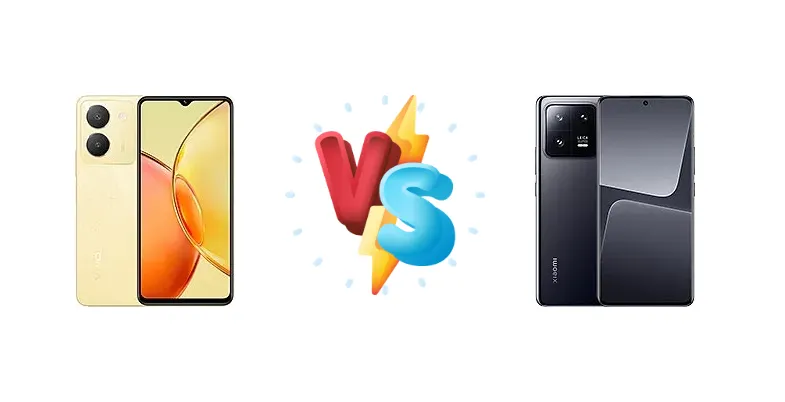
The smartphone market presents a vast spectrum of choices, from aggressively priced entry-level devices to uncompromising flagships. We pit the vivo Y36 (India), a budget-focused 4G device, against the Xiaomi 13 Pro, a premium offering powered by the latest Snapdragon 8 Gen 2. This comparison isn't about declaring a single 'winner,' but understanding where each phone excels and for whom it's the better fit.
🏆 Quick Verdict
For the average user prioritizing affordability and essential functionality, the vivo Y36 (India) offers a compelling package. However, the Xiaomi 13 Pro dominates in performance, display quality, and charging speed, justifying its higher price tag for power users and photography enthusiasts.
| Network |
|---|
| 2G bands | GSM 850 / 900 / 1800 / 1900 | GSM 850 / 900 / 1800 / 1900 |
| 3G bands | HSDPA 850 / 900 / 2100 | HSDPA 800 / 850 / 900 / 1700(AWS) / 1900 / 2100 |
| 4G bands | 1, 3, 5, 8, 38, 40, 41 | 1, 2, 3, 4, 5, 7, 8, 12, 13, 17, 18, 19, 20, 25, 26, 28, 32, 38, 39, 40, 41, 42, 48, 66 - International |
| 5G bands | - | 1, 3, 5, 7, 8, 20, 28, 38, 40, 41, 66, 71, 75, 77, 78 SA/NSA - International |
| Speed | HSPA, LTE | HSPA, LTE, 5G |
| Technology | GSM / HSPA / LTE | GSM / CDMA / HSPA / CDMA2000 / LTE / 5G |
| | - | 1, 3, 5, 8, 28, 38, 40, 41, 77, 78, 79 SA/NSA - China |
| Launch |
|---|
| Announced | 2023, June 22 | 2022, December 11 |
| Status | Available. Released 2023, June 22 | Available. Released 2022, December 14 |
| Body |
|---|
| Build | Glass front, plastic back, plastic frame | Glass front (Gorilla Glass Victus), ceramic back or silicone polymer back, aluminum frame |
| Dimensions | 164.1 x 76.2 x 8.2 mm (6.46 x 3.00 x 0.32 in) | 162.9 x 74.6 x 8.4 mm or 8.7 mm |
| SIM | Nano-SIM + Nano-SIM | · Nano-SIM + eSIM· Nano-SIM + Nano-SIM |
| Weight | 202 g (7.13 oz) | 210 g or 229 g (7.41 oz) |
| | - | IP68 dust/water resistant (up to 1.5m for 30 min) |
| Display |
|---|
| Protection | - | Corning Gorilla Glass Victus |
| Resolution | 1080 x 2388 pixels (~395 ppi density) | 1440 x 3200 pixels, 20:9 ratio (~522 ppi density) |
| Size | 6.64 inches, 106.8 cm2 (~85.4% screen-to-body ratio) | 6.73 inches, 108.9 cm2 (~89.6% screen-to-body ratio) |
| Type | IPS LCD, 90Hz, 650 nits (peak) | LTPO AMOLED, 1B colors, 120Hz, Dolby Vision, HDR10+, 1200 nits (HBM), 1900 nits (peak) |
| Platform |
|---|
| CPU | Octa-core (4x2.4 GHz Kryo 265 Gold & 4x1.9 GHz Kryo 265 Silver) | Octa-core (1x3.2 GHz Cortex-X3 & 2x2.8 GHz Cortex-A715 & 2x2.8 GHz Cortex-A710 & 3x2.0 GHz Cortex-A510) |
| Chipset | Qualcomm SM6225 Snapdragon 680 4G (6 nm) | Qualcomm SM8550-AB Snapdragon 8 Gen 2 (4 nm) |
| GPU | Adreno 610 | Adreno 740 |
| OS | Android 13, Funtouch 13 | Android 13, upgradable to Android 14, HyperOS |
| Memory |
|---|
| Card slot | microSDXC (dedicated slot) | No |
| Internal | 128GB 8GB RAM | 128GB 8GB RAM, 256GB 8GB RAM, 256GB 12GB RAM, 512GB 12GB RAM |
| | - | UFS 3.1 - 128GB
UFS 4.0 - 256/512GB |
| Main Camera |
|---|
| Dual | 50 MP, f/1.8, (wide), PDAF
Auxiliary lens | - |
| Features | LED flash | Laser AF, color spectrum sensor, Leica lens, Dual-LED dual-tone flash, HDR, panorama |
| Triple | - | 50.3 MP, f/1.9, 23mm (wide), 1.0"-type, 1.6µm, dual pixel PDAF, OIS
50 MP, f/2.0, 75mm (telephoto), PDAF (10cm - ∞), 3.2x optical zoom
50 MP, f/2.2, 14mm, 115˚ (ultrawide), AF |
| Video | 1080p@30fps | 8K@24fps (HDR), 4K@24/30/60fps (HDR10+, 10-bit Dolby Vision HDR, 10-bit LOG), 1080p@30/120/240/960fps, 1080p@1920fps, gyro-EIS |
| Selfie camera |
|---|
| Features | - | HDR, panorama |
| Single | 16 MP, f/2.0, (wide) | 32 MP, f/2.0, 22mm (wide), 1/3.14", 0.7µm |
| Video | 1080p@30fps | 1080p@30fps |
| Sound |
|---|
| 3.5mm jack | - | No |
| 35mm jack | Yes | No |
| Loudspeaker | Yes | Yes, with stereo speakers |
| | - | 24-bit/192kHz audio |
| Comms |
|---|
| Bluetooth | 5.1, A2DP, LE | 5.3, A2DP, aptX HD, aptX Adaptive |
| Infrared port | - | Yes |
| NFC | No | Yes |
| Positioning | GPS, GLONASS, GALILEO, BDS, QZSS | GPS (L1+L5), GLONASS (G1), BDS (B1I+B1c+B2a), GALILEO (E1+E5a), QZSS (L1+L5), NavIC (L5) |
| Radio | FM radio | No |
| USB | USB Type-C 2.0, OTG | USB Type-C 2.0, OTG |
| WLAN | Wi-Fi 802.11 a/b/g/n/ac, dual-band | Wi-Fi 802.11 a/b/g/n/ac/6e, dual-band, Wi-Fi Direct |
| Features |
|---|
| Sensors | Fingerprint (side-mounted), accelerometer, proximity, gyro, compass | Fingerprint (under display, optical), accelerometer, proximity, gyro, compass, barometer |
| Battery |
|---|
| Charging | 44W wired, 30% in 15 min
Reverse wired | 120W wired, PD3.0, QC4, 100% in 19 min
50W wireless, 100% in 36 min
10W reverse wireless |
| Type | 5000 mAh | Li-Po 4820 mAh |
| Misc |
|---|
| Colors | Meteor Black, Vibrant Gold | Ceramic White, Ceramic Black, Ceramic Flora Green, Mountain Blue |
| Models | - | 2210132G, 2210132C |
| Price | About 190 EUR | About 750 EUR |
| Tests |
|---|
| Battery life | - |
Endurance rating 115h
|
| Camera | - |
Photo / Video |
| Display | - |
Contrast ratio: Infinite (nominal) |
| Loudspeaker | - |
-25.6 LUFS (Very good)
|
| Performance | - |
AnTuTu: 1281666 (v9)
GeekBench: 5087 (v5.1), 5323 (v6)
GFXBench: 64fps (ES 3.1 onscreen) |
vivo Y36 (India)
- Significantly more affordable
- Potentially longer battery life due to less power-hungry chipset
- Reverse wired charging for accessories
- Substantially slower performance
- Inferior display quality
- Less capable camera system
Xiaomi 13 Pro
- Exceptional performance with Snapdragon 8 Gen 2
- Stunning display with high brightness and contrast
- Ultra-fast 120W wired and 50W wireless charging
- Much higher price point
- Potentially shorter battery life under heavy load
- May be overkill for basic smartphone users
Display Comparison
The Xiaomi 13 Pro boasts a significantly more advanced display experience. While both phones lack specific refresh rate data, the Xiaomi 13 Pro’s measured peak brightness of 1253 nits dwarfs what we’d expect from the Y36, ensuring excellent visibility even in direct sunlight. The 'Infinite' contrast ratio suggests a high-quality OLED panel, likely with excellent black levels. The Y36, positioned in a lower price bracket, likely utilizes an LCD panel with lower brightness and contrast, impacting outdoor usability and overall visual fidelity.
Camera Comparison
Both devices are listed as having 'Photo / Video' capabilities, but the details are sparse. The Xiaomi 13 Pro, typical of flagship devices, likely features a larger sensor, optical image stabilization (OIS), and advanced image processing algorithms. While the Y36 may offer acceptable image quality in good lighting conditions, it will likely struggle in low-light scenarios. Without specific sensor size or aperture information for the Y36, it’s safe to assume the Xiaomi 13 Pro provides a significantly more versatile and higher-quality camera experience.
Performance
The performance gap is substantial. The vivo Y36’s Snapdragon 680 (6nm) is a capable chip for basic tasks, featuring an octa-core configuration with Kryo 265 cores clocked up to 2.4 GHz. However, it’s no match for the Xiaomi 13 Pro’s Snapdragon 8 Gen 2 (4nm). The 8 Gen 2’s architecture – a combination of Cortex-X3, A715, A710, and A510 cores – delivers a massive leap in CPU and GPU performance. The 4nm process node further enhances efficiency, reducing thermal throttling during sustained workloads. Gamers and power users will find the Xiaomi 13 Pro far more responsive and capable of handling demanding titles.
Battery Life
The Xiaomi 13 Pro’s 120W wired charging is a game-changer, achieving a full charge in just 19 minutes. It also supports 50W wireless charging (36 minutes to full) and 10W reverse wireless charging. The vivo Y36’s 44W wired charging, while respectable, is considerably slower, taking approximately 30% charge in 15 minutes. Both phones have an endurance rating of 115 hours, but the Xiaomi 13 Pro’s active use score of 10:55h suggests it can maintain performance under heavier load without significant battery drain.
Buying Guide
Buy the vivo Y36 (India) if you need a reliable smartphone for everyday tasks like calling, messaging, social media, and light web browsing, and value long-term battery life over raw speed. Buy the Xiaomi 13 Pro if you demand the fastest possible performance for gaming and demanding applications, a stunning display, and a versatile camera system, and are willing to pay a premium for these features.
Frequently Asked Questions
❓ Does the Snapdragon 680 in the vivo Y36 (India) struggle with multitasking?
While the Snapdragon 680 is adequate for basic multitasking, running multiple demanding apps simultaneously may result in noticeable slowdowns. It's best suited for switching between a few apps at a time, rather than heavy multitasking.
❓ How does the 120W charging on the Xiaomi 13 Pro affect battery health over time?
Xiaomi employs charging algorithms designed to mitigate the impact of fast charging on battery health. While all batteries degrade over time, the Xiaomi 13 Pro's charging system aims to optimize charging speed while minimizing long-term degradation. However, consistent use of extremely fast charging *can* contribute to faster degradation compared to slower charging methods.
❓ Is the camera on the vivo Y36 (India) sufficient for casual social media use?
Yes, the vivo Y36 (India) should be sufficient for casual social media photography in well-lit conditions. However, expect limited detail and dynamic range in challenging lighting scenarios. The Xiaomi 13 Pro will provide significantly better results for more demanding photography needs.
❓ Will the Xiaomi 13 Pro get noticeably warm during extended gaming sessions?
The Snapdragon 8 Gen 2 is efficient, but demanding games will still generate heat. The Xiaomi 13 Pro likely incorporates a sophisticated cooling system to manage thermal throttling, but some warmth is expected during prolonged gaming. The 4nm process helps mitigate this compared to older chipsets.