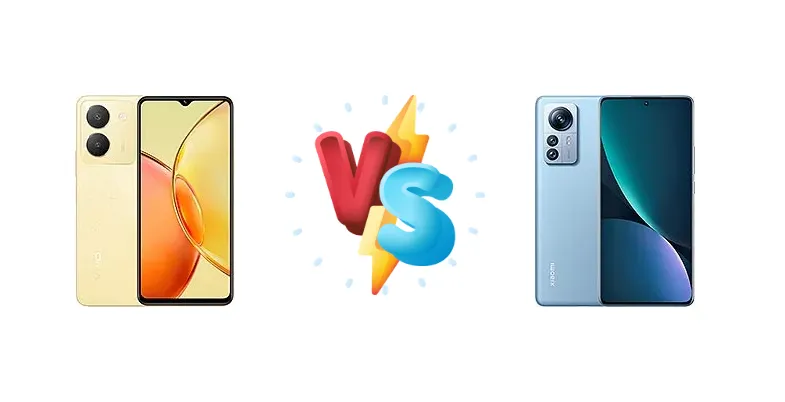
The smartphone market presents a wide spectrum of choices, from budget-friendly options like the vivo Y36 to premium flagships like the Xiaomi 12 Pro. While seemingly worlds apart, both phones cater to distinct needs. This comparison dissects their core components – chipset, charging, and overall capabilities – to determine which device delivers the best value for your money.
🏆 Quick Verdict
For the average user prioritizing affordability and all-day battery life, the vivo Y36 is the clear winner. However, the Xiaomi 12 Pro (Dimensity) dominates in raw performance, offering a significantly smoother experience for demanding tasks and gaming, justifying its higher price tag.
| Network |
|---|
| 2G bands | GSM 850 / 900 / 1800 / 1900 | GSM 850 / 900 / 1800 / 1900 |
| 3G bands | HSDPA 850 / 900 / 2100 | HSDPA 800 / 850 / 900 / 1700(AWS) / 1900 / 2100 |
| 4G bands | 1, 3, 5, 8, 38, 40, 41 | 1, 2, 3, 4, 5, 7, 8, 18, 19, 26, 34, 38, 39, 40, 41, 42 |
| 5G bands | - | 1, 3, 5, 8, 28, 38, 40, 41, 77, 78 SA/NSA |
| Speed | HSPA, LTE | HSPA, LTE, 5G |
| Technology | GSM / HSPA / LTE | GSM / CDMA / HSPA / EVDO / LTE / 5G |
| | - | CDMA2000 1xEV-DO |
| Launch |
|---|
| Announced | 2023, June 22 | 2022, July 04 |
| Status | Available. Released 2023, June 22 | Available. Released 2022, July 13 |
| Body |
|---|
| Build | Glass front, plastic back, plastic frame | - |
| Dimensions | 164.1 x 76.2 x 8.2 mm (6.46 x 3.00 x 0.32 in) | 163.6 x 74.6 x 8.2 mm (6.44 x 2.94 x 0.32 in) |
| SIM | Nano-SIM + Nano-SIM | Nano-SIM + Nano-SIM |
| Weight | 202 g (7.13 oz) | 201 g (7.09 oz) |
| Display |
|---|
| Protection | - | Corning Gorilla Glass Victus |
| Resolution | 1080 x 2388 pixels (~395 ppi density) | 1440 x 3200 pixels, 20:9 ratio (~521 ppi density) |
| Size | 6.64 inches, 106.8 cm2 (~85.4% screen-to-body ratio) | 6.73 inches, 109.4 cm2 (~89.6% screen-to-body ratio) |
| Type | IPS LCD, 90Hz, 650 nits (peak) | LTPO2 AMOLED, 1B colors, 120Hz, Dolby Vision, HDR10+, 1000 nits (HBM), 1500 nits (peak) |
| Platform |
|---|
| CPU | Octa-core (4x2.4 GHz Kryo 265 Gold & 4x1.9 GHz Kryo 265 Silver) | Octa-core (1x3.20 GHz Cortex-X2 & 3x2.85 GHz Cortex-A710 & 4x1.80 GHz Cortex-A510) |
| Chipset | Qualcomm SM6225 Snapdragon 680 4G (6 nm) | Mediatek Dimensity 9000+ (4 nm) |
| GPU | Adreno 610 | Mali-G710 MC10 |
| OS | Android 13, Funtouch 13 | Android 12, MIUI 13 |
| Memory |
|---|
| Card slot | microSDXC (dedicated slot) | No |
| Internal | 128GB 8GB RAM | 128GB 8GB RAM, 256GB 12GB RAM |
| | - | UFS 3.1 |
| Main Camera |
|---|
| Dual | 50 MP, f/1.8, (wide), PDAF
Auxiliary lens | - |
| Features | LED flash | Color spectrum sensor, Dual-LED dual-tone flash, HDR, panorama |
| Single | - | 32 MP, f/2.5, 26mm (wide), 0.7µm |
| Triple | - | 50 MP, f/1.9, 24mm (wide), 1/1.28", 1.22µm, dual pixel PDAF, OIS
13 MP, f/2.4, 15mm, 123˚ (ultrawide), 1/3.06", 1.12µm
5 MP, f/2.4, 50mm (telephoto macro), AF |
| Video | 1080p@30fps | 4K@30/60fps, 1080p@30/60/120fps, gyro-EIS |
| Selfie camera |
|---|
| Features | - | HDR, panorama |
| Single | 16 MP, f/2.0, (wide) | 32 MP, f/2.5, 26mm (wide), 0.7µm |
| Video | 1080p@30fps | 1080p@30/60fps, 720p@120fps |
| Sound |
|---|
| 3.5mm jack | - | No |
| 35mm jack | Yes | No |
| Loudspeaker | Yes | Yes, with stereo speakers |
| | - | 24-bit/192kHz audio
Tuned by Harman Kardon |
| Comms |
|---|
| Bluetooth | 5.1, A2DP, LE | 5.3, A2DP, LE |
| Infrared port | - | Yes |
| NFC | No | Yes |
| Positioning | GPS, GLONASS, GALILEO, BDS, QZSS | GPS (L1+L5), GLONASS (L1), BDS (B1I+B1c+B2a), GALILEO (E1+E5a), QZSS (L1+L5), NavIC (L5) |
| Radio | FM radio | No |
| USB | USB Type-C 2.0, OTG | USB Type-C 2.0, OTG |
| WLAN | Wi-Fi 802.11 a/b/g/n/ac, dual-band | Wi-Fi 802.11 a/b/g/n/ac/6, dual-band, Wi-Fi Direct |
| Features |
|---|
| Sensors | Fingerprint (side-mounted), accelerometer, proximity, gyro, compass | Fingerprint (under display, optical), accelerometer, gyro, proximity, compass |
| Battery |
|---|
| Charging | 44W wired, 30% in 15 min
Reverse wired | 67W wired, PD3.0, QC4 |
| Type | 5000 mAh | Li-Po 5160 mAh |
| Misc |
|---|
| Colors | Meteor Black, Vibrant Gold | Gray, Blue |
| Models | - | 2207122MC |
| Price | About 190 EUR | About 570 EUR |
vivo Y36 (India)
- More affordable price point
- Potentially longer battery life due to efficient processor
- Reverse wired charging capability
- Significantly lower performance compared to the 12 Pro
- Likely a less advanced display
- Camera performance will be limited by the chipset
Xiaomi 12 Pro (Dimensity)
- Exceptional performance with the Dimensity 9000+ chipset
- Faster 67W charging with PD3.0/QC4 support
- Likely a superior display with AMOLED and higher refresh rate
- Higher price tag
- Potentially shorter battery life under heavy load
- May require more frequent charging
Display Comparison
Display specifications are not provided for either device. However, given the Y36's positioning, it likely features a standard LCD panel, while the 12 Pro, as a flagship, almost certainly boasts an AMOLED display with a higher refresh rate. The Xiaomi 12 Pro’s flagship status suggests a higher peak brightness and potentially LTPO technology for adaptive refresh rates, improving battery efficiency. Bezels are expected to be slimmer on the 12 Pro, contributing to a more immersive viewing experience. Color accuracy will likely be superior on the 12 Pro due to its AMOLED panel and calibration.
Camera Comparison
Camera details beyond sensor counts are unavailable. However, the Xiaomi 12 Pro, being a flagship, likely incorporates a larger main sensor with Optical Image Stabilization (OIS) for sharper images and improved low-light performance. The Dimensity 9000+ also features a powerful ISP (Image Signal Processor) capable of handling complex image processing tasks. The Y36 likely relies on software processing to enhance image quality, but will be limited by its less powerful chipset. The absence of details on lens apertures makes a precise comparison difficult, but the 12 Pro is expected to have wider apertures for better light gathering.
Performance
The performance gap between these devices is substantial. The Xiaomi 12 Pro’s Mediatek Dimensity 9000+ (4nm) is a high-end chipset featuring a Cortex-X2 prime core clocked at 3.20 GHz, designed for peak performance. This contrasts sharply with the vivo Y36’s Qualcomm Snapdragon 680 (6nm), which prioritizes efficiency over raw power. The Dimensity 9000+’s architecture – 1x Cortex-X2, 3x Cortex-A710, and 4x Cortex-A510 – allows for significantly faster processing speeds and improved multitasking. The 4nm fabrication process of the Dimensity chip also contributes to better thermal management, reducing throttling during sustained workloads. While the Snapdragon 680 is adequate for everyday tasks, the Dimensity 9000+ is geared towards demanding applications like gaming and video editing.
Battery Life
The vivo Y36 supports 44W wired charging, claiming a 30% charge in 15 minutes. The Xiaomi 12 Pro steps up the pace with 67W wired charging, supporting PD3.0 and QC4 standards. While battery capacity isn’t specified, the faster charging speed of the 12 Pro allows for quicker top-ups. The Snapdragon 680’s efficiency in the Y36 may translate to longer battery life during typical usage, but the 12 Pro’s faster charging mitigates the impact of a potentially smaller battery. The 12 Pro’s charging standards also offer broader compatibility with various chargers.
Buying Guide
Buy the vivo Y36 (India) if you need a reliable daily driver with a long-lasting battery and efficient performance for basic tasks like calling, messaging, and social media. Buy the Xiaomi 12 Pro (Dimensity) if you prioritize a flagship-level experience with exceptional processing power for gaming, video editing, and multitasking, and are willing to pay a premium for it.
Frequently Asked Questions
❓ Will the Snapdragon 680 in the vivo Y36 struggle with graphically intensive games like PUBG or Call of Duty?
Yes, the Snapdragon 680 is a mid-range processor and will likely require significantly reduced graphics settings and frame rate caps to achieve playable performance in demanding games. Expect noticeable frame drops and potential stuttering, especially in intense scenes. The Xiaomi 12 Pro’s Dimensity 9000+ is far better equipped for smooth gaming at higher settings.
❓ Does the Xiaomi 12 Pro (Dimensity) tend to overheat during prolonged gaming sessions?
The Dimensity 9000+ is a powerful chip, but its 4nm fabrication process and Xiaomi’s thermal management solutions generally prevent excessive overheating. While some warmth is expected during extended gaming, the 12 Pro is designed to sustain peak performance for longer periods than the vivo Y36, which is more prone to throttling due to its less efficient chipset.
❓ Is the 44W charging on the vivo Y36 fast enough for a quick top-up during a short break?
The 44W charging is reasonably fast, delivering a 30% charge in 15 minutes as advertised. This is sufficient for a quick boost, but it’s considerably slower than the 67W charging on the Xiaomi 12 Pro, which can significantly reduce charging times.