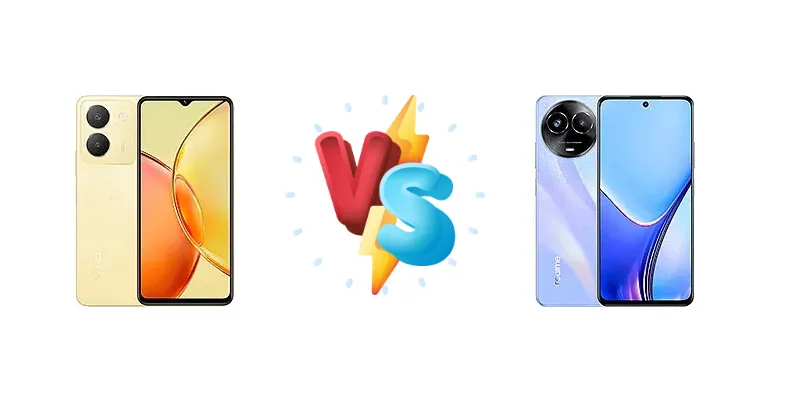
The sub-₹15,000 (approximately $180 USD) smartphone segment in India is fiercely competitive. The vivo Y36 and Realme 11x both aim to deliver a compelling experience without breaking the bank, but they take different approaches. The Y36 relies on Qualcomm’s Snapdragon 680, prioritizing efficiency, while the 11x opts for MediaTek’s Dimensity 6100+ for a performance boost. This comparison dives deep into the specifics to determine which device offers the best overall package.
🏆 Quick Verdict
For the average user prioritizing sustained performance and faster charging, the Realme 11x emerges as the winner. Its Dimensity 6100+ chipset provides a noticeable edge in multitasking and gaming, and the 33W charging, while slower on paper, offers a more practical fill-up time due to the smaller battery capacity. However, the vivo Y36 remains a strong contender for those valuing Qualcomm’s established efficiency.
| Network |
|---|
| 2G bands | GSM 850 / 900 / 1800 / 1900 | GSM 850 / 900 / 1800 / 1900 |
| 3G bands | HSDPA 850 / 900 / 2100 | HSDPA 850 / 900 / 2100 |
| 4G bands | 1, 3, 5, 8, 38, 40, 41 | 1, 3, 5, 8, 28, 40, 41 |
| 5G bands | - | 1, 3, 5, 8, 28, 40, 41, 77, 78 SA/NSA |
| Speed | HSPA, LTE | HSPA, LTE, 5G |
| Technology | GSM / HSPA / LTE | GSM / HSPA / LTE / 5G |
| Launch |
|---|
| Announced | 2023, June 22 | 2023, August 23 |
| Status | Available. Released 2023, June 22 | Available. Released 2023, August 30 |
| Body |
|---|
| Build | Glass front, plastic back, plastic frame | Glass front, aluminum frame, plastic back |
| Dimensions | 164.1 x 76.2 x 8.2 mm (6.46 x 3.00 x 0.32 in) | 165.7 x 76 x 7.9 mm (6.52 x 2.99 x 0.31 in) |
| SIM | Nano-SIM + Nano-SIM | Nano-SIM + Nano-SIM |
| Weight | 202 g (7.13 oz) | 190 g (6.70 oz) |
| Display |
|---|
| Resolution | 1080 x 2388 pixels (~395 ppi density) | 1080 x 2400 pixels, 20:9 ratio (~392 ppi density) |
| Size | 6.64 inches, 106.8 cm2 (~85.4% screen-to-body ratio) | 6.72 inches, 109.0 cm2 (~86.6% screen-to-body ratio) |
| Type | IPS LCD, 90Hz, 650 nits (peak) | IPS LCD, 120Hz, 550 nits (typ), 680 nits (HBM) |
| Platform |
|---|
| CPU | Octa-core (4x2.4 GHz Kryo 265 Gold & 4x1.9 GHz Kryo 265 Silver) | Octa-core (2x2.2 GHz Cortex-A76 & 6x2.0 GHz Cortex-A55) |
| Chipset | Qualcomm SM6225 Snapdragon 680 4G (6 nm) | Mediatek Dimensity 6100+ (6 nm) |
| GPU | Adreno 610 | Mali-G57 MC2 |
| OS | Android 13, Funtouch 13 | Android 13, Realme UI 4.0 |
| Memory |
|---|
| Card slot | microSDXC (dedicated slot) | microSDXC (dedicated slot) |
| Internal | 128GB 8GB RAM | 128GB 6GB RAM, 128GB 8GB RAM |
| Main Camera |
|---|
| Dual | 50 MP, f/1.8, (wide), PDAF
Auxiliary lens | 64 MP, f/1.8, 25mm (wide), 1/2.0", 0.7µm, PDAF
Auxiliary lens |
| Features | LED flash | LED flash, HDR, panorama |
| Video | 1080p@30fps | 1080p@30fps |
| Selfie camera |
|---|
| Features | - | Panorama |
| Single | 16 MP, f/2.0, (wide) | 8 MP, f/2.1, 26mm (wide) |
| Video | 1080p@30fps | 1080p@30fps |
| Sound |
|---|
| 35mm jack | Yes | Yes |
| Loudspeaker | Yes | Yes |
| Comms |
|---|
| Bluetooth | 5.1, A2DP, LE | 5.2, A2DP, LE |
| NFC | No | No |
| Positioning | GPS, GLONASS, GALILEO, BDS, QZSS | GPS, GALILEO, GLONASS, BDS |
| Radio | FM radio | Unspecified |
| USB | USB Type-C 2.0, OTG | USB Type-C 2.0 |
| WLAN | Wi-Fi 802.11 a/b/g/n/ac, dual-band | Wi-Fi 802.11 a/b/g/n/ac, dual-band, Wi-Fi Direct |
| Features |
|---|
| Sensors | Fingerprint (side-mounted), accelerometer, proximity, gyro, compass | Fingerprint (side-mounted), accelerometer, proximity, compass |
| Battery |
|---|
| Charging | 44W wired, 30% in 15 min
Reverse wired | 33W wired, 50% in 29 min |
| Type | 5000 mAh | 5000 mAh |
| Misc |
|---|
| Colors | Meteor Black, Vibrant Gold | Midnight Black, Purple Dawn |
| Models | - | RMX3785 |
| Price | About 190 EUR | About 170 EUR |
vivo Y36 (India)
- Potentially longer battery life due to Snapdragon 680 efficiency
- 44W fast charging support
- Reliable Qualcomm chipset
- Less powerful chipset for gaming and multitasking
- Likely slower overall performance compared to the Realme 11x
Realme 11x
- More powerful MediaTek Dimensity 6100+ chipset
- Faster charging speeds (50% in 29 mins)
- Potentially better sustained performance
- Smaller battery capacity
- May experience slightly shorter battery life during heavy usage
Display Comparison
Neither device boasts a standout display. Both likely utilize LCD panels, a common trait in this price bracket. While specific details like peak brightness and color gamut coverage are unavailable, the Realme 11x’s slightly higher price point *might* translate to a marginally better panel. However, the difference is unlikely to be significant. Bezels are expected to be comparable, and both will likely target a 60Hz refresh rate, prioritizing battery life over visual fluidity.
Camera Comparison
Camera performance is difficult to assess without detailed sample images. Both phones likely feature a primary camera around the 50MP mark, but sensor size and image processing algorithms are crucial. The Realme 11x, given its slightly higher positioning, *may* benefit from a larger sensor or more sophisticated software. However, the presence of a 2MP macro camera on both devices suggests limited utility in that area. Focusing on the main sensor’s capabilities – aperture, pixel binning – will be key to determining real-world image quality. Expect decent performance in good lighting conditions, but low-light photography will likely be a challenge for both.
Performance
The core difference lies in the chipsets. The Realme 11x’s MediaTek Dimensity 6100+ (6nm) features a more modern CPU architecture – two Cortex-A76 cores clocked at 2.2 GHz alongside six Cortex-A55 cores at 2.0 GHz – compared to the vivo Y36’s Qualcomm Snapdragon 680 (6nm) with its four Kryo 265 Gold cores at 2.4 GHz and four Kryo 265 Silver cores at 1.9 GHz. While the Snapdragon 680’s individual core clock speed is higher, the Dimensity 6100+’s architecture provides superior sustained performance and better multi-core capabilities. This translates to smoother app switching, faster loading times, and a more enjoyable gaming experience on the Realme 11x. The 6nm process node on both chips contributes to reasonable thermal efficiency, but the Dimensity 6100+ is likely to handle prolonged workloads more effectively.
Battery Life
The vivo Y36 packs a larger battery, but the Realme 11x compensates with faster charging. The Y36’s 44W charging claims a 30% charge in 15 minutes, while the 11x’s 33W charging reaches 50% in 29 minutes. Considering the Y36 likely has a larger battery capacity, achieving a full charge will take considerably longer. The Realme 11x’s faster charging, coupled with its potentially lower battery capacity, offers a more convenient top-up experience for users who frequently need a quick boost. The Snapdragon 680’s efficiency in the Y36 will contribute to longer battery life during typical usage, but the Dimensity 6100+’s performance advantage may offset this during demanding tasks.
Buying Guide
Buy the vivo Y36 (India) if you need a reliable daily driver with a focus on battery life and a proven chipset known for stability. It’s ideal for users who primarily browse, use social media, and make calls. Buy the Realme 11x if you prefer a more responsive experience for gaming, streaming, and multitasking, and appreciate the faster charging capabilities despite a slightly smaller battery.
Frequently Asked Questions
❓ Does the MediaTek Dimensity 6100+ in the Realme 11x get noticeably warm during extended gaming sessions?
While the Dimensity 6100+ is a 6nm chip and therefore relatively efficient, prolonged gaming will inevitably generate heat. However, Realme typically employs thermal management solutions to mitigate throttling. Expect some warmth, but it shouldn't reach uncomfortable levels or significantly impact performance for most games.
❓ Is the 44W charging on the vivo Y36 significantly faster in real-world use than the 33W on the Realme 11x, considering the battery capacity difference?
Despite the higher wattage, the vivo Y36's larger battery means a full charge will take longer overall. The Realme 11x's 33W charging, combined with a potentially smaller battery, will likely provide a more convenient top-up experience, reaching usable charge levels much faster.
❓ How does the Snapdragon 680 in the vivo Y36 handle multitasking compared to the Dimensity 6100+ in the Realme 11x?
The Dimensity 6100+'s CPU architecture is superior for multitasking. Its Cortex-A76 cores offer a significant performance advantage over the Snapdragon 680's Kryo 265 Gold cores, resulting in smoother app switching and less lag when running multiple applications simultaneously.
❓ Are there any significant software differences between vivo's Funtouch OS and Realme UI on these devices?
Both Funtouch OS and Realme UI are based on Android, but they offer distinct user experiences. Realme UI is generally considered closer to stock Android, with a cleaner interface and fewer pre-installed apps. Funtouch OS tends to be more heavily customized, with a different aesthetic and additional features. Preference is subjective, but Realme UI is often favored by users who prefer a minimalist approach.