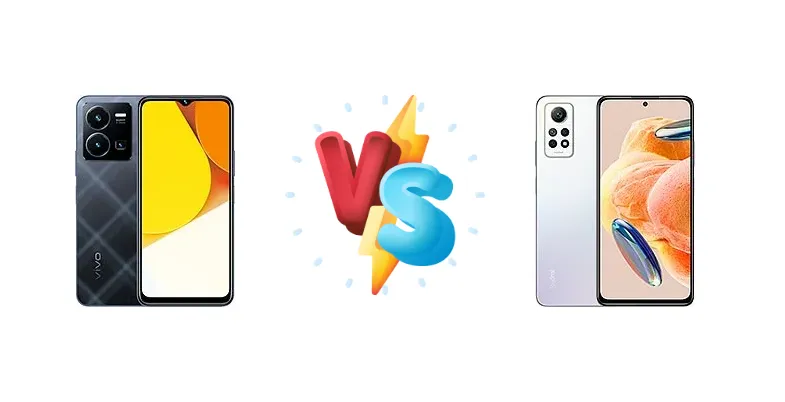
Both the vivo Y35 and the Xiaomi Redmi Note 12 Pro 4G target the competitive sub-$250 4G smartphone market. While both offer a solid feature set, they diverge significantly in their core processing power and charging capabilities. This comparison dissects those differences to determine which device delivers the best value for your money.
🏆 Quick Verdict
For the average user prioritizing consistent performance and faster charging, the Xiaomi Redmi Note 12 Pro 4G is the better choice. Its Snapdragon 732G chipset offers a noticeable performance uplift over the Y35’s Snapdragon 680, and the 67W charging significantly reduces downtime. However, the Y35 remains a viable option for those on a tighter budget.
| Network |
|---|
| 2G bands | GSM 850 / 900 / 1800 / 1900 | GSM 850 / 900 / 1800 / 1900 |
| 3G bands | HSDPA 850 / 900 / 2100 | HSDPA 850 / 900 / 1700(AWS) / 1900 / 2100 |
| 4G bands | 1, 3, 5, 8, 40 | 1, 2, 3, 4, 5, 7, 8, 20, 28, 38, 40, 41, 66 |
| Speed | HSPA, LTE | HSPA, LTE |
| Technology | GSM / HSPA / LTE | GSM / HSPA / LTE |
| Launch |
|---|
| Announced | 2022, August 15 | 2023, March 03 |
| Status | Available. Released 2022, August 15 | Available. Released 2023, April 11 |
| Body |
|---|
| Build | Glass front, plastic frame, plastic back | - |
| Dimensions | 164.3 x 76.1 x 8.3 mm (6.47 x 3.00 x 0.33 in) | 164.2 x 76.1 x 8.1 mm (6.46 x 3.00 x 0.32 in) |
| SIM | Nano-SIM + Nano-SIM | Nano-SIM + Nano-SIM |
| Weight | 188 g (6.63 oz) | 201.8 g (7.13 oz) |
| Display |
|---|
| Resolution | 1080 x 2408 pixels, 20:9 ratio (~401 ppi density) | 1080 x 2400 pixels, 20:9 ratio (~395 ppi density) |
| Size | 6.58 inches, 104.3 cm2 (~83.4% screen-to-body ratio) | 6.67 inches, 107.4 cm2 (~86.0% screen-to-body ratio) |
| Type | IPS LCD, 90Hz, 550 nits (HBM) | AMOLED, 120Hz, Dolby Vision, 700 nits (HBM), 1100 nits (peak) |
| Platform |
|---|
| CPU | Octa-core (4x2.4 GHz Kryo 265 Gold & 4x1.9 GHz Kryo 265 Silver) | Octa-core (2x2.2 GHz Kryo 470 Gold & 6x1.8 GHz Kryo 470 Silver) |
| Chipset | Qualcomm SM6225 Snapdragon 680 4G (6 nm) | Qualcomm SM7150 Snapdragon 732G (8 nm) |
| GPU | Adreno 610 | Adreno 618 |
| OS | Android 11, Funtouch 12 | Android 11, MIUI 13 |
| Memory |
|---|
| Card slot | microSDXC (dedicated slot) | microSDXC (uses shared SIM slot) |
| Internal | 64GB 4GB RAM, 128GB 4GB RAM, 128GB 8GB RAM, 256GB 8GB RAM | 128GB 6GB RAM, 128GB 8GB RAM, 256GB 8GB RAM |
| | - | UFS 2.2 |
| Main Camera |
|---|
| Features | LED flash | LED flash, HDR, panorama |
| Quad | - | 108 MP, f/1.9, (wide), 1/1.52", 0.7µm, PDAF
8 MP, 120˚, (ultrawide)
2 MP (macro)
Auxiliary lens |
| Triple | 50 MP, f/1.8, (wide), PDAF
2 MP (macro)
Auxiliary lens | - |
| Video | 1080p@30fps | 4K@30fps, 1080p@30/60fps |
| Selfie camera |
|---|
| Features | HDR | - |
| Single | 16 MP, f/2.0, (wide) | 16 MP, f/2.4, (wide) |
| Video | 1080p@30fps | 1080p@30fps |
| Sound |
|---|
| 3.5mm jack | - | Yes |
| 35mm jack | Yes | Yes |
| Loudspeaker | Yes | Yes, with stereo speakers |
| Comms |
|---|
| Bluetooth | 5.0, A2DP, LE | 5.0, A2DP, LE |
| Infrared port | - | Yes |
| NFC | No | Yes (market/region dependent) |
| Positioning | GPS, GLONASS, GALILEO, BDS, QZSS | GPS, GLONASS, GALILEO, BDS |
| Radio | FM radio | Unspecified |
| USB | USB Type-C 2.0, OTG | USB Type-C 2.0, OTG |
| WLAN | Wi-Fi 802.11 a/b/g/n/ac, dual-band, Wi-Fi Direct | Wi-Fi 802.11 a/b/g/n/ac, dual-band |
| Features |
|---|
| Sensors | Fingerprint (side-mounted), accelerometer, proximity, gyro, compass | Fingerprint (side-mounted), accelerometer, gyro, compass |
| Battery |
|---|
| Charging | 44W wired, 70% in 34 min
Reverse wired | 67W wired |
| Type | 5000 mAh | Li-Po 5000 mAh |
| Misc |
|---|
| Colors | Dawn Gold, Agate Black | Star Blue, Graphite Gray, Polar White, Ice blue |
| Models | - | 2209116AG, 2209116AG |
| Price | About 100 EUR | About 150 EUR |
vivo Y35
- Lower price point makes it accessible.
- Snapdragon 680 offers good power efficiency for basic tasks.
- Reverse wired charging provides added convenience.
- Snapdragon 680 is less powerful than the 732G.
- Slower 44W charging takes longer to replenish the battery.
Xiaomi Redmi Note 12 Pro 4G
- Snapdragon 732G delivers smoother performance.
- 67W fast charging significantly reduces charging time.
- More capable ISP for potentially better image quality.
- Generally more expensive than the vivo Y35.
- May experience slightly more heat under sustained load.
Display Comparison
Neither device boasts a standout display. While specific panel details (like peak brightness or color gamut coverage) are absent, the focus here is on the processing power impacting UI smoothness. Both likely utilize IPS LCD panels, common in this price bracket. The real difference lies in how well the chipset can drive the display; a more powerful processor translates to smoother animations and faster app loading times, indirectly enhancing the visual experience.
Camera Comparison
Without detailed camera specs beyond the chipsets, a direct comparison is limited. However, the Snapdragon 732G’s image signal processor (ISP) is more advanced than the 680’s, enabling better noise reduction, dynamic range, and overall image quality. This doesn’t guarantee superior photos, as lens quality and software processing play a crucial role, but the 732G provides a stronger foundation for camera performance. The Redmi Note 12 Pro 4G is more likely to produce sharper, more detailed images, especially in challenging lighting conditions.
Performance
The Xiaomi Redmi Note 12 Pro 4G’s Snapdragon 732G (8nm) represents a clear advantage over the vivo Y35’s Snapdragon 680 (6nm). The 732G features a more powerful CPU configuration – 2x2.2 GHz Kryo 470 Gold cores versus the Y35’s 4x2.4 GHz Kryo 265 Gold cores – and a more capable GPU. While the 6nm process of the 680 *should* offer better efficiency, the architectural improvements and higher clock speeds of the 732G translate to a more responsive user experience, particularly noticeable during multitasking and gaming. The 732G’s Adreno 618 GPU will handle graphically demanding games at medium settings with greater consistency than the 680’s Adreno 610.
Battery Life
Both phones offer respectable battery life, but the charging speeds are where they diverge. The Redmi Note 12 Pro 4G’s 67W wired charging is significantly faster than the vivo Y35’s 44W charging. Xiaomi claims a 70% charge in 34 minutes for the Y35, while the Redmi Note 12 Pro 4G will likely achieve a full charge in under an hour. This difference is substantial for users who frequently need to top up their battery throughout the day. While battery capacity isn’t specified, the faster charging of the Redmi Note 12 Pro 4G effectively mitigates any potential disadvantage from a slightly smaller battery.
Buying Guide
Buy the vivo Y35 if you prioritize a lower upfront cost and are primarily focused on basic smartphone tasks like calling, texting, and light social media use. Its Snapdragon 680 is sufficient for these workloads and offers good power efficiency. Buy the Xiaomi Redmi Note 12 Pro 4G if you value smoother multitasking, occasional gaming, and significantly faster charging. The Snapdragon 732G provides a more responsive experience, and the 67W charging is a game-changer for users who dislike waiting for their phone to power up.
Frequently Asked Questions
❓ Will the Snapdragon 732G in the Redmi Note 12 Pro 4G handle demanding games like PUBG Mobile smoothly?
Yes, the Snapdragon 732G is capable of running PUBG Mobile at medium to high settings with a playable frame rate. While it won't deliver the same experience as a flagship chipset, it provides a significantly smoother gaming experience compared to the Snapdragon 680 in the vivo Y35.
❓ How much faster is the 67W charging on the Redmi Note 12 Pro 4G compared to the 44W charging on the vivo Y35 in real-world use?
The 67W charging on the Redmi Note 12 Pro 4G can realistically shave off 20-30 minutes of charging time compared to the vivo Y35’s 44W charging. While vivo claims 70% in 34 minutes, the Redmi Note 12 Pro 4G can likely reach a full charge in under an hour, offering a substantial convenience boost.
❓ Does the Snapdragon 680 in the vivo Y35 get noticeably hot during extended use, like video recording or gaming?
The Snapdragon 680 is generally efficient, but it can experience some thermal throttling during prolonged intensive tasks. While it won't get uncomfortably hot, you may notice a slight performance dip after extended gaming or video recording sessions. The Redmi Note 12 Pro 4G, with its more powerful chipset, may also heat up, but its larger thermal capacity could manage it slightly better.