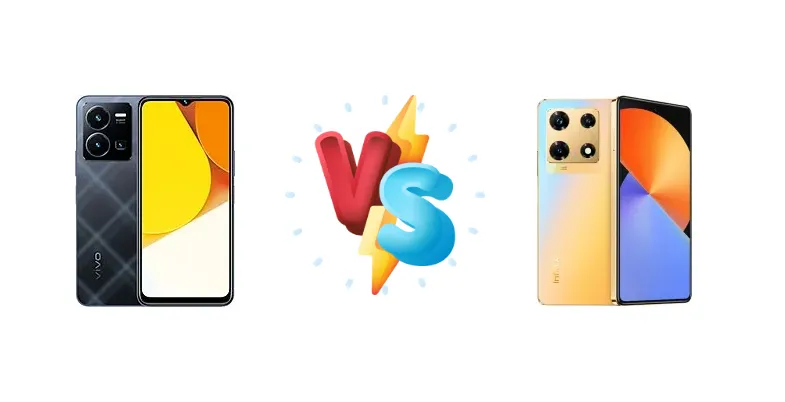
The sub-$200 smartphone market is fiercely competitive, and the vivo Y35 and Infinix Note 30 Pro represent compelling options. The Y35 leverages Qualcomm’s Snapdragon 680, prioritizing efficiency, while the Note 30 Pro opts for MediaTek’s Helio G99, aiming for a balance of performance and power. This comparison dissects their key differences to help you choose the right device.
🏆 Quick Verdict
For the average user prioritizing fast charging and a slightly more responsive experience, the Infinix Note 30 Pro emerges as the winner. Its 68W charging and Helio G99 chipset offer tangible benefits over the vivo Y35’s 44W charging and Snapdragon 680, despite the Y35’s slightly more efficient processor.
| Network |
|---|
| 2G bands | GSM 850 / 900 / 1800 / 1900 | GSM 850 / 900 / 1800 / 1900 |
| 3G bands | HSDPA 850 / 900 / 2100 | HSDPA 850 / 900 / 1700(AWS) / 1900 / 2100 |
| 4G bands | 1, 3, 5, 8, 40 | 1, 2, 3, 4, 5, 7, 8, 12, 17, 20, 28, 38, 40, 41, 66 |
| Speed | HSPA, LTE | HSPA, LTE |
| Technology | GSM / HSPA / LTE | GSM / HSPA / LTE |
| Launch |
|---|
| Announced | 2022, August 15 | 2023, May 22 |
| Status | Available. Released 2022, August 15 | Available. Released 2023, May 22 |
| Body |
|---|
| Build | Glass front, plastic frame, plastic back | Glass front, plastic frame, glass back |
| Dimensions | 164.3 x 76.1 x 8.3 mm (6.47 x 3.00 x 0.33 in) | 162.7 x 76 x 8.2 mm (6.41 x 2.99 x 0.32 in) |
| SIM | Nano-SIM + Nano-SIM | Nano-SIM + Nano-SIM |
| Weight | 188 g (6.63 oz) | 203 g (7.16 oz) |
| | - | IP53 |
| Display |
|---|
| Resolution | 1080 x 2408 pixels, 20:9 ratio (~401 ppi density) | 1080 x 2400 pixels, 20:9 ratio (~395 ppi density) |
| Size | 6.58 inches, 104.3 cm2 (~83.4% screen-to-body ratio) | 6.67 inches, 107.4 cm2 (~86.9% screen-to-body ratio) |
| Type | IPS LCD, 90Hz, 550 nits (HBM) | AMOLED, 1B colors, 120Hz, 900 nits (peak) |
| | - | * the display diagonal size and resolution is unconfirmed |
| Platform |
|---|
| CPU | Octa-core (4x2.4 GHz Kryo 265 Gold & 4x1.9 GHz Kryo 265 Silver) | Octa-core (2x2.2 GHz Cortex-A76 & 6x2.0 GHz Cortex-A55) |
| Chipset | Qualcomm SM6225 Snapdragon 680 4G (6 nm) | Mediatek Helio G99 (6 nm) |
| GPU | Adreno 610 | Mali-G57 MC2 |
| OS | Android 11, Funtouch 12 | Android 13, XOS 13 |
| Memory |
|---|
| Card slot | microSDXC (dedicated slot) | microSDXC (dedicated slot) |
| Internal | 64GB 4GB RAM, 128GB 4GB RAM, 128GB 8GB RAM, 256GB 8GB RAM | 256GB 8GB RAM |
| Main Camera |
|---|
| Features | LED flash | Quad-LED flash, HDR, panorama |
| Triple | 50 MP, f/1.8, (wide), PDAF
2 MP (macro)
Auxiliary lens | 108 MP, (wide), 1/1.67", PDAF
2 MP (macro)
Auxiliary lens |
| Video | 1080p@30fps | 1440p@30fps, 1080p@30fps |
| Selfie camera |
|---|
| Features | HDR | LED flash, HDR |
| Single | 16 MP, f/2.0, (wide) | 32 MP, f/2.0, (wide), 1/2.8" |
| Video | 1080p@30fps | 1080p@30fps |
| Sound |
|---|
| 3.5mm jack | - | Yes |
| 35mm jack | Yes | Yes |
| Loudspeaker | Yes | Yes, with dual speakers |
| | - | Sound by JBL
24-bit/192kHz audio |
| Comms |
|---|
| Bluetooth | 5.0, A2DP, LE | Yes |
| NFC | No | Yes (market/region dependent) |
| Positioning | GPS, GLONASS, GALILEO, BDS, QZSS | GPS |
| Radio | FM radio | FM radio |
| USB | USB Type-C 2.0, OTG | USB Type-C 2.0, OTG |
| WLAN | Wi-Fi 802.11 a/b/g/n/ac, dual-band, Wi-Fi Direct | Wi-Fi 802.11 a/b/g/n/ac, dual-band, Wi-Fi Direct |
| Features |
|---|
| Sensors | Fingerprint (side-mounted), accelerometer, proximity, gyro, compass | Fingerprint (side-mounted), accelerometer, gyro, proximity, compass |
| Battery |
|---|
| Charging | 44W wired, 70% in 34 min
Reverse wired | 68W wired, PD3.0, 80% in 30 min
15W wireless
Reverse wireless |
| Type | 5000 mAh | 5000 mAh |
| Misc |
|---|
| Colors | Dawn Gold, Agate Black | Magic Black, Variable Gold |
| Models | - | X678B |
| Price | About 100 EUR | - |
vivo Y35
- Potentially better power efficiency with Snapdragon 680
- Reliable Qualcomm chipset with established software support
- Reverse wired charging capability
- Slower charging speed (44W)
- Less powerful processor compared to Helio G99
- Lacks wireless charging
Infinix Note 30 Pro
- Faster 68W wired charging
- Wireless charging and reverse wireless charging
- More powerful MediaTek Helio G99 processor
- Potentially lower battery efficiency compared to Snapdragon 680
- MediaTek chipsets sometimes have less consistent software updates
- Larger size may not appeal to all users
Display Comparison
Neither device boasts a standout display. Both likely utilize LCD panels, common in this price bracket. The focus here isn't on visual fidelity, but on usability. While specific display specs (resolution, brightness) are missing, the Note 30 Pro’s larger screen size (typically found in the Note series) may offer a more immersive viewing experience. However, without knowing the peak brightness of each, it’s difficult to assess outdoor visibility.
Camera Comparison
Without detailed camera specs, a direct comparison is challenging. Both phones likely feature a multi-camera setup with a primary sensor and supporting lenses. However, the quality of image processing and sensor size will be crucial. Given the price point, expect similar performance in good lighting conditions. The Note 30 Pro may have a slight advantage due to MediaTek’s image signal processor (ISP) capabilities, but this is speculative. The inclusion of a 2MP macro lens on either device is largely a marketing tactic and offers limited practical benefit.
Performance
The core difference lies in the chipsets. The Infinix Note 30 Pro’s MediaTek Helio G99, built on a 6nm process, features two Cortex-A76 cores clocked at 2.2 GHz, offering a performance edge over the vivo Y35’s Snapdragon 680. The Snapdragon 680 utilizes four Kryo 265 Gold cores at 2.4 GHz, but the older Cortex-A76 architecture in the Helio G99 generally translates to better sustained performance in demanding tasks. The Snapdragon 680’s 6nm node does contribute to better power efficiency, potentially leading to longer battery life during light usage. The Note 30 Pro’s GPU is also likely to be more capable, offering a smoother gaming experience, though neither phone is a dedicated gaming device.
Battery Life
The Infinix Note 30 Pro significantly pulls ahead in charging speed with its 68W wired charging, capable of reaching 80% in 30 minutes. This is a substantial improvement over the vivo Y35’s 44W charging, which takes 34 minutes to reach 70%. Furthermore, the Note 30 Pro adds 15W wireless charging and reverse wireless charging, features absent on the Y35. While battery capacity isn’t specified, the faster charging and wireless capabilities of the Note 30 Pro make it the more convenient option for users who frequently need to top up their device.
Buying Guide
Buy the vivo Y35 if you prioritize all-day battery life and a consistently stable, if not blazing-fast, experience. It’s ideal for users who primarily browse, use social media, and make calls. Buy the Infinix Note 30 Pro if you value faster charging speeds, a more responsive user interface, and the convenience of wireless charging, making it better suited for multimedia consumption and light gaming.
Frequently Asked Questions
❓ Does the MediaTek Helio G99 in the Infinix Note 30 Pro get noticeably warmer during extended gaming sessions?
The Helio G99 is known to generate more heat under sustained load compared to the Snapdragon 680. While the Note 30 Pro likely incorporates thermal management solutions, users engaging in prolonged gaming may experience some warming. However, the performance gains generally outweigh this minor drawback.
❓ Is the 44W charging on the vivo Y35 sufficient for overnight charging, or will it significantly impact battery health over time?
44W charging is generally considered safe for overnight charging and shouldn't drastically impact battery health. Modern smartphones employ charging algorithms that slow down the charging rate as the battery approaches full capacity, minimizing stress. However, consistently leaving a phone plugged in at 100% for extended periods can contribute to long-term battery degradation.
❓ Can the Infinix Note 30 Pro wirelessly charge other devices using its reverse wireless charging feature, and how fast is it?
Yes, the Infinix Note 30 Pro supports reverse wireless charging at 15W. While not as fast as wired charging, it's sufficient for topping up accessories like wireless earbuds or smartwatches. Expect a significantly slower charging speed compared to charging another device with a dedicated charger.