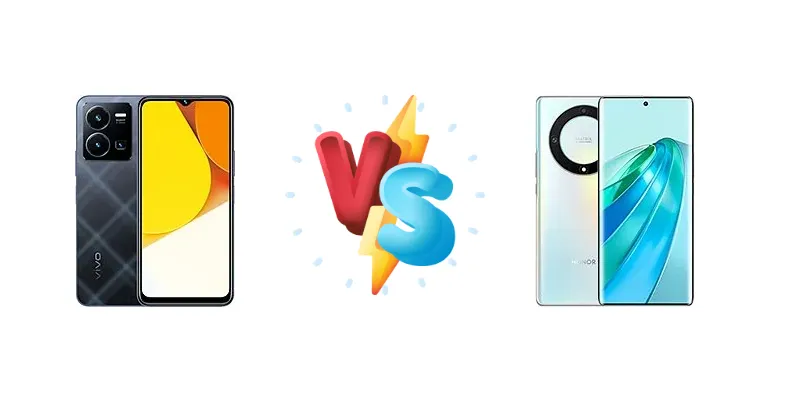
The vivo Y35 and Honor X9a represent compelling options in the crowded budget smartphone market. Both leverage Qualcomm's Snapdragon series, but target slightly different priorities. The Y35 focuses on a balance of features and rapid charging, while the X9a emphasizes 5G connectivity and a streamlined user experience. This comparison dissects their key differences to determine which device delivers the best value.
🏆 Quick Verdict
For the average user prioritizing future-proofing and occasional 5G access, the Honor X9a is the better choice. Its Snapdragon 695 offers a noticeable performance uplift and 5G capability, despite slightly slower charging. However, the vivo Y35 remains a strong contender for those primarily focused on reliable 4G performance and exceptionally fast charging.
| Network |
|---|
| 2G bands | GSM 850 / 900 / 1800 / 1900 | GSM 850 / 900 / 1800 / 1900 |
| 3G bands | HSDPA 850 / 900 / 2100 | HSDPA 850 / 900 / 1900 / 2100 |
| 4G bands | 1, 3, 5, 8, 40 | LTE |
| 5G bands | - | SA/NSA |
| Speed | HSPA, LTE | HSPA, LTE, 5G |
| Technology | GSM / HSPA / LTE | GSM / HSPA / LTE / 5G |
| Launch |
|---|
| Announced | 2022, August 15 | 2023, January 04 |
| Status | Available. Released 2022, August 15 | Available. Released 2023, January 06 |
| Body |
|---|
| Build | Glass front, plastic frame, plastic back | - |
| Dimensions | 164.3 x 76.1 x 8.3 mm (6.47 x 3.00 x 0.33 in) | 161.6 x 73.9 x 7.9 mm (6.36 x 2.91 x 0.31 in) |
| SIM | Nano-SIM + Nano-SIM | Nano-SIM + Nano-SIM |
| Weight | 188 g (6.63 oz) | 175 g (6.17 oz) |
| Display |
|---|
| Resolution | 1080 x 2408 pixels, 20:9 ratio (~401 ppi density) | 1080 x 2400 pixels, 20:9 ratio (~395 ppi density) |
| Size | 6.58 inches, 104.3 cm2 (~83.4% screen-to-body ratio) | 6.67 inches, 107.4 cm2 (~89.9% screen-to-body ratio) |
| Type | IPS LCD, 90Hz, 550 nits (HBM) | AMOLED, 1B colors, 120Hz, 800 nits (HBM) |
| Platform |
|---|
| CPU | Octa-core (4x2.4 GHz Kryo 265 Gold & 4x1.9 GHz Kryo 265 Silver) | Octa-core (2x2.2 GHz Kryo 660 Gold & 6x1.7 GHz Kryo 660 Silver) |
| Chipset | Qualcomm SM6225 Snapdragon 680 4G (6 nm) | Qualcomm SM6375 Snapdragon 695 5G (6 nm) |
| GPU | Adreno 610 | Adreno 619 |
| OS | Android 11, Funtouch 12 | Android 12, upgradable to Android 13, MagicOS 7 |
| Memory |
|---|
| Card slot | microSDXC (dedicated slot) | No |
| Internal | 64GB 4GB RAM, 128GB 4GB RAM, 128GB 8GB RAM, 256GB 8GB RAM | 128GB 6GB RAM, 128GB 8GB RAM, 256GB 8GB RAM |
| Main Camera |
|---|
| Dual | - | 64 MP, f/1.8, (wide), PDAF
5 MP, f/2.2, (ultrawide)
2 MP (macro) |
| Features | LED flash | LED flash, panorama, HDR |
| Single | - | 16 MP, f/2.5, (wide) |
| Triple | 50 MP, f/1.8, (wide), PDAF
2 MP (macro)
Auxiliary lens | - |
| Video | 1080p@30fps | 1080p@30fps |
| Selfie camera |
|---|
| Features | HDR | - |
| Single | 16 MP, f/2.0, (wide) | 16 MP, f/2.5, (wide) |
| Video | 1080p@30fps | 1080p@30fps |
| Sound |
|---|
| 3.5mm jack | - | No |
| 35mm jack | Yes | No |
| Loudspeaker | Yes | Yes |
| Comms |
|---|
| Bluetooth | 5.0, A2DP, LE | 5.1, A2DP, LE, aptX HD |
| Infrared port | - | Yes |
| NFC | No | Yes |
| Positioning | GPS, GLONASS, GALILEO, BDS, QZSS | GPS, GLONASS, GALILEO, BDS |
| Radio | FM radio | No |
| USB | USB Type-C 2.0, OTG | USB Type-C 2.0, OTG |
| WLAN | Wi-Fi 802.11 a/b/g/n/ac, dual-band, Wi-Fi Direct | Wi-Fi 802.11 a/b/g/n/ac, dual-band, Wi-Fi Direct |
| Features |
|---|
| Sensors | Fingerprint (side-mounted), accelerometer, proximity, gyro, compass | Fingerprint (under display, optical), accelerometer, gyro, proximity, compass |
| | - | 24-bit/192kHz audio |
| Battery |
|---|
| Charging | 44W wired, 70% in 34 min
Reverse wired | 40W wired |
| Type | 5000 mAh | Li-Po 5100 mAh |
| Misc |
|---|
| Colors | Dawn Gold, Agate Black | Titanium Silver, Emerald Green, Midnight Black |
| Models | - | RMO-NX1 |
| Price | About 100 EUR | $ 212.08 |
vivo Y35
- Faster 44W charging with reverse wired capability
- Reliable 4G performance for everyday tasks
- Potentially more affordable price point
- Lacks 5G connectivity
- Slightly less powerful processor compared to the X9a
Honor X9a
- 5G connectivity for future-proofing
- More powerful Snapdragon 695 processor
- Potentially cleaner software experience
- Slower 40W charging
- May be slightly more expensive
Display Comparison
Neither device boasts a standout display. Both likely utilize LCD panels, common in this price bracket. While specific display specs (resolution, brightness) are missing, the focus here is on processing power, not visual fidelity. Bezels are expected to be moderate on both, and color accuracy will likely be tuned for vibrant, rather than accurate, reproduction. The absence of high refresh rates is standard for this segment.
Camera Comparison
Without detailed camera specifications, a direct comparison is difficult. Both phones likely feature a multi-camera setup with a primary sensor, an ultrawide, and potentially a macro lens. However, the quality of these sensors is paramount. We can assume both will perform adequately in good lighting conditions, but low-light performance will be a key differentiator. The absence of Optical Image Stabilization (OIS) on either device suggests image stabilization will rely on software algorithms. The 2MP macro lenses commonly found on these devices offer limited practical benefit, and should not be a deciding factor.
Performance
The core difference lies in the chipsets. The Honor X9a’s Snapdragon 695 5G (6nm) represents a step up from the vivo Y35’s Snapdragon 680 4G (6nm). The 695 features a more modern CPU configuration – 2x2.2 GHz Kryo 660 Gold cores versus the Y35’s 4x2.4 GHz Kryo 265 Gold cores – and crucially, an integrated 5G modem. While the Y35’s cores clock higher, the 695’s architecture and additional cores provide better sustained performance in multi-threaded tasks and gaming. The 6nm process node on both contributes to reasonable efficiency, but the 695’s newer design likely offers a slight edge in thermal management. The Y35 will handle daily tasks well, but the X9a will feel snappier with demanding apps.
Battery Life
The vivo Y35’s 44W wired charging is a significant advantage. It claims a 70% charge in just 34 minutes, offering a substantial convenience factor. The Honor X9a’s 40W charging is respectable, but slower. While battery capacity isn’t specified, both likely house batteries in the 5000mAh range. The Y35’s faster charging effectively mitigates any potential capacity difference, allowing for quicker top-ups throughout the day. The inclusion of reverse wired charging on the Y35 is a bonus, enabling it to charge other devices.
Buying Guide
Buy the vivo Y35 if you need a dependable 4G smartphone with incredibly fast 44W charging, prioritizing quick top-ups and consistent performance for everyday tasks. Buy the Honor X9a if you prefer 5G connectivity for future-proofing, a slightly more powerful processor for smoother multitasking and gaming, and a cleaner software experience, even if it means sacrificing a bit of charging speed.
Frequently Asked Questions
❓ Will the Snapdragon 695 in the Honor X9a handle demanding games like PUBG Mobile smoothly?
The Snapdragon 695 is capable of running PUBG Mobile, but expect to play at medium settings for a consistently smooth experience. While not a dedicated gaming chip, it offers a noticeable performance improvement over the Snapdragon 680, allowing for higher frame rates and reduced stuttering.
❓ How long does it realistically take to fully charge the vivo Y35 with the 44W charger?
vivo claims 70% charge in 34 minutes. A full 0-100% charge will likely take around 50-60 minutes, making it significantly faster than the Honor X9a's 40W charging. This is a major advantage for users who frequently need to quickly top up their battery.
❓ Does the Honor X9a support carrier aggregation for improved 5G speeds?
While the Snapdragon 695 supports 5G, the extent of carrier aggregation support varies by region and carrier. Check with your local carrier to confirm which 5G bands and aggregation features are supported for optimal performance.
❓ Is the software experience significantly different between vivo's Funtouch OS and Honor's Magic UI?
Yes. Honor's Magic UI is generally considered closer to stock Android, offering a cleaner and more streamlined user experience. vivo's Funtouch OS is more heavily customized, with a different aesthetic and additional features that some users may find unnecessary.