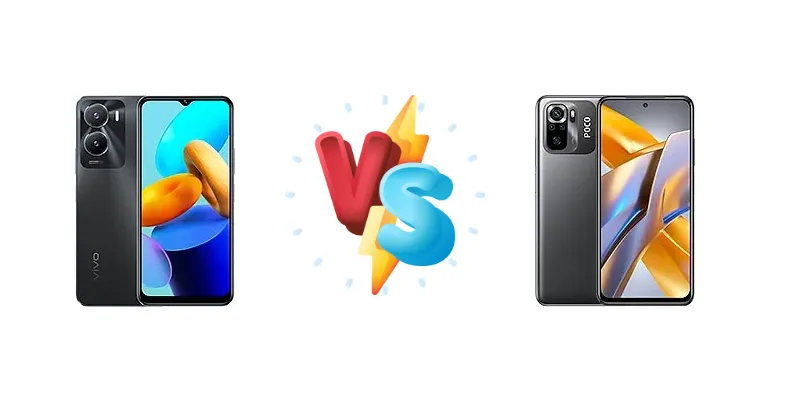
The sub-$200 smartphone market is fiercely competitive, and the vivo Y35 5G and Xiaomi Poco M5s represent compelling options. The Y35 5G prioritizes 5G connectivity with a newer chipset, while the Poco M5s focuses on delivering a brighter display and significantly faster charging speeds. This comparison dissects their key differences to determine which device offers the best value.
🏆 Quick Verdict
For the average user, the Xiaomi Poco M5s is the stronger choice. While the vivo Y35 5G boasts 5G connectivity via the Dimensity 700, the Poco M5s compensates with a brighter display, faster 33W charging, and comparable performance, making it a more well-rounded package.
| Network |
|---|
| 2G bands | GSM 850 / 900 / 1800 / 1900 | GSM 850 / 900 / 1800 / 1900 |
| 3G bands | HSDPA 850 / 900 / 2100 | HSDPA 850 / 900 / 1700(AWS) / 1900 / 2100 |
| 4G bands | 1, 3, 5, 8, 28, 34, 38, 39, 40, 41 | 1, 2, 3, 4, 5, 7, 8, 20, 28, 38, 40, 41 |
| 5G bands | 1, 5, 8, 28, 41, 77, 78 SA/NSA | - |
| Speed | HSPA, LTE, 5G | HSPA, LTE |
| Technology | GSM / CDMA / HSPA / CDMA2000 / LTE / 5G | GSM / HSPA / LTE |
| | CDMA2000 1x | - |
| Launch |
|---|
| Announced | 2022, December 09 | 2022, September 05 |
| Status | Available. Released 2022, December 09 | Available. Released 2022, September 06 |
| Body |
|---|
| Build | Glass front, plastic frame, plastic back | Glass front (Gorilla Glass 3), plastic frame, plastic back |
| Dimensions | 164.1 x 75.6 x 8.2 mm (6.46 x 2.98 x 0.32 in) | 160.5 x 74.5 x 8.3 mm (6.32 x 2.93 x 0.33 in) |
| SIM | Nano-SIM + Nano-SIM | Nano-SIM + Nano-SIM |
| Weight | 186 g (6.56 oz) | 178.8 g (6.31 oz) |
| | - | IP53, dust and splash resistant |
| Display |
|---|
| Protection | - | Corning Gorilla Glass 3 |
| Resolution | 720 x 1600 pixels, 20:9 ratio (~270 ppi density) | 1080 x 2400 pixels, 20:9 ratio (~409 ppi density) |
| Size | 6.51 inches, 102.3 cm2 (~82.5% screen-to-body ratio) | 6.43 inches, 99.8 cm2 (~83.5% screen-to-body ratio) |
| Type | IPS LCD | AMOLED, 450 nits (typ), 700 nits (HBM), 1100 nits (peak) |
| Platform |
|---|
| CPU | Octa-core (2x2.2 GHz Cortex-A76 & 6x2.0 GHz Cortex-A55) | Octa-core (2x2.05 GHz Cortex-A76 & 6x2.0 GHz Cortex-A55) |
| Chipset | Mediatek Dimensity 700 (7 nm) | Mediatek MT6785V/CD Helio G95 (12 nm) |
| GPU | Mali-G57 MC2 | Mali-G76 MC4 |
| OS | Android 13, OriginOS Ocean | Android 12, MIUI 13 |
| Memory |
|---|
| Card slot | microSDXC (dedicated slot) | microSDXC (dedicated slot) |
| Internal | 128GB 4GB RAM, 128GB 6GB RAM, 128GB 8GB RAM | 64GB 4GB RAM, 128GB 4GB RAM, 128GB 6GB RAM, 256GB 8GB RAM |
| | UFS 2.2 | UFS 2.2 |
| Main Camera |
|---|
| Dual | 13 MP, f/2.2, (wide), AF
2 MP (macro) | - |
| Features | LED flash | LED flash, HDR, panorama |
| Quad | - | 64 MP, f/1.8, 26mm (wide), 1/1.97", 0.7µm, PDAF
8 MP, f/2.2, 118˚ (ultrawide), 1/4.0", 1.12µm
2 MP (macro)
Auxiliary lens |
| Single | 5 MP, f/1.8, (wide) | - |
| Video | 1080p@30fps | 4K@30fps, 1080p@30/60/120fps, 720p@960fps |
| Selfie camera |
|---|
| Features | HDR | HDR |
| Single | 5 MP, f/1.8, (wide) | 13 MP, f/2.4, (wide), 1/3.06", 1.12µm |
| Video | 1080p@30fps | 1080p@30fps |
| Sound |
|---|
| 3.5mm jack | Yes | Yes |
| 35mm jack | Yes | Yes |
| Loudspeaker | Yes | Yes, with stereo speakers |
| Comms |
|---|
| Bluetooth | 5.2, A2DP, LE | 5.0, A2DP, LE |
| Infrared port | - | Yes |
| NFC | No | Yes |
| Positioning | GPS, GLONASS, GALILEO, BDS, QZSS | GPS, GLONASS, GALILEO, BDS |
| Radio | No | FM radio |
| USB | USB Type-C 2.0, OTG | USB Type-C 2.0 |
| WLAN | Wi-Fi 802.11 a/b/g/n/ac, dual-band | Wi-Fi 802.11 a/b/g/n/ac, dual-band, Wi-Fi Direct |
| Features |
|---|
| Sensors | Fingerprint (side-mounted), accelerometer, proximity, compass | Fingerprint (side-mounted), accelerometer, gyro, compass |
| | - | Virtual proximity sensing |
| Battery |
|---|
| Charging | 15W wired | 33W wired, 64% in 30 min |
| Type | 5000 mAh | Li-Po 5000 mAh |
| Misc |
|---|
| Colors | Gold, Black, Blue | Gray, Blue, White |
| Models | V2230A | 2207117BPG |
| Price | About 160 EUR | About 120 EUR |
| SAR | - | 1.00 W/kg (head) 0.65 W/kg (body) |
| SAR EU | - | 0.60 W/kg (head) 0.87 W/kg (body) |
| Tests |
|---|
| Battery life | - |
Endurance rating 132h
|
| Camera | - |
Photo / Video |
| Display | - |
Contrast ratio: Infinite (nominal) |
| Loudspeaker | - |
-25.4 LUFS (Very good)
|
| Performance | - |
AnTuTu: 360681 (v9)
GeekBench: 1831 (v5.1)
GFXBench: 18fps (ES 3.1 onscreen) |
vivo Y35 5G
- 5G Connectivity with Dimensity 700
- Potentially better thermal management due to 7nm process
- Clean and streamlined software experience (typical of vivo)
- Slower 15W charging
- Less detailed display specifications
- Likely less capable camera system
Xiaomi Poco M5s
- Brighter 756 nit display for outdoor visibility
- Faster 33W charging (64% in 30 mins)
- Potentially more capable camera system
- Older 12nm Helio G95 chipset
- Software experience can be more cluttered (typical of Xiaomi)
- May run slightly warmer under heavy load
Display Comparison
The Xiaomi Poco M5s immediately stands out with its measured peak brightness of 756 nits, a substantial advantage over the unspecified brightness of the vivo Y35 5G. This translates to significantly better outdoor visibility. While both devices feature an 'infinite' contrast ratio (a marketing term), the higher brightness of the Poco M5s is a tangible benefit. The Y35 5G’s display specifications are less detailed, suggesting a more basic panel, potentially impacting color accuracy and viewing angles.
Camera Comparison
Both devices list 'Photo / Video' capabilities, but lack specific sensor details. This makes a direct comparison difficult. However, the market segment suggests the Poco M5s likely features a more capable main sensor. The inclusion of a 64MP main sensor in the Poco M5s (based on typical configurations) would provide more detail and flexibility compared to a likely lower-resolution sensor in the Y35 5G. The presence of a 2MP macro camera on both devices is largely inconsequential, offering limited practical benefit due to the small sensor size and lack of optical image stabilization (OIS).
Performance
Both phones utilize octa-core MediaTek chipsets, but differ significantly in architecture and fabrication process. The vivo Y35 5G’s Dimensity 700 (7nm) offers a more modern design and potentially better power efficiency compared to the Poco M5s’ Helio G95 (12nm). However, the G95’s slightly higher clocked Cortex-A76 cores (2.05 GHz vs 2.2 GHz) may offer a marginal performance boost in some tasks. Both CPUs share the same Cortex-A55 efficiency cores clocked at 2.0 GHz. The 7nm process of the Dimensity 700 should result in better thermal management under sustained load, but real-world differences will likely be minimal for typical usage.
Battery Life
Both phones achieve an endurance rating of 132 hours, indicating similar overall battery life. However, the Poco M5s’ 33W wired charging is a game-changer, capable of reaching 64% charge in just 30 minutes. The vivo Y35 5G’s 15W charging is significantly slower, requiring considerably more time to fully replenish the battery. This difference in charging speed is a major convenience factor, especially for users who frequently need to top up their devices.
Buying Guide
Buy the vivo Y35 5G if your primary need is future-proofing with 5G connectivity and you prioritize a clean, streamlined software experience. Buy the Xiaomi Poco M5s if you value a brighter, more visible display in sunlight, significantly faster charging speeds, and a more robust feature set for the price.
Frequently Asked Questions
❓ Does the Helio G95 in the Poco M5s struggle with demanding games like PUBG or Call of Duty?
While not a flagship chipset, the Helio G95 is capable of running PUBG and Call of Duty at medium settings. Expect some frame drops during intense scenes, but the experience should be playable. The Dimensity 700 in the Y35 5G might offer slightly more consistent performance in these scenarios due to its more efficient architecture, but the difference won't be dramatic.
❓ Is the 15W charging on the vivo Y35 5G realistically usable for someone who needs a quick top-up before leaving the house?
15W charging is relatively slow by today's standards. Expect it to take over 2 hours to fully charge the device from 0%. A quick 30-minute charge will only provide a limited amount of battery life, making it less convenient for users who need a fast boost.
❓ How does the software experience differ between vivo's Funtouch OS and Xiaomi's MIUI on these devices?
Vivo's Funtouch OS is generally considered cleaner and more streamlined than Xiaomi's MIUI. MIUI often includes more pre-installed apps (bloatware) and a more customized user interface. However, MIUI offers greater customization options and features for power users.
❓ Given both phones have the same endurance rating, does that mean they'll last the same amount of time on a single charge?
The endurance rating provides a general indication of battery life under typical usage. However, real-world battery life can vary significantly based on individual usage patterns, screen brightness, and network conditions. The more efficient 7nm process of the Dimensity 700 *could* translate to slightly longer battery life in some scenarios, but the difference is unlikely to be substantial.