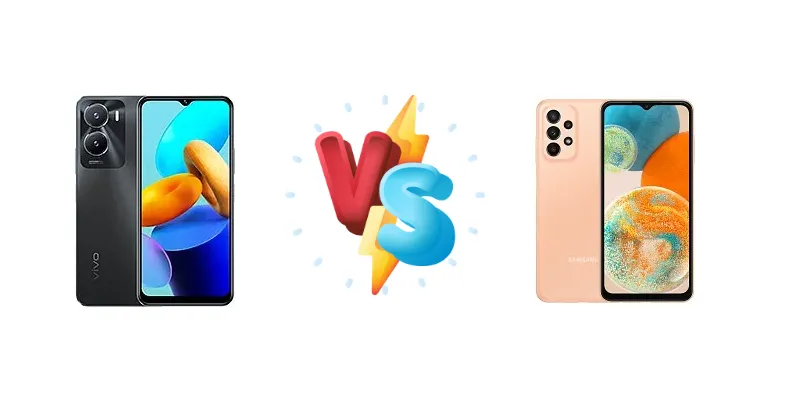
The sub-$250 5G smartphone market is fiercely competitive. Both the vivo Y35 5G and Samsung Galaxy A23 5G aim to deliver 5G connectivity without breaking the bank. However, they take different approaches, with Samsung leaning on its brand recognition and display tech, while vivo focuses on a more recent chipset and aggressive pricing. This comparison dissects the key differences to help you choose the right device.
🏆 Quick Verdict
For the average user prioritizing consistent performance and a slightly brighter display, the Samsung Galaxy A23 5G emerges as the better choice. Its Snapdragon 695 offers a more refined experience, and the 25W charging is a significant advantage, despite the similar endurance rating. However, the vivo Y35 5G presents a compelling value proposition for those seeking the latest chipset at the lowest possible price.
| Network |
|---|
| 2G bands | GSM 850 / 900 / 1800 / 1900 | GSM 850 / 900 / 1800 / 1900 |
| 3G bands | HSDPA 850 / 900 / 2100 | HSDPA 850 / 900 / 1700(AWS) / 1900 / 2100 |
| 4G bands | 1, 3, 5, 8, 28, 34, 38, 39, 40, 41 | 1, 2, 3, 4, 5, 7, 8, 12, 17, 20, 26, 28, 32, 38, 40, 41, 66 - International |
| 5G bands | 1, 5, 8, 28, 41, 77, 78 SA/NSA | 1, 3, 7, 8, 20, 28, 38, 40, 41, 77, 78 SA/NSA/Sub6 - International |
| Speed | HSPA, LTE, 5G | HSPA, LTE, 5G |
| Technology | GSM / CDMA / HSPA / CDMA2000 / LTE / 5G | GSM / HSPA / LTE / 5G |
| | CDMA2000 1x | 2, 5, 30, 66, 77 SA/NSA/Sub6/mmWave - USA |
| Launch |
|---|
| Announced | 2022, December 09 | 2022, August 05 |
| Status | Available. Released 2022, December 09 | Available. Released 2022, September 02 |
| Body |
|---|
| Build | Glass front, plastic frame, plastic back | Glass front (Gorilla Glass 5), plastic frame, plastic back |
| Dimensions | 164.1 x 75.6 x 8.2 mm (6.46 x 2.98 x 0.32 in) | 165.4 x 76.9 x 8.4 mm (6.51 x 3.03 x 0.33 in) |
| SIM | Nano-SIM + Nano-SIM | · Nano-SIM· Nano-SIM + Nano-SIM |
| Weight | 186 g (6.56 oz) | 197 g (6.95 oz) |
| Display |
|---|
| Protection | - | Corning Gorilla Glass 5 |
| Resolution | 720 x 1600 pixels, 20:9 ratio (~270 ppi density) | 1080 x 2408 pixels, 20:9 ratio (~400 ppi density) |
| Size | 6.51 inches, 102.3 cm2 (~82.5% screen-to-body ratio) | 6.6 inches, 104.9 cm2 (~82.5% screen-to-body ratio) |
| Type | IPS LCD | PLS LCD, 120Hz |
| Platform |
|---|
| CPU | Octa-core (2x2.2 GHz Cortex-A76 & 6x2.0 GHz Cortex-A55) | Octa-core (2x2.2 GHz Kryo 660 Gold & 6x1.7 GHz Kryo 660 Silver) |
| Chipset | Mediatek Dimensity 700 (7 nm) | Qualcomm SM6375 Snapdragon 695 5G (6 nm) |
| GPU | Mali-G57 MC2 | Adreno 619 |
| OS | Android 13, OriginOS Ocean | Android 12, upgradable to Android 14, One UI 6 |
| Memory |
|---|
| Card slot | microSDXC (dedicated slot) | microSDXC (dedicated slot) |
| Internal | 128GB 4GB RAM, 128GB 6GB RAM, 128GB 8GB RAM | 64GB 4GB RAM, 64GB 6GB RAM, 128GB 4GB RAM, 128GB 6GB RAM, 128GB 8GB RAM |
| | UFS 2.2 | - |
| Main Camera |
|---|
| Dual | 13 MP, f/2.2, (wide), AF
2 MP (macro) | - |
| Features | LED flash | LED flash, panorama, HDR |
| Quad | - | 50 MP, f/1.8, 26mm (wide), 1/2.76", 0.64µm, PDAF, OIS
5 MP, f/2.2, 13mm, 123˚ (ultrawide), 1/5.0", 1.12µm
2 MP (macro)
Auxiliary lens |
| Single | 5 MP, f/1.8, (wide) | - |
| Video | 1080p@30fps | 1080p@30fps |
| Selfie camera |
|---|
| Features | HDR | - |
| Single | 5 MP, f/1.8, (wide) | 8 MP, f/2.0, 25mm (wide), 1/4.0", 1.12µm - USA
8 MP, f/2.2, 25mm (wide), 1/4.0", 1.12µm - International |
| Video | 1080p@30fps | 1080p@30fps |
| Sound |
|---|
| 3.5mm jack | Yes | Yes |
| 35mm jack | Yes | Yes |
| Loudspeaker | Yes | Yes |
| Comms |
|---|
| Bluetooth | 5.2, A2DP, LE | 5.1, A2DP, LE |
| NFC | No | Yes |
| Positioning | GPS, GLONASS, GALILEO, BDS, QZSS | GPS, GLONASS, GALILEO, BDS |
| Radio | No | FM radio (market/region dependent) |
| USB | USB Type-C 2.0, OTG | USB Type-C 2.0 |
| WLAN | Wi-Fi 802.11 a/b/g/n/ac, dual-band | Wi-Fi 802.11 a/b/g/n/ac, dual-band, Wi-Fi Direct |
| Features |
|---|
| Sensors | Fingerprint (side-mounted), accelerometer, proximity, compass | Fingerprint (side-mounted), accelerometer, gyro, compass, barometer (USA only) |
| | - | Virtual proximity sensing |
| Battery |
|---|
| Charging | 15W wired | 25W wired |
| Type | 5000 mAh | Li-Po 5000 mAh |
| Misc |
|---|
| Colors | Gold, Black, Blue | Black, White, Peach, Blue |
| Models | V2230A | SM-A236U, SM-A236U1, SM-A236B, SM-A236B/DS, SM-A236B/DSN, SM-A236E, SM-S236DL |
| Price | About 160 EUR | $ 84.44 / £ 129.00 / € 125.28 / ₹ 21,000 |
| SAR | - | 0.68 W/kg (head) 0.57 W/kg (body) |
| SAR EU | - | 1.49 W/kg (head) 1.25 W/kg (body) |
| Tests |
|---|
| Battery life | - |
Endurance rating 138h
|
| Camera | - |
Photo / Video |
| Display | - |
Contrast ratio: 1328:1 (nominal) |
| Loudspeaker | - |
-25.9 LUFS (Very good)
|
| Performance | - |
AnTuTu: 318821 (v9)
GeekBench: 1940 (v5.1)
GFXBench: 16fps (ES 3.1 onscreen) |
vivo Y35 5G
- More recent chipset (Dimensity 700)
- Potentially lower price point
- 5G connectivity
- Slower 15W charging
- Less refined software experience (potentially)
- Display brightness data unavailable
Samsung Galaxy A23 5G
- Faster 25W charging
- Brighter display (508 nits)
- More efficient Snapdragon 695 chipset
- Older chipset (Snapdragon 695)
- Potentially higher price
- Similar battery endurance despite faster charging
Display Comparison
The Samsung Galaxy A23 5G boasts a display capable of reaching 508 nits of peak brightness, providing better visibility outdoors compared to the vivo Y35 5G (brightness data unavailable). Both displays share a 1328:1 contrast ratio, suggesting similar color depth and black levels. However, Samsung’s panel benefits from its established display technology, potentially offering more accurate color reproduction. While neither phone is expected to feature high refresh rates, the A23’s higher brightness is a tangible advantage for outdoor use.
Camera Comparison
Both devices offer 'Photo / Video' capabilities, but detailed camera specs are limited. Without sensor size or aperture information, a direct comparison is difficult. However, Samsung’s image processing algorithms are generally more refined, potentially resulting in more pleasing photos in various lighting conditions. The inclusion of Optical Image Stabilization (OIS) on the A23 (assuming it carries over from previous A-series models) would be a significant advantage for video recording and low-light photography. The presence of a 2MP macro camera on both devices is largely a marketing gimmick and unlikely to deliver substantial image quality improvements.
Performance
The core difference lies in the chipsets: the vivo Y35 5G utilizes the Mediatek Dimensity 700 (7nm), while the Samsung Galaxy A23 5G features the Qualcomm Snapdragon 695 5G (6nm). The 6nm process node of the Snapdragon 695 generally translates to better power efficiency and thermal management compared to the 7nm Dimensity 700. While both CPUs feature a 2x2.2 GHz core configuration, the Snapdragon’s Kryo 660 Gold cores are architecturally more advanced than the Cortex-A76 cores in the Dimensity 700, potentially leading to slightly better single-core performance. The A23’s GPU is also likely to offer a more consistent gaming experience.
Battery Life
Both phones achieve an endurance rating of 138 hours, indicating similar overall battery life. However, the Samsung Galaxy A23 5G’s 25W wired charging significantly outperforms the vivo Y35 5G’s 15W charging. This translates to a much faster 0-100% charge time for the A23, reducing downtime. While the battery capacity isn’t specified for either device, the faster charging speed of the A23 provides a practical advantage for users who frequently need to top up their battery.
Buying Guide
Buy the vivo Y35 5G if you need the most up-to-date chipset in this price bracket and are comfortable with potentially slower software updates. It’s ideal for users who prioritize raw processing power for basic tasks and light gaming. Buy the Samsung Galaxy A23 5G if you prefer a more polished software experience, faster charging, and a slightly brighter, more visible display, even if it means settling for a slightly older chipset. This is the better option for multimedia consumption and everyday use.
Frequently Asked Questions
❓ Will the Snapdragon 695 in the Galaxy A23 5G struggle with demanding games like PUBG or Call of Duty?
While the Snapdragon 695 isn't a flagship chipset, it's capable of running PUBG and Call of Duty at medium settings with reasonable frame rates. Expect some frame drops during intense action, but it's generally playable. The Dimensity 700 in the Y35 5G will offer similar performance, but the 695's thermal management may lead to more sustained performance during longer gaming sessions.
❓ How significant is the difference in charging speed between 15W and 25W charging?
The difference is substantial. 25W charging on the Galaxy A23 5G will likely take around 1.5-2 hours for a full charge, while the 15W charging on the Y35 5G could take upwards of 3 hours. This is a significant convenience factor for users who need to quickly top up their battery throughout the day.
❓ Does the Samsung Galaxy A23 5G receive more frequent software updates compared to the vivo Y35 5G?
Generally, Samsung provides more consistent and timely software updates for its A-series devices compared to vivo's Y-series. This includes both security patches and Android version upgrades, offering a more secure and feature-rich user experience over the long term.