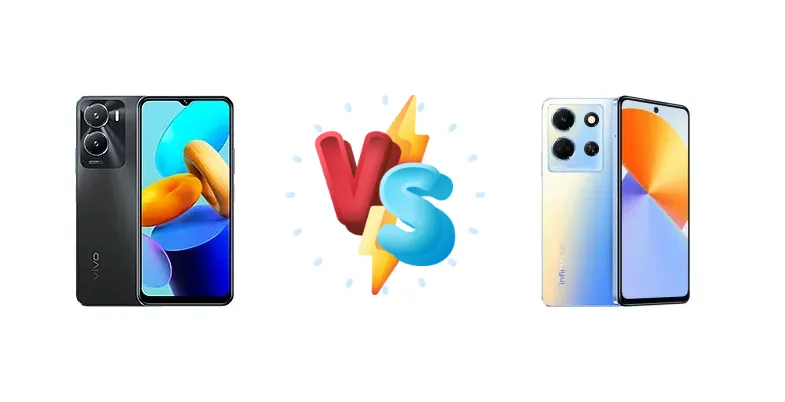
The sub-$200 5G smartphone market is fiercely competitive. Both the vivo Y35 5G and the Infinix Note 30 5G aim to deliver 5G connectivity and a modern smartphone experience without breaking the bank. However, they take different approaches – the Y35 5G focuses on established reliability, while the Note 30 5G pushes the boundaries with faster charging and a newer chipset. This comparison will dissect their strengths and weaknesses to determine which device offers the best value.
🏆 Quick Verdict
For the average user prioritizing fast charging and a brighter display, the Infinix Note 30 5G is the clear winner. Its 45W charging and 607 nits of brightness significantly outperform the vivo Y35 5G's 15W charging and unspecified display capabilities. However, the Y35 5G remains a viable option for those seeking a dependable device from a well-known brand.
| Network |
|---|
| 2G bands | GSM 850 / 900 / 1800 / 1900 | GSM 850 / 900 / 1800 / 1900 |
| 3G bands | HSDPA 850 / 900 / 2100 | HSDPA 850 / 900 / 1700(AWS) / 1900 / 2100 |
| 4G bands | 1, 3, 5, 8, 28, 34, 38, 39, 40, 41 | 1, 2, 3, 4, 5, 7, 8, 12, 17, 20, 28, 38, 40, 41, 66 |
| 5G bands | 1, 5, 8, 28, 41, 77, 78 SA/NSA | 1, 3, 5, 7, 8, 12, 22, 28, 38, 40, 41, 66, 77, 78 |
| Speed | HSPA, LTE, 5G | HSPA, LTE, 5G |
| Technology | GSM / CDMA / HSPA / CDMA2000 / LTE / 5G | GSM / HSPA / LTE / 5G |
| | CDMA2000 1x | - |
| Launch |
|---|
| Announced | 2022, December 09 | 2023, May 22 |
| Status | Available. Released 2022, December 09 | Available. Released 2023, May 22 |
| Body |
|---|
| Build | Glass front, plastic frame, plastic back | Glass front, plastic frame, glass or leather back |
| Dimensions | 164.1 x 75.6 x 8.2 mm (6.46 x 2.98 x 0.32 in) | 168.5 x 76.5 x 8.5 mm (6.63 x 3.01 x 0.33 in) |
| SIM | Nano-SIM + Nano-SIM | Nano-SIM + Nano-SIM |
| Weight | 186 g (6.56 oz) | 205 g (7.23 oz) |
| Display |
|---|
| Resolution | 720 x 1600 pixels, 20:9 ratio (~270 ppi density) | 1080 x 2460 pixels (~396 ppi density) |
| Size | 6.51 inches, 102.3 cm2 (~82.5% screen-to-body ratio) | 6.78 inches, 109.2 cm2 (~84.7% screen-to-body ratio) |
| Type | IPS LCD | IPS LCD, 120Hz, 580 nits (peak) |
| Platform |
|---|
| CPU | Octa-core (2x2.2 GHz Cortex-A76 & 6x2.0 GHz Cortex-A55) | Octa-core (2x2.4 GHz Cortex-A76 & 6x2.0 GHz Cortex-A55) |
| Chipset | Mediatek Dimensity 700 (7 nm) | Mediatek Dimensity 6080 (6 nm) |
| GPU | Mali-G57 MC2 | Mali-G57 MC2 |
| OS | Android 13, OriginOS Ocean | Android 13 |
| Memory |
|---|
| Card slot | microSDXC (dedicated slot) | microSDXC (dedicated slot) |
| Internal | 128GB 4GB RAM, 128GB 6GB RAM, 128GB 8GB RAM | 128GB 4GB RAM, 256GB 8GB RAM |
| | UFS 2.2 | - |
| Main Camera |
|---|
| Dual | 13 MP, f/2.2, (wide), AF
2 MP (macro) | - |
| Features | LED flash | Quad-LED flash, HDR, panorama |
| Single | 5 MP, f/1.8, (wide) | - |
| Triple | - | 108 MP, f/1.75, 26mm (wide), 1/1.67", 0.64µm, PDAF
Auxiliary lenses |
| Video | 1080p@30fps | 1440p@30fps, 1080p@30/60fps |
| Selfie camera |
|---|
| Features | HDR | Dual-LED flash, HDR |
| Single | 5 MP, f/1.8, (wide) | 16 MP, f/2.0, (wide) |
| Video | 1080p@30fps | 1080p@30fps |
| Sound |
|---|
| 3.5mm jack | Yes | - |
| 35mm jack | Yes | Yes |
| Loudspeaker | Yes | Yes, with dual speakers |
| Comms |
|---|
| Bluetooth | 5.2, A2DP, LE | Yes |
| NFC | No | Yes |
| Positioning | GPS, GLONASS, GALILEO, BDS, QZSS | GPS |
| Radio | No | FM radio |
| USB | USB Type-C 2.0, OTG | USB Type-C 2.0, OTG |
| WLAN | Wi-Fi 802.11 a/b/g/n/ac, dual-band | Wi-Fi 802.11 a/b/g/n/ac, dual-band, Wi-Fi Direct |
| Features |
|---|
| Sensors | Fingerprint (side-mounted), accelerometer, proximity, compass | Fingerprint (side-mounted), accelerometer, gyro, proximity, compass |
| Battery |
|---|
| Charging | 15W wired | 45W wired, bypass charging |
| Type | 5000 mAh | 5000 mAh |
| Misc |
|---|
| Colors | Gold, Black, Blue | Magic Black, Interstellar Blue, Sunset Gold |
| Models | V2230A | X6711 |
| Price | About 160 EUR | - |
vivo Y35 5G
- Reliable brand reputation (vivo)
- Established software experience
- Affordable price point
- Slow 15W charging
- Likely lower display brightness
- Older Dimensity 700 chipset
Infinix Note 30 5G
- Fast 45W charging with bypass charging
- Brighter 607 nits display
- More efficient Dimensity 6080 chipset
- Less established brand (Infinix)
- Software experience may vary
- Potential for more bloatware
Display Comparison
The Infinix Note 30 5G boasts a significant advantage in display technology. While the vivo Y35 5G’s display specifications are unavailable, the Note 30 5G’s measured 607 nits of peak brightness ensures excellent visibility outdoors, a crucial benefit for users who frequently use their phones in bright environments. Furthermore, the 1521:1 contrast ratio on the Infinix Note 30 5G suggests deeper blacks and more vibrant colors, enhancing the overall viewing experience. The lack of detailed display specs for the Y35 5G suggests a more basic panel, likely with lower brightness and contrast.
Camera Comparison
Without detailed camera specifications for either device, a direct comparison is challenging. However, given the market segment, it’s safe to assume both phones prioritize affordability over cutting-edge camera technology. The presence of a 2MP macro camera on both devices is likely a marketing feature with limited real-world utility. Image quality will likely depend more on software processing than sensor size or lens quality. Users shouldn't expect flagship-level photography from either device, but the Note 30 5G’s newer chipset *may* offer slightly improved image processing capabilities.
Performance
Both phones utilize Mediatek Dimensity chipsets, but the Infinix Note 30 5G’s Dimensity 6080 (6nm) represents a generational leap over the vivo Y35 5G’s Dimensity 700 (7nm). The 6nm process node is more efficient, leading to better thermal management and potentially sustained performance during extended gaming sessions. While both CPUs share the same core configuration (2x2.4/2.2 GHz Cortex-A76 & 6x2.0 GHz Cortex-A55), the higher clock speeds on the Note 30 5G’s CPU, combined with the more efficient chipset, translate to snappier app launches and smoother multitasking. The Y35 5G will handle everyday tasks adequately, but the Note 30 5G offers a noticeable performance edge.
Battery Life
The Infinix Note 30 5G’s 45W wired charging is a game-changer in this price bracket. This allows for significantly faster charging times compared to the vivo Y35 5G’s 15W charging. The Note 30 5G also features bypass charging, allowing the phone to be powered directly from the charger while in use, minimizing battery strain during gaming or other intensive tasks. While battery capacity isn’t specified for either device, the faster charging speed of the Note 30 5G effectively mitigates any potential capacity disadvantage.
Buying Guide
Buy the vivo Y35 5G if you need a reliable, no-frills 5G experience from a trusted brand and aren't concerned with rapid charging or a particularly vibrant display. Buy the Infinix Note 30 5G if you prioritize fast 45W charging with bypass charging, a brighter and more visible screen in sunlight, and a slightly more modern chipset for improved performance in demanding tasks.
Frequently Asked Questions
❓ Does the Infinix Note 30 5G’s Dimensity 6080 chipset get hot during prolonged gaming sessions?
The Dimensity 6080’s 6nm process node is more efficient than the Dimensity 700 in the vivo Y35 5G, meaning it generates less heat under load. While some throttling is inevitable during extended gaming, the Note 30 5G is likely to maintain higher sustained performance due to its improved thermal efficiency. The bypass charging feature also helps by powering the device directly, reducing battery-related heat.
❓ Is the 15W charging on the vivo Y35 5G noticeably slow compared to the Infinix Note 30 5G?
Yes, the difference is substantial. 15W charging will take significantly longer to fully charge the vivo Y35 5G compared to the Infinix Note 30 5G’s 45W charging. Expect a 0-100% charge to take well over two hours on the Y35 5G, while the Note 30 5G can achieve a full charge in around an hour or less.
❓ How does the software experience differ between vivo’s Funtouch OS and Infinix’s XOS?
Vivo’s Funtouch OS is generally considered more polished and refined, with a focus on customization and user-friendliness. Infinix’s XOS, while improving, has historically been criticized for pre-installed bloatware and a less intuitive interface. However, XOS offers a range of features and customization options, and recent updates have addressed some of the earlier concerns.