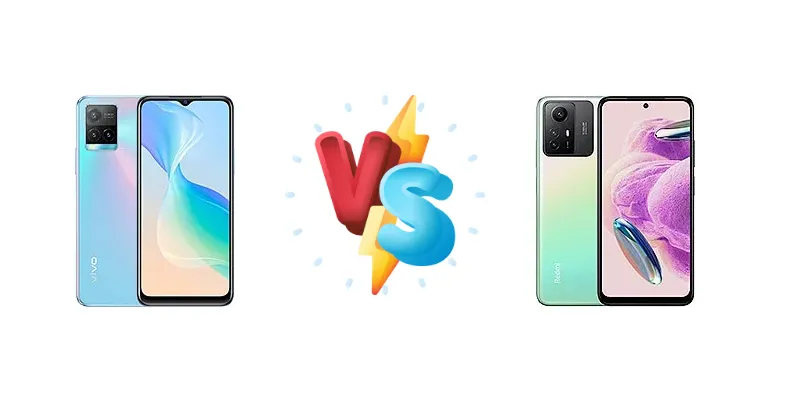
The mid-range smartphone market is fiercely competitive, and the vivo Y33t and Xiaomi Redmi Note 12S are two strong contenders vying for your attention. Both offer compelling features at accessible prices, but which one truly comes out on top? Let's dive into a detailed comparison to help you decide.
🏆 Quick Verdict
The Xiaomi Redmi Note 12S edges out the vivo Y33t thanks to its faster charging, slightly better performance, and generally more modern features. While the Y33t has reverse charging, the Note 12S provides a more well-rounded experience for most users.
| Network |
|---|
| 2G bands | GSM 850 / 900 / 1800 / 1900 | GSM 850 / 900 / 1800 / 1900 |
| 3G bands | HSDPA 850 / 900 / 2100 | HSDPA 850 / 900 / 2100 |
| 4G bands | 1, 3, 5, 8, 38, 40, 41 | 1, 3, 5, 7, 8, 20, 28, 38, 40, 41 |
| Speed | HSPA, LTE | HSPA, LTE |
| Technology | GSM / HSPA / LTE | GSM / HSPA / LTE |
| Launch |
|---|
| Announced | 2022, January 11 | 2023, March 06 |
| Status | Available. Released 2022, January 11 | Available. Released 2023, April 26 |
| Body |
|---|
| Build | Glass front, plastic frame, plastic back | - |
| Dimensions | 164.3 x 76.1 x 8 mm (6.47 x 3.00 x 0.31 in) | 159.9 x 73.9 x 8.1 mm (6.30 x 2.91 x 0.32 in) |
| SIM | Nano-SIM + Nano-SIM | Nano-SIM + Nano-SIM |
| Weight | 182 g (6.42 oz) | 176 g (6.21 oz) |
| Display |
|---|
| Resolution | 1080 x 2408 pixels, 20:9 ratio (~401 ppi density) | 1080 x 2400 pixels, 20:9 ratio (~409 ppi density) |
| Size | 6.58 inches, 104.3 cm2 (~83.4% screen-to-body ratio) | 6.43 inches, 99.8 cm2 (~84.5% screen-to-body ratio) |
| Type | IPS LCD | AMOLED, 90Hz, 700 nits (HBM), 1000 nits (peak) |
| Platform |
|---|
| CPU | Octa-core (4x2.4 GHz Kryo 265 Gold & 4x1.9 GHz Kryo 265 Silver) | Octa-core (2x2.05 GHz Cortex-A76 & 6x2.0 GHz Cortex-A55) |
| Chipset | Qualcomm SM6225 Snapdragon 680 4G (6 nm) | Mediatek MT6781 Helio G96 (12 nm) |
| GPU | Adreno 610 | Mali-G57 MC2 |
| OS | Android 11, Funtouch 12 | Android 13, MIUI 14 |
| Memory |
|---|
| Card slot | microSDXC (dedicated slot) | microSDXC (dedicated slot) |
| Internal | 128GB 6GB RAM, 128GB 8GB RAM | 64GB 6GB RAM, 128GB 6GB RAM, 256GB 8GB RAM |
| Main Camera |
|---|
| Features | LED flash | LED flash, HDR, panorama |
| Single | 16 MP, f/2.0, (wide) | - |
| Triple | 50 MP, f/1.8, (wide), PDAF
2 MP (macro)
Auxiliary lens | 108 MP, f/1.9, (wide), 1/1.52", 0.7µm, PDAF
8 MP, f/2.2, 118˚ (ultrawide), 1/4.0", 1.12µm
2 MP (macro) |
| Video | 1080p@30fps | 1080p@30fps |
| Selfie camera |
|---|
| Features | HDR | - |
| Single | 16 MP, f/2.0, (wide) | 16 MP, f/2.4, (wide) |
| Video | 1080p@30fps | 1080p@30fps |
| Sound |
|---|
| 3.5mm jack | Yes | Yes |
| 35mm jack | Yes | Yes |
| Loudspeaker | Yes | Yes, with stereo speakers |
| Comms |
|---|
| Bluetooth | 5.0, A2DP, LE | 5.2, A2DP, LE |
| Infrared port | - | Yes |
| NFC | No | Yes (market/region dependent) |
| Positioning | GPS, GLONASS, GALILEO, BDS, QZSS | GPS (L1), GLONASS (G1), GALILEO (E1), BDS (B1) |
| Radio | FM radio | Stereo FM radio, recording |
| USB | USB Type-C 2.0, OTG | USB Type-C 2.0 |
| WLAN | Wi-Fi 802.11 a/b/g/n/ac, dual-band, Wi-Fi Direct | Wi-Fi 802.11 a/b/g/n/ac, dual-band |
| Features |
|---|
| Sensors | Fingerprint (side-mounted), accelerometer, proximity, compass | Fingerprint (side-mounted), accelerometer, gyro, proximity, compass |
| Battery |
|---|
| Charging | 18W wired
2.5W reverse wired | 33W wired |
| Type | 5000 mAh | Li-Po 5000 mAh |
| Misc |
|---|
| Colors | Mirror Black, Midday Dream | Onyx Black, Ice Blue, Pearl Green |
| Models | - | 2303CRA44A, 23030RAC7Y, 2303ERA42L |
| Price | About 230 EUR | € 122.47 / $ 149.99 / £ 229.89 |
vivo Y33t
- Reverse wired charging
- Compact design
- Decent battery life
- Good value for money
- Slower charging speed
- Less powerful chipset
- IPS LCD display
- 60Hz refresh rate
Xiaomi Redmi Note 12S
- Faster charging (33W)
- AMOLED display (90Hz)
- More powerful chipset
- 108MP main camera
- Brighter display
- No reverse charging
- Design may not appeal to everyone
- 12nm process
Display Comparison
The Redmi Note 12S boasts a 6.43-inch AMOLED display with a 90Hz refresh rate, offering vibrant colors and smooth scrolling. The Y33t features a 6.58-inch IPS LCD display with a 60Hz refresh rate. The AMOLED panel on the Redmi Note 12S provides a significantly better viewing experience, especially for multimedia consumption.
Camera Comparison
The Redmi Note 12S features a 108MP main camera, offering impressive detail and dynamic range. The Y33t has a 50MP main camera. While both take decent photos, the Note 12S generally produces better results, especially in challenging lighting conditions. Both phones offer decent selfie cameras.
Performance
The Snapdragon 680 in the Y33t is efficient but not particularly powerful. The Helio G96 in the Redmi Note 12S offers a noticeable performance boost, handling everyday tasks and moderate gaming with greater ease. While both are capable, the Note 12S provides a smoother overall experience.
Battery Life
Both phones have a 5000mAh battery, providing all-day battery life. However, the Redmi Note 12S's 33W fast charging significantly reduces charging times compared to the Y33t's 18W charging. The Y33t's 2.5W reverse charging is a niche feature.
Buying Guide
Who should buy the vivo Y33t? Users prioritizing reverse charging and a slightly more compact design might find the Y33t appealing. Who should buy the Xiaomi Redmi Note 12S? Those seeking faster charging, a brighter display, and a more powerful chipset for smoother performance will likely prefer the Redmi Note 12S.
Frequently Asked Questions
❓ Is the vivo Y33t good for gaming?
The Y33t can handle casual games, but demanding titles may experience lag. The Redmi Note 12S is a better choice for gamers.
❓ Which phone has better battery life?
Both offer similar battery life, but the Redmi Note 12S charges much faster.
❓ Does the Redmi Note 12S support 5G?
No, neither the vivo Y33t nor the Xiaomi Redmi Note 12S support 5G connectivity.