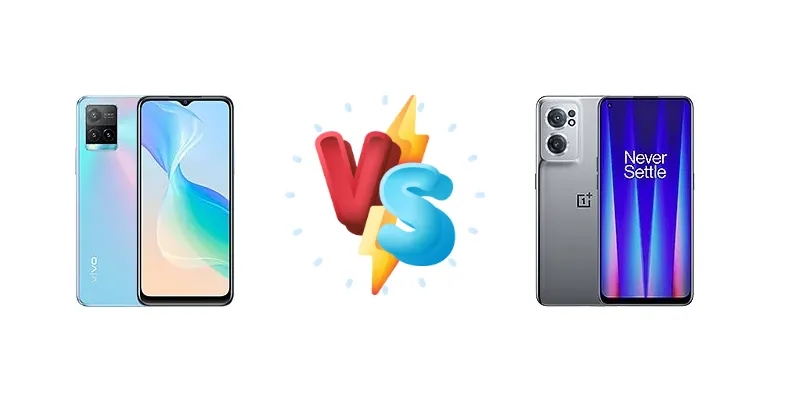
The sub-$250 smartphone market is fiercely competitive. The vivo Y33t and OnePlus Nord CE 2 5G both aim to deliver 5G connectivity and a solid user experience without breaking the bank. However, they take different approaches – the Y33t prioritizes efficiency with a Snapdragon 680, while the Nord CE 2 5G opts for more raw power with a MediaTek Dimensity 900. This comparison dissects these choices to determine which phone offers the best value.
🏆 Quick Verdict
For the average user prioritizing fast charging and a more powerful processor for demanding tasks, the OnePlus Nord CE 2 5G is the clear winner. Its 65W charging dramatically reduces downtime, and the Dimensity 900 offers a noticeable performance edge over the Snapdragon 680, making it better suited for gaming and multitasking.
| Network |
|---|
| 2G bands | GSM 850 / 900 / 1800 / 1900 | GSM 850 / 900 / 1800 / 1900 |
| 3G bands | HSDPA 850 / 900 / 2100 | HSDPA 850 / 900 / 1700(AWS) / 1900 / 2100 |
| 4G bands | 1, 3, 5, 8, 38, 40, 41 | 1, 2, 3, 4, 5, 7, 8, 12, 17, 18, 19, 20, 26, 28, 38, 39, 40, 41, 66 - Europe |
| 5G bands | - | 1, 3, 5, 7, 8, 20, 28, 38, 40, 41, 66, 77, 78 SA/NSA - Europe |
| Speed | HSPA, LTE | HSPA 42.2/5.76 Mbps, LTE Cat18 1200/150 Mbps, 5G |
| Technology | GSM / HSPA / LTE | GSM / HSPA / LTE / 5G |
| | - | 1, 3, 5, 8, 40, 41, 77, 78 SA/NSA - India |
| Launch |
|---|
| Announced | 2022, January 11 | 2022, February 17 |
| Status | Available. Released 2022, January 11 | Available. Released 2022, February 22 |
| Body |
|---|
| Build | Glass front, plastic frame, plastic back | - |
| Dimensions | 164.3 x 76.1 x 8 mm (6.47 x 3.00 x 0.31 in) | 160.6 x 73.2 x 7.8 mm (6.32 x 2.88 x 0.31 in) |
| SIM | Nano-SIM + Nano-SIM | Nano-SIM + Nano-SIM |
| Weight | 182 g (6.42 oz) | 173 g (6.10 oz) |
| Display |
|---|
| Protection | - | Corning Gorilla Glass 5 |
| Resolution | 1080 x 2408 pixels, 20:9 ratio (~401 ppi density) | 1080 x 2400 pixels, 20:9 ratio (~409 ppi density) |
| Size | 6.58 inches, 104.3 cm2 (~83.4% screen-to-body ratio) | 6.43 inches, 99.8 cm2 (~84.9% screen-to-body ratio) |
| Type | IPS LCD | AMOLED, 90Hz, HDR10+ |
| Platform |
|---|
| CPU | Octa-core (4x2.4 GHz Kryo 265 Gold & 4x1.9 GHz Kryo 265 Silver) | Octa-core (2x2.4 GHz Cortex-A78 & 6x2.0 GHz Cortex-A55) |
| Chipset | Qualcomm SM6225 Snapdragon 680 4G (6 nm) | Mediatek Dimensity 900 (6 nm) |
| GPU | Adreno 610 | Mali-G68 MC4 |
| OS | Android 11, Funtouch 12 | Android 11, upgradable to Android 13, OxygenOS 13 |
| Memory |
|---|
| Card slot | microSDXC (dedicated slot) | microSDXC (dedicated slot) |
| Internal | 128GB 6GB RAM, 128GB 8GB RAM | 128GB 6GB RAM, 128GB 8GB RAM |
| | - | UFS 2.2 |
| Main Camera |
|---|
| Features | LED flash | LED flash, HDR, panorama |
| Single | 16 MP, f/2.0, (wide) | 16 MP, f/2.4, 27mm (wide), 1.0µm |
| Triple | 50 MP, f/1.8, (wide), PDAF
2 MP (macro)
Auxiliary lens | 64 MP, f/1.8, 26mm (wide), 1/1.97", 0.7µm, PDAF
8 MP, f/2.2, 119˚ (ultrawide)
2 MP (macro) |
| Video | 1080p@30fps | 4K@30fps, 1080p@30/60/120fps, gyro-EIS |
| Selfie camera |
|---|
| Features | HDR | HDR |
| Single | 16 MP, f/2.0, (wide) | 16 MP, f/2.4, 27mm (wide), 1.0µm |
| Video | 1080p@30fps | 1080p@30/60fps, gyro-EIS |
| Sound |
|---|
| 3.5mm jack | Yes | Yes |
| 35mm jack | Yes | Yes |
| Loudspeaker | Yes | Yes |
| Comms |
|---|
| Bluetooth | 5.0, A2DP, LE | 5.2, A2DP, LE, aptX HD |
| NFC | No | Yes |
| Positioning | GPS, GLONASS, GALILEO, BDS, QZSS | GPS, GLONASS, GALILEO, BDS, QZSS |
| Radio | FM radio | Unspecified |
| USB | USB Type-C 2.0, OTG | USB Type-C 2.0, OTG |
| WLAN | Wi-Fi 802.11 a/b/g/n/ac, dual-band, Wi-Fi Direct | Wi-Fi 802.11 a/b/g/n/ac/6, dual-band, Wi-Fi Direct |
| Features |
|---|
| Sensors | Fingerprint (side-mounted), accelerometer, proximity, compass | Fingerprint (under display, optical), accelerometer, gyro, proximity, compass |
| Battery |
|---|
| Charging | 18W wired
2.5W reverse wired | 65W wired |
| Type | 5000 mAh | Li-Po 4500 mAh |
| Misc |
|---|
| Colors | Mirror Black, Midday Dream | Gray Mirror, Bahama Blue |
| Models | - | IV2201 |
| Price | About 230 EUR | £ 99.00 / € 182.18 |
vivo Y33t
- Potentially better battery life due to Snapdragon 680 efficiency.
- More affordable price point.
- Reverse wired charging capability.
- Significantly slower charging speed (18W).
- Less powerful processor for demanding tasks.
OnePlus Nord CE 2 5G
- Much faster 65W charging.
- More powerful MediaTek Dimensity 900 processor.
- Better performance for gaming and multitasking.
- Potentially shorter battery life compared to the Y33t.
- Slightly higher price.
Display Comparison
Neither device boasts a standout display. While specific panel details (like peak brightness or color gamut coverage) are absent, both operate at 6nm, suggesting similar power efficiency. The focus here isn't on visual fidelity, but on functional usability. Bezels are likely comparable given the price point, and both will likely utilize IPS LCD panels, prioritizing cost-effectiveness over OLED vibrancy.
Camera Comparison
Without detailed sensor information, a direct camera comparison is difficult. However, the market segment suggests both phones will feature a primary sensor paired with auxiliary lenses of limited utility. The aperture and sensor size of the main camera will be the key differentiators. We can assume the Nord CE 2 5G, being positioned slightly higher, may have a larger sensor, capturing more light and resulting in better low-light performance. Image processing algorithms will also play a role, and OnePlus generally offers more refined software processing.
Performance
The core difference lies in the chipsets. The OnePlus Nord CE 2 5G’s MediaTek Dimensity 900, with its 2x Cortex-A78 performance cores clocked at 2.4 GHz, offers a significant advantage in CPU-intensive tasks compared to the vivo Y33t’s Snapdragon 680. The Snapdragon 680 utilizes 4x Kryo 265 Gold cores at the same 2.4 GHz, but the architecture is less performant than the Cortex-A78. The Dimensity 900 also benefits from a more modern GPU, translating to better gaming performance. While both are 6nm chips, the Dimensity 900’s superior core design and GPU give it a clear edge. The Y33t will be sufficient for basic tasks, but the Nord CE 2 5G will handle multitasking and demanding apps with greater ease.
Battery Life
The vivo Y33t’s 18W charging is significantly slower than the OnePlus Nord CE 2 5G’s 65W SuperVOOC charging. While battery capacity isn’t specified, the charging speed difference is substantial. The Nord CE 2 5G can likely go from 0-100% in under 40 minutes, while the Y33t will take well over an hour. This difference is crucial for users who value convenience and minimal downtime. The Snapdragon 680’s efficiency might offset the slower charging somewhat, providing comparable overall battery life, but the Nord CE 2 5G’s rapid charging is a major advantage.
Buying Guide
Buy the vivo Y33t if you need a reliable, long-lasting phone for everyday tasks like calling, texting, and social media, and value battery efficiency over peak performance. It’s ideal for users who don’t heavily game or run demanding applications. Buy the OnePlus Nord CE 2 5G if you prefer a phone that can handle more intensive workloads, such as gaming or video editing, and appreciate the convenience of incredibly fast 65W charging, even if it means slightly reduced battery life.
Frequently Asked Questions
❓ Is the MediaTek Dimensity 900 in the OnePlus Nord CE 2 5G prone to overheating during extended gaming sessions?
While the Dimensity 900 is a capable processor, sustained high loads can generate heat. However, OnePlus typically implements thermal management solutions to mitigate throttling. Real-world performance will depend on ambient temperature and game settings, but it's generally well-controlled for the price point.
❓ Does the Snapdragon 680 in the vivo Y33t support VoLTE and VoWiFi for improved call quality?
The Snapdragon 680 does support VoLTE (Voice over LTE) and VoWiFi (Voice over Wi-Fi), but carrier compatibility is crucial. Ensure your mobile carrier supports these features on the vivo Y33t to experience improved call quality and network connectivity.
❓ How does the 18W charging on the vivo Y33t compare to typical power banks?
The 18W charging is relatively slow compared to modern fast charging standards. Many power banks offer 22.5W or higher output, meaning a compatible power bank could actually charge the Y33t *faster* than its included charger.