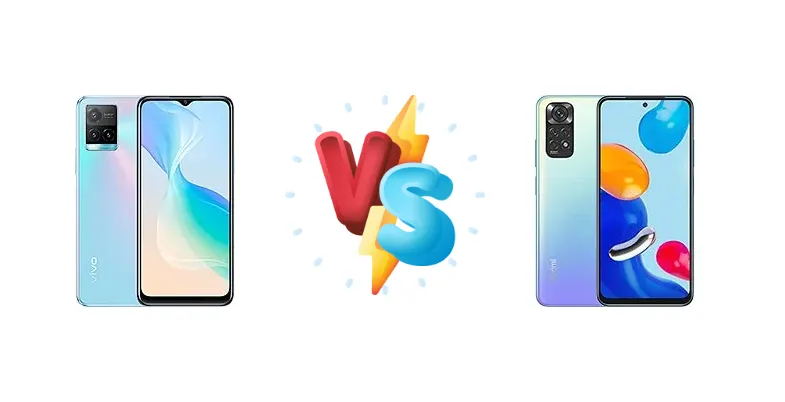
The budget smartphone market is fiercely competitive, offering incredible value for money. Today, we're pitting two popular contenders against each other: the vivo Y33s and the Xiaomi Redmi Note 11. Both promise a solid experience, but which one truly comes out on top?
🏆 Quick Verdict
The Xiaomi Redmi Note 11 edges out the vivo Y33s thanks to its faster charging, brighter display, and more efficient chipset. While the Y33s offers reverse charging, the Redmi Note 11's overall package provides a more compelling experience for most users.
| Network |
|---|
| 2G bands | GSM 850 / 900 / 1800 / 1900 | GSM 850 / 900 / 1800 / 1900 |
| 3G bands | HSDPA 850 / 900 / 2100 | HSDPA 850 / 900 / 1700(AWS) / 1900 / 2100 |
| 4G bands | 1, 3, 5, 8, 38, 40, 41 | 1, 2, 3, 4, 5, 7, 8, 20, 28, 38, 40, 41 |
| Speed | HSPA, LTE | HSPA, LTE |
| Technology | GSM / HSPA / LTE | GSM / HSPA / LTE |
| Launch |
|---|
| Announced | 2021, August 24 | 2022, January 26 |
| Status | Available. Released 2021, August 24 | Available. Released 2022, February 09 |
| Body |
|---|
| Dimensions | 164.3 x 76.1 x 8 mm (6.47 x 3.00 x 0.31 in) | 159.9 x 73.9 x 8.1 mm (6.30 x 2.91 x 0.32 in) |
| SIM | Nano-SIM + Nano-SIM | Nano-SIM + Nano-SIM |
| Weight | 182 g (6.42 oz) | 179 g (6.31 oz) |
| | - | IP53, dust and splash resistant |
| Display |
|---|
| Protection | - | Corning Gorilla Glass 3 |
| Resolution | 1080 x 2408 pixels, 20:9 ratio (~401 ppi density) | 1080 x 2400 pixels, 20:9 ratio (~409 ppi density) |
| Size | 6.58 inches, 104.3 cm2 (~83.4% screen-to-body ratio) | 6.43 inches, 99.8 cm2 (~84.5% screen-to-body ratio) |
| Type | IPS LCD | AMOLED, 90Hz, 700 nits, 1000 nits (peak) |
| Platform |
|---|
| CPU | Octa-core (2x2.0 GHz Cortex-A75 & 6x1.8 GHz Cortex-A55) | Octa-core (4x2.4 GHz Kryo 265 Gold & 4x1.9 GHz Kryo 265 Silver) |
| Chipset | Mediatek MT6769V/CU Helio G80 (12 nm) | Qualcomm SM6225 Snapdragon 680 4G (6 nm) |
| GPU | Mali-G52 MC2 | Adreno 610 |
| OS | Android 11, Funtouch 11.1 | Android 11, upgradable to Android 13, HyperOS |
| Memory |
|---|
| Card slot | microSDXC (dedicated slot) | microSDXC (dedicated slot) |
| Internal | 64GB 4GB RAM, 128GB 4GB RAM, 128GB 8GB RAM | 64GB 4GB RAM, 64GB 6GB RAM, 128GB 4GB RAM, 128GB 6GB RAM |
| | - | UFS 2.2 |
| Main Camera |
|---|
| Dual | 50 MP, f/1.8, (wide), PDAF
2 MP (macro)
Auxiliary lens | - |
| Features | LED flash | LED flash, HDR, panorama |
| Quad | - | 50 MP, f/1.8, 26mm (wide), 1/2.76", 0.64µm, PDAF
8 MP, f/2.2, 118˚ (ultrawide), 1/4.0", 1.12µm
2 MP (macro)
Auxiliary lens |
| Single | 16 MP, f/2.0, (wide) | 13 MP, f/2.4, (wide), 1/3.1", 1.12µm |
| Video | 1080p@30fps | 1080p@30fps |
| Selfie camera |
|---|
| Single | 16 MP, f/2.0, (wide) | 13 MP, f/2.4, (wide), 1/3.1", 1.12µm |
| Video | 1080p@30fps | 1080p@30fps |
| Sound |
|---|
| 3.5mm jack | Yes | Yes |
| 35mm jack | Yes | Yes |
| Loudspeaker | Yes | Yes, with stereo speakers |
| | - | 24-bit/192kHz audio |
| Comms |
|---|
| Bluetooth | 5.0, A2DP, LE | 5.0, A2DP, LE |
| Infrared port | - | Yes |
| NFC | Yes | Yes (market/region dependent) |
| Positioning | GPS, GLONASS, GALILEO, BDS | GPS, GLONASS, BDS, GALILEO |
| Radio | FM radio | FM radio |
| USB | USB Type-C 2.0, OTG | USB Type-C 2.0, OTG |
| WLAN | Wi-Fi 802.11 a/b/g/n/ac, dual-band, Wi-Fi Direct | Wi-Fi 802.11 a/b/g/n/ac, dual-band, Wi-Fi Direct |
| Features |
|---|
| Sensors | Fingerprint (side-mounted), accelerometer, gyro, proximity, compass | Fingerprint (side-mounted), accelerometer, gyro, compass |
| | - | Virtual proximity sensing |
| Battery |
|---|
| Charging | 18W wired
5W reverse wired | 33W wired, PD3.0, QC3, 100% in 60 min |
| Type | 5000 mAh | Li-Po 5000 mAh |
| Misc |
|---|
| Colors | Mirror Black, Midday Dream | Graphite Gray, Twilight Blue, Star Blue |
| Models | V2109 | 2201117TG, 2201117TI, 2201117TY, 2201117TL |
| Price | About 210 EUR | £ 95.00 / € 97.99 / ₹ 11,950 |
| SAR | - | 0.97 W/kg (head) 0.93 W/kg (body) |
| SAR EU | - | 0.60 W/kg (head) 0.99 W/kg (body) |
| Tests |
|---|
| Battery life | - |
Endurance rating 126h
|
| Camera | - |
Photo / Video |
| Display | - |
Contrast ratio: Infinite (nominal) |
| Loudspeaker | - |
-25.8 LUFS (Very good)
|
| Performance | - |
AnTuTu: 228044 (v8), 244526 (v9)
GeekBench: 1662 (v5.1)
GFXBench: 6.8fps (ES 3.1 onscreen) |
vivo Y33s
- Reverse wired charging
- Slightly more compact design
- Decent performance for everyday tasks
- Slower charging speed
- Less bright display
- Older chipset
Xiaomi Redmi Note 11
- Faster 33W charging
- Brighter AMOLED display
- More efficient Snapdragon 680 chipset
- Excellent battery life
- Design may not appeal to everyone
- No expandable storage (depending on variant)
Display Comparison
The Redmi Note 11 boasts a significantly brighter display (736 nits vs unspecified for Y33s), making it easier to see in direct sunlight. While both offer decent color reproduction, the Redmi Note 11's contrast ratio (infinite nominal) suggests deeper blacks and better overall image quality. The Y33s likely has a standard LCD panel, while the Redmi Note 11 uses an AMOLED panel.
Camera Comparison
Both phones offer capable camera systems for their price range. The Redmi Note 11 likely has a slight advantage in image processing and low-light performance due to the Snapdragon 680's ISP. Specific camera specs (megapixels, aperture) are needed for a more precise comparison, but initial impressions suggest the Redmi Note 11 delivers slightly better results.
Performance
The Snapdragon 680 in the Redmi Note 11, built on a 6nm process, is generally more efficient and offers better performance than the Helio G80 in the Y33s (12nm). Expect smoother multitasking and slightly faster app loading times on the Redmi Note 11. Both phones handle everyday tasks well, but the Redmi Note 11 has a noticeable edge in demanding scenarios.
Battery Life
Both phones offer excellent battery life, with an endurance rating of 126 hours. However, the Redmi Note 11's 33W fast charging is a significant advantage over the Y33s' 18W charging. The Redmi Note 11 can be fully charged in approximately 60 minutes, while the Y33s will take considerably longer.
Buying Guide
The vivo Y33s is a good choice for users prioritizing reverse charging and a slightly more compact design. The Xiaomi Redmi Note 11 is ideal for those seeking faster charging, a brighter display for outdoor visibility, and a more modern chipset for smoother performance.
Frequently Asked Questions
❓ Does the vivo Y33s have 5G?
No, the vivo Y33s is a 4G smartphone.
❓ Is the Xiaomi Redmi Note 11 expandable?
Some variants of the Redmi Note 11 offer microSD card expansion, while others do not. Check the specific model you are purchasing.
❓ Which phone has better gaming performance?
The Xiaomi Redmi Note 11 generally offers better gaming performance due to its more modern and efficient chipset.