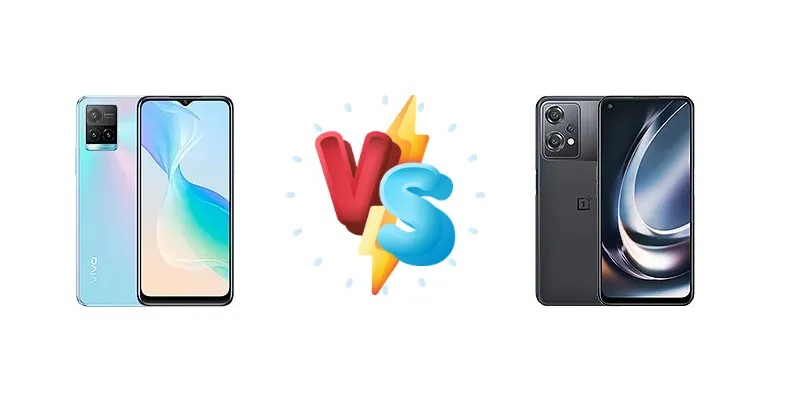
The sub-$250 smartphone market is fiercely competitive. The vivo Y33s, with its focus on affordability, goes head-to-head with the OnePlus Nord CE 2 Lite 5G, which prioritizes 5G connectivity and faster charging. This comparison dissects the key differences to determine which device delivers the best value for your money.
🏆 Quick Verdict
For most users, the OnePlus Nord CE 2 Lite 5G is the superior choice. Its Snapdragon 695 chipset, built on a more efficient 6nm process, provides a noticeable performance boost and future-proofs the device with 5G support. While the Y33s offers a slightly more mature software experience, the Nord CE 2 Lite’s 33W charging significantly reduces downtime.
| Network |
|---|
| 2G bands | GSM 850 / 900 / 1800 / 1900 | GSM 850 / 900 / 1800 / 1900 |
| 3G bands | HSDPA 850 / 900 / 2100 | HSDPA 800 / 850 / 900 / 1700(AWS) / 1900 / 2100 |
| 4G bands | 1, 3, 5, 8, 38, 40, 41 | 1, 2, 3, 4, 5, 7, 8, 12, 13, 17, 18, 19, 20, 26, 28, 38, 39, 40, 41, 66 - Europe |
| 5G bands | - | 1, 3, 5, 7, 8, 20, 28, 38, 40, 41, 66, 77, 78 SA/NSA - Europe |
| Speed | HSPA, LTE | HSPA, LTE, 5G |
| Technology | GSM / HSPA / LTE | GSM / HSPA / LTE / 5G |
| Launch |
|---|
| Announced | 2021, August 24 | 2022, April 28 |
| Status | Available. Released 2021, August 24 | Available. Released 2022, April 30 |
| Body |
|---|
| Build | - | Glass front, plastic frame, plastic back |
| Dimensions | 164.3 x 76.1 x 8 mm (6.47 x 3.00 x 0.31 in) | 164.3 x 75.6 x 8.5 mm (6.47 x 2.98 x 0.33 in) |
| SIM | Nano-SIM + Nano-SIM | Nano-SIM + Nano-SIM |
| Weight | 182 g (6.42 oz) | 195 g (6.88 oz) |
| Display |
|---|
| Resolution | 1080 x 2408 pixels, 20:9 ratio (~401 ppi density) | 1080 x 2412 pixels, 20:9 ratio (~401 ppi density) |
| Size | 6.58 inches, 104.3 cm2 (~83.4% screen-to-body ratio) | 6.59 inches, 104.5 cm2 (~84.1% screen-to-body ratio) |
| Type | IPS LCD | IPS LCD, 120Hz |
| Platform |
|---|
| CPU | Octa-core (2x2.0 GHz Cortex-A75 & 6x1.8 GHz Cortex-A55) | Octa-core (2x2.2 GHz Kryo 660 Gold & 6x1.7 GHz Kryo 660 Silver) |
| Chipset | Mediatek MT6769V/CU Helio G80 (12 nm) | Qualcomm SM6375 Snapdragon 695 5G (6 nm) |
| GPU | Mali-G52 MC2 | Adreno 619 |
| OS | Android 11, Funtouch 11.1 | Android 12, upgradable to Android 13, OxygenOS 13 |
| Memory |
|---|
| Card slot | microSDXC (dedicated slot) | microSDXC (uses shared SIM slot) |
| Internal | 64GB 4GB RAM, 128GB 4GB RAM, 128GB 8GB RAM | 128GB 6GB RAM, 128GB 8GB RAM |
| Main Camera |
|---|
| Dual | 50 MP, f/1.8, (wide), PDAF
2 MP (macro)
Auxiliary lens | - |
| Features | LED flash | LED flash, HDR, panorama |
| Single | 16 MP, f/2.0, (wide) | - |
| Triple | - | 64 MP, f/1.7, 26mm (wide), 0.7µm, PDAF
2 MP (macro)
Auxiliary lens |
| Video | 1080p@30fps | 1080p@30fps |
| Selfie camera |
|---|
| Features | - | HDR |
| Single | 16 MP, f/2.0, (wide) | 16 MP, f/2.0, (wide), 1/3.0", 1.0µm |
| Video | 1080p@30fps | 1080p@30fps |
| Sound |
|---|
| 3.5mm jack | Yes | Yes |
| 35mm jack | Yes | Yes |
| Loudspeaker | Yes | Yes |
| Comms |
|---|
| Bluetooth | 5.0, A2DP, LE | 5.2, A2DP, LE, aptX HD |
| NFC | Yes | Yes (market/region dependent) |
| Positioning | GPS, GLONASS, GALILEO, BDS | GPS, GLONASS, GALILEO, BDS, QZSS |
| Radio | FM radio | Unspecified |
| USB | USB Type-C 2.0, OTG | USB Type-C 2.0, OTG |
| WLAN | Wi-Fi 802.11 a/b/g/n/ac, dual-band, Wi-Fi Direct | Wi-Fi 802.11 a/b/g/n/ac, dual-band, Wi-Fi Direct |
| Features |
|---|
| Sensors | Fingerprint (side-mounted), accelerometer, gyro, proximity, compass | Fingerprint (side-mounted), accelerometer, gyro, proximity, compass |
| Battery |
|---|
| Charging | 18W wired
5W reverse wired | 33W wired |
| Type | 5000 mAh | Li-Po 5000 mAh |
| Misc |
|---|
| Colors | Mirror Black, Midday Dream | Black Dusk, Blue Tide |
| Models | V2109 | CPH2381, CPH2409 |
| Price | About 210 EUR | About 220 EUR |
| SAR | - | 1.19 W/kg (head) 0.71 W/kg (body) |
vivo Y33s
- Potentially more refined software experience (based on vivo’s history)
- Reverse wired charging for accessory top-ups
- Generally lower price point
- Less powerful and less efficient Helio G80 chipset
- Slower 18W charging
- No 5G connectivity
OnePlus Nord CE 2 Lite 5G
- Faster and more efficient Snapdragon 695 chipset
- Significantly faster 33W charging
- 5G connectivity for future-proofing
- More capable ISP for improved image processing
- OxygenOS (OnePlus’s software) can be more prone to updates and changes
- Potentially slightly higher price
Display Comparison
Neither device boasts a standout display. Both likely utilize LCD panels, a common trait in this price bracket. However, detailed display specs (resolution, brightness, color gamut) are missing. The focus here shifts to processing power, as display quality is unlikely to be a major differentiator. Bezels are expected to be comparable, reflecting the budget nature of both phones.
Camera Comparison
Without detailed camera sensor information, a direct comparison is limited. However, the market segment suggests both phones will feature a primary sensor paired with depth and macro lenses. The Y33s likely relies heavily on software processing to enhance image quality, while the Snapdragon 695 in the Nord CE 2 Lite offers a more capable ISP (Image Signal Processor) for faster and more accurate image processing. The absence of Optical Image Stabilization (OIS) on either device suggests low-light performance will be a challenge.
Performance
The core difference lies in the chipsets. The OnePlus Nord CE 2 Lite 5G’s Qualcomm Snapdragon 695 (6nm) is a clear upgrade over the vivo Y33s’ MediaTek Helio G80 (12nm). The 6nm process node translates to improved power efficiency and reduced thermal throttling, meaning sustained performance is higher on the OnePlus. The Snapdragon 695’s Kryo 660 Gold cores, clocked at 2.2 GHz, also outperform the Helio G80’s Cortex-A75 cores at 2.0 GHz. This difference will be most noticeable in multitasking, gaming, and demanding applications. The Snapdragon 695 also includes an integrated 5G modem, a feature absent in the Y33s.
Battery Life
The OnePlus Nord CE 2 Lite 5G’s 33W wired charging is a significant advantage over the vivo Y33s’ 18W charging. This translates to substantially faster charging times, reducing downtime. While battery capacity isn’t specified, the Snapdragon 695’s superior efficiency means the Nord CE 2 Lite is likely to offer comparable, if not better, real-world battery life despite potentially having a smaller battery capacity. The Y33s also offers 5W reverse wired charging, a niche feature for topping up accessories, but not a deciding factor for most users.
Buying Guide
Buy the vivo Y33s if you prioritize a stable, well-established software experience and are less concerned with 5G or demanding applications. It’s a solid choice for basic smartphone tasks. Buy the OnePlus Nord CE 2 Lite 5G if you want a faster, more future-proof device with significantly quicker charging, and plan to utilize 5G networks or enjoy mobile gaming.
Frequently Asked Questions
❓ Will the Snapdragon 695 in the Nord CE 2 Lite 5G handle demanding games like PUBG Mobile?
The Snapdragon 695 is capable of running PUBG Mobile at medium settings with stable frame rates. While it won’t deliver a flagship gaming experience, it’s a significant step up from the Helio G80 and will provide a more enjoyable gaming experience overall. Expect to see frame rates around 30-40fps on medium settings.
❓ How much faster is the 33W charging on the Nord CE 2 Lite 5G compared to the Y33s’ 18W charging?
The 33W charging on the Nord CE 2 Lite 5G can realistically reduce charging times by 40-50% compared to the Y33s’ 18W charging. A full charge from 0% to 100% on the Nord CE 2 Lite 5G is expected to take around 60-75 minutes, while the Y33s will likely take over 2 hours.
❓ Does the OnePlus Nord CE 2 Lite 5G support carrier aggregation for improved 5G speeds?
Yes, the Snapdragon 695 supports carrier aggregation, allowing it to combine multiple 5G channels for faster and more reliable 5G speeds, provided your carrier supports it. This is a key advantage for users in areas with strong 5G coverage.