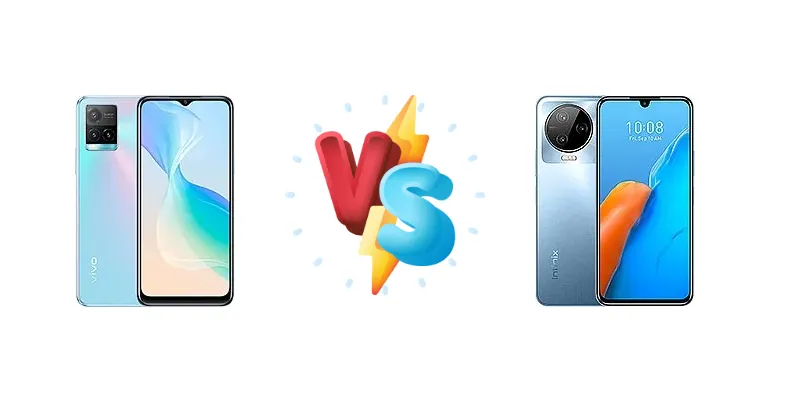
The sub-$200 smartphone market is fiercely competitive. The vivo Y33s, with its established brand recognition, faces a strong challenger in the Infinix Note 12 Pro. While both aim for affordability, they take different approaches to performance and features, making a direct comparison crucial for budget-conscious buyers.
🏆 Quick Verdict
For most users, the Infinix Note 12 Pro is the better choice. Its newer Mediatek Helio G99 chipset, built on a more efficient 6nm process, delivers noticeably improved performance and efficiency compared to the vivo Y33s’ Helio G80. The faster 33W charging is a significant convenience, offsetting the slightly smaller potential battery capacity.
| Network |
|---|
| 2G bands | GSM 850 / 900 / 1800 / 1900 | GSM 850 / 900 / 1800 / 1900 |
| 3G bands | HSDPA 850 / 900 / 2100 | HSDPA 850 / 900 / 1700(AWS) / 1900 / 2100 |
| 4G bands | 1, 3, 5, 8, 38, 40, 41 | 1, 2, 3, 4, 5, 7, 8, 20, 28, 38, 40, 41 |
| Speed | HSPA, LTE | HSPA, LTE |
| Technology | GSM / HSPA / LTE | GSM / HSPA / LTE |
| Launch |
|---|
| Announced | 2021, August 24 | 2022, July 16 |
| Status | Available. Released 2021, August 24 | Available. Released 2022, July 18 |
| Body |
|---|
| Build | - | Glass front, plastic frame, plastic back |
| Dimensions | 164.3 x 76.1 x 8 mm (6.47 x 3.00 x 0.31 in) | 164.4 x 76.5 x 7.8 mm (6.47 x 3.01 x 0.31 in) |
| SIM | Nano-SIM + Nano-SIM | Nano-SIM + Nano-SIM |
| Weight | 182 g (6.42 oz) | 192 g (6.77 oz) |
| Display |
|---|
| Resolution | 1080 x 2408 pixels, 20:9 ratio (~401 ppi density) | 1080 x 2400 pixels, 20:9 ratio (~393 ppi density) |
| Size | 6.58 inches, 104.3 cm2 (~83.4% screen-to-body ratio) | 6.7 inches, 108.4 cm2 (~86.2% screen-to-body ratio) |
| Type | IPS LCD | AMOLED |
| Platform |
|---|
| CPU | Octa-core (2x2.0 GHz Cortex-A75 & 6x1.8 GHz Cortex-A55) | Octa-core (2x2.2 GHz Cortex-A76 & 6x2.0 GHz Cortex-A55) |
| Chipset | Mediatek MT6769V/CU Helio G80 (12 nm) | Mediatek Helio G99 (6 nm) |
| GPU | Mali-G52 MC2 | Mali-G57 MC2 |
| OS | Android 11, Funtouch 11.1 | Android 12, XOS 10.6 |
| Memory |
|---|
| Card slot | microSDXC (dedicated slot) | microSDXC (dedicated slot) |
| Internal | 64GB 4GB RAM, 128GB 4GB RAM, 128GB 8GB RAM | 256GB 8GB RAM |
| Main Camera |
|---|
| Dual | 50 MP, f/1.8, (wide), PDAF
2 MP (macro)
Auxiliary lens | - |
| Features | LED flash | Quad-LED flash, HDR, panorama |
| Single | 16 MP, f/2.0, (wide) | - |
| Triple | - | 108 MP, f/1.8, (wide), 1/1.67", PDAF
Auxiliary lenses |
| Video | 1080p@30fps | 1440p@30fps |
| Selfie camera |
|---|
| Features | - | Dual-LED flash |
| Single | 16 MP, f/2.0, (wide) | 16 MP, f/2.0, (wide) |
| Video | 1080p@30fps | 1440p@30fps |
| Sound |
|---|
| 3.5mm jack | Yes | Yes |
| 35mm jack | Yes | Yes |
| Loudspeaker | Yes | Yes, with dual speakers |
| Comms |
|---|
| Bluetooth | 5.0, A2DP, LE | Yes |
| NFC | Yes | Yes |
| Positioning | GPS, GLONASS, GALILEO, BDS | GPS |
| Radio | FM radio | FM radio |
| USB | USB Type-C 2.0, OTG | USB Type-C 2.0, OTG |
| WLAN | Wi-Fi 802.11 a/b/g/n/ac, dual-band, Wi-Fi Direct | Yes |
| Features |
|---|
| Sensors | Fingerprint (side-mounted), accelerometer, gyro, proximity, compass | Fingerprint (side-mounted), accelerometer, proximity, gyro, compass |
| Battery |
|---|
| Charging | 18W wired
5W reverse wired | 33W wired |
| Type | 5000 mAh | 5000 mAh |
| Misc |
|---|
| Colors | Mirror Black, Midday Dream | Volcanic Grey, Tuscany Blue, Alpine White |
| Models | V2109 | X676B |
| Price | About 210 EUR | About 420 EUR |
vivo Y33s
- Established Brand Reputation
- Sufficient for Basic Tasks
- Reverse Wired Charging
- Older Helio G80 Chipset
- Slower 18W Charging
- Less Efficient 12nm Process
Infinix Note 12 Pro
- Faster Helio G99 Chipset
- More Efficient 6nm Process
- Faster 33W Charging
- Less Brand Recognition
- Potential for Software Bloatware
Display Comparison
Neither device boasts a standout display. Both likely utilize LCD panels, common in this price bracket. However, detailed display specs (resolution, brightness, color gamut) are missing. The focus here is on internal performance. The absence of high refresh rate panels on either device suggests a prioritization of battery life over visual fluidity.
Camera Comparison
Without detailed camera specifications, a direct comparison is limited. Both phones likely feature a multi-camera setup with a primary sensor, but the sensor size and aperture are critical factors. The market segment suggests both will rely heavily on software processing. The presence of a 2MP macro lens on either device is largely a marketing tactic, offering minimal practical benefit due to the small sensor size and lack of optical image stabilization (OIS).
Performance
The core difference lies in the chipsets. The Infinix Note 12 Pro’s Mediatek Helio G99 (6nm) represents a significant leap over the vivo Y33s’ Helio G80 (12nm). The 6nm process inherently offers better power efficiency, translating to less heat generation and potentially longer sustained performance. The G99’s CPU, featuring 2x2.2 GHz Cortex-A76 cores, also outperforms the Y33s’ 2x2.0 GHz Cortex-A75 cores. This means faster app loading times, smoother multitasking, and a more enjoyable gaming experience on the Infinix. While both use octa-core configurations, the architectural improvements in the G99 are substantial.
Battery Life
The vivo Y33s features 18W wired charging, while the Infinix Note 12 Pro steps up to 33W. This difference is substantial. 33W charging will significantly reduce the time spent tethered to a wall outlet, offering a more convenient user experience. While the battery capacity isn't specified, the G99's improved efficiency on the Infinix Note 12 Pro could offset a potentially smaller battery size, resulting in comparable or even better real-world battery life.
Buying Guide
Buy the vivo Y33s if you prioritize a familiar brand and are primarily focused on basic smartphone tasks like calling, texting, and light social media use. Its 18W charging and Helio G80 are sufficient for these needs. Buy the Infinix Note 12 Pro if you want a more responsive experience for gaming, multitasking, or demanding apps, and value faster charging speeds. The G99 chipset provides a tangible performance boost for a minimal price increase.
Frequently Asked Questions
❓ Will the Infinix Note 12 Pro’s Helio G99 handle demanding games like PUBG Mobile smoothly?
Yes, the Helio G99 is a capable chipset for gaming. Its Cortex-A76 cores and improved GPU performance compared to the Helio G80 in the vivo Y33s will deliver a smoother and more consistent frame rate in PUBG Mobile, especially at medium settings. However, expect some frame drops during intense firefights.
❓ Does the 18W charging on the vivo Y33s feel noticeably slower compared to the 33W on the Infinix Note 12 Pro?
Absolutely. 18W charging is adequate, but 33W is a significant step up. You can expect a 0-100% charge on the Infinix Note 12 Pro to take roughly 60-75 minutes, while the vivo Y33s will likely take 2-3 hours. This difference is particularly noticeable for users who frequently need to top up their battery quickly.
❓ Is the difference in chipset performance between the Helio G99 and Helio G80 noticeable in everyday tasks like browsing and social media?
Yes, the difference is noticeable. While both chips can handle basic tasks, the Helio G99 offers snappier app launches, smoother scrolling, and a more responsive overall experience. Multitasking will also feel less sluggish on the Infinix Note 12 Pro.