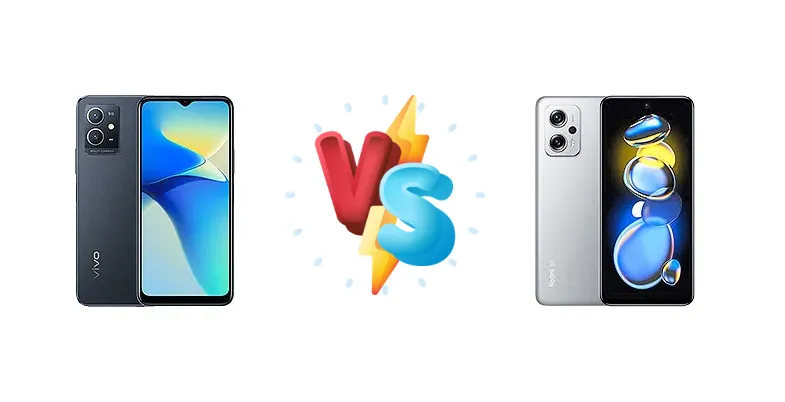
The Xiaomi Redmi Note 11T Pro+ and vivo Y33e represent distinct approaches to the mid-range smartphone market. The Redmi Note 11T Pro+ aggressively targets performance with a flagship-adjacent chipset and incredibly fast charging, while the vivo Y33e prioritizes affordability and efficiency. This comparison dissects their key differences to help you determine which device best suits your needs.
🏆 Quick Verdict
For users prioritizing raw performance and ultra-fast charging, the Xiaomi Redmi Note 11T Pro+ is the clear winner. Its Dimensity 8100 chipset delivers a significantly smoother experience, especially in demanding tasks. However, the vivo Y33e remains a compelling option for budget-conscious users who value efficiency and a lower price point.
| Network |
|---|
| 2G bands | GSM 850 / 900 / 1800 / 1900 | GSM 850 / 900 / 1800 / 1900 - SIM 1 & SIM 2 |
| 3G bands | HSDPA 850 / 900 / 2100 | HSDPA 800 / 850 / 900 / 2100 |
| 4G bands | 1, 3, 5, 8, 28, 34, 38, 39, 40, 41 | 1, 3, 5, 8, 19, 34, 38, 39, 40, 41, 42 |
| 5G bands | 1, 5, 8, 28, 41, 77, 78 SA/NSA | 1, 3, 5, 8, 28, 38, 41, 77, 78 SA/NSA |
| Speed | HSPA, LTE, 5G | HSPA, LTE-A (CA), 5G |
| Technology | GSM / CDMA / HSPA / CDMA2000 / LTE / 5G | GSM / CDMA / HSPA / EVDO / LTE / 5G |
| | CDMA2000 1x | CDMA2000 1xEV-DO |
| Launch |
|---|
| Announced | 2022, May 30 | 2022, May 24 |
| Status | Cancelled | Available. Released 2022, May 31 |
| Body |
|---|
| Build | Glass front, plastic frame, plastic back | - |
| Dimensions | 164 x 75.9 x 8.5 mm (6.46 x 2.99 x 0.33 in) | 163.6 x 74.3 x 8.9 mm (6.44 x 2.93 x 0.35 in) |
| SIM | Nano-SIM + Nano-SIM | Dual SIM (Nano-SIM, dual stand-by) |
| Weight | 198 g (6.98 oz) | 198 g (6.98 oz) |
| | - | IP53, dust and splash resistant |
| Display |
|---|
| Resolution | 720 x 1600 pixels, 20:9 ratio (~270 ppi density) | 1080 x 2460 pixels (~407 ppi density) |
| Size | 6.51 inches, 102.3 cm2 (~82.2% screen-to-body ratio) | 6.6 inches, 103.4 cm2 (~85.1% screen-to-body ratio) |
| Type | IPS LCD | IPS LCD, 144Hz, HDR10, Dolby Vision, 650 nits (typ) |
| Platform |
|---|
| CPU | Octa-core (2x2.2 GHz Cortex-A76 & 6x2.0 GHz Cortex-A55) | Octa-core (4x2.85 GHz Cortex-A78 & 4x2.0 GHz Cortex-A55) |
| Chipset | Mediatek Dimensity 700 (7 nm) | Mediatek Dimensity 8100 (5 nm) |
| GPU | Mali-G57 MC2 | Mali-G610 MC6 |
| OS | Android 12, OriginOS Ocean | Android 12, MIUI 13 |
| Memory |
|---|
| Card slot | microSDXC | No |
| Internal | 128GB 4GB RAM | 128GB 8GB RAM, 256GB 8GB RAM, 512GB 8GB RAM |
| | - | UFS 3.1 |
| Main Camera |
|---|
| Dual | 13 MP, f/2.2, 26mm (wide), PDAF
2 MP (macro) | - |
| Features | LED flash, HDR, panorama | LED flash, HDR, panorama |
| Single | 8 MP, f/2.0, (wide) | 16 MP, (wide) |
| Triple | - | 64 MP, (wide), 1/1.72", 0.8µm, PDAF
8 MP, 120˚, (ultrawide)
2 MP, (macro) |
| Video | 1080p@30fps | 4K@30fps, 1080p@30/60/120fps, 720p@960fps |
| Selfie camera |
|---|
| Single | 8 MP, f/2.0, (wide) | 16 MP, (wide) |
| Video | 1080p@30fps | 1080p@30/60fps |
| Sound |
|---|
| 3.5mm jack | Yes | Yes |
| 35mm jack | Yes | - |
| Loudspeaker | Yes | Yes, with stereo speakers |
| | - | 24-bit/192kHz audio |
| Comms |
|---|
| Bluetooth | 5.1, A2DP, LE, aptX HD | 5.3, A2DP, LE |
| Infrared port | - | Yes |
| NFC | No | Yes |
| Positioning | GPS, GLONASS, GALILEO, BDS, QZSS | GPS (L1), GLONASS (G1), BDS (B1I+B1c), GALILEO (E1), QZSS (L1) |
| Radio | Unspecified | No |
| USB | USB Type-C, OTG | USB Type-C 2.0, OTG |
| WLAN | Wi-Fi 802.11 a/b/g/n/ac, dual-band, Wi-Fi Direct | Wi-Fi 802.11 a/b/g/n/ac/6, dual-band, Wi-Fi Direct |
| Features |
|---|
| Sensors | Fingerprint (side-mounted), accelerometer, proximity, compass | Fingerprint (side-mounted), accelerometer, proximity, gyro, compass, color spectrum |
| Battery |
|---|
| Charging | 10W wired | 120W wired, PD3.0, 50% in 10 min, 100% in 19 min (advertised) |
| Type | 5000 mAh | Li-Po 4400 mAh, non-removable |
| Misc |
|---|
| Colors | Black, Blue | Blue, Silver, Black |
| Models | V2166A | 22041216UC |
| Price | About 180 EUR | About 300 EUR |
vivo Y33e
- Excellent value for money
- Efficient Dimensity 700 chipset
- Reliable for everyday tasks
- Slow 10W charging
- Limited performance for demanding games
Xiaomi Redmi Note 11T Pro+
- Blazing-fast 120W charging
- Powerful Dimensity 8100 chipset
- Superior performance for gaming and multitasking
- Higher price point
- Potentially more heat under sustained load
Display Comparison
While display specifications aren't provided for the vivo Y33e, it's likely to feature a standard 60Hz LCD panel common in its price bracket. The Redmi Note 11T Pro+ benefits from a more advanced display, though specifics are missing. The core difference lies in the processing power driving the visuals; the Dimensity 8100's superior GPU will translate to smoother frame rates in games and a more responsive user interface, regardless of the panel type. The Redmi's potential for higher peak brightness will also improve outdoor visibility.
Camera Comparison
Without detailed camera specifications for either device, a direct comparison is limited. However, the Redmi Note 11T Pro+ likely features a more sophisticated camera system, leveraging the processing power of the Dimensity 8100 for improved image processing. The Y33e will likely rely on software optimizations to compensate for a potentially less capable sensor. The Redmi's chipset will also enable faster image capture and potentially better video recording capabilities.
Performance
The performance gap between these devices is substantial. The Xiaomi Redmi Note 11T Pro+'s Mediatek Dimensity 8100 (5nm) boasts significantly more processing power than the vivo Y33e's Dimensity 700 (7nm). The 8100's Cortex-A78 cores, clocked at 2.85 GHz, offer a considerable uplift in single-core performance, crucial for app launch speeds and general responsiveness. The 5nm manufacturing process also contributes to better thermal efficiency, meaning the Redmi Note 11T Pro+ is less likely to throttle under sustained load. The Y33e's Dimensity 700 is adequate for everyday tasks, but will struggle with graphically intensive games and multitasking.
Battery Life
The Redmi Note 11T Pro+’s 120W wired charging is the standout feature here. Advertised to reach 100% in just 19 minutes, it drastically reduces downtime compared to the vivo Y33e’s slow 10W charging. While battery capacity isn't specified for either device, the Redmi's rapid charging effectively mitigates the impact of a potentially smaller battery. Users who frequently find themselves needing to top up their phone will greatly benefit from the Redmi Note 11T Pro+'s charging speed.
Buying Guide
Buy the vivo Y33e if you need a reliable, everyday smartphone for basic tasks like calling, texting, social media, and light web browsing, and you're on a tight budget. Buy the Xiaomi Redmi Note 11T Pro+ if you prefer a phone capable of handling demanding games, multitasking, and benefit from significantly faster charging speeds, even if it means a higher upfront cost.
Frequently Asked Questions
❓ How much faster is the Redmi Note 11T Pro+'s charging compared to the vivo Y33e?
The Redmi Note 11T Pro+ charges at 120W, reaching 100% in approximately 19 minutes. The vivo Y33e charges at only 10W, requiring several hours to fully charge. This difference is substantial and caters to users who prioritize minimal downtime.
❓ Will the Dimensity 700 in the vivo Y33e be sufficient for playing PUBG Mobile?
The Dimensity 700 can run PUBG Mobile, but likely at lower graphics settings and frame rates to maintain a stable experience. Expect occasional stuttering during intense firefights. The Redmi Note 11T Pro+'s Dimensity 8100 will provide a much smoother and more consistent PUBG Mobile experience at higher settings.
❓ Is the Redmi Note 11T Pro+ likely to overheat during extended gaming sessions?
While the Dimensity 8100 is a powerful chip, the 5nm process helps with thermal efficiency. However, prolonged gaming will likely generate heat. Xiaomi typically implements thermal management solutions, but sustained peak performance may result in some throttling to prevent overheating.