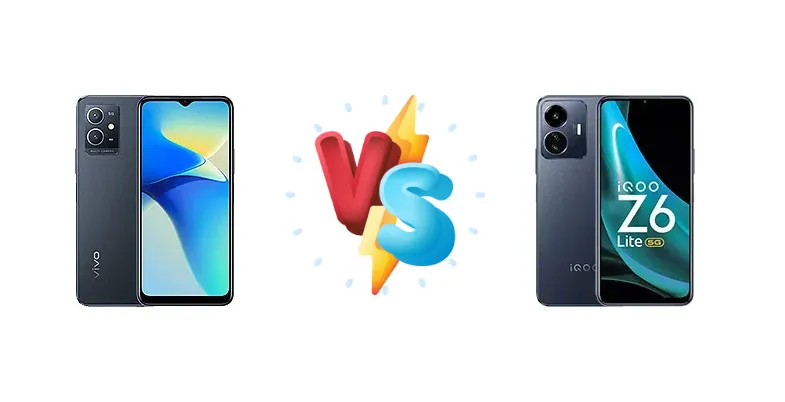
The vivo Y33e and iQOO Z6 Lite represent two distinct approaches to the budget smartphone market. The Y33e, powered by the Mediatek Dimensity 700, aims for a balance of features, while the iQOO Z6 Lite leverages the Qualcomm Snapdragon 4 Gen 1, focusing on efficiency and a streamlined experience. This comparison will dissect their key differences to determine which device offers the best value.
🏆 Quick Verdict
For the average user prioritizing faster charging and potentially smoother everyday performance, the iQOO Z6 Lite is the better choice. Its Snapdragon 4 Gen 1, built on a 6nm process, offers a slight edge in efficiency, and the 18W charging significantly reduces downtime compared to the Y33e's 10W charging.
| Network |
|---|
| 2G bands | GSM 850 / 900 / 1800 / 1900 | GSM 850 / 900 / 1800 / 1900 |
| 3G bands | HSDPA 850 / 900 / 2100 | HSDPA 850 / 900 / 2100 |
| 4G bands | 1, 3, 5, 8, 28, 34, 38, 39, 40, 41 | 1, 3, 5, 8, 38, 40, 41 |
| 5G bands | 1, 5, 8, 28, 41, 77, 78 SA/NSA | 77, 78 SA/NSA |
| Speed | HSPA, LTE, 5G | HSPA, LTE, 5G |
| Technology | GSM / CDMA / HSPA / CDMA2000 / LTE / 5G | GSM / HSPA / LTE / 5G |
| | CDMA2000 1x | - |
| Launch |
|---|
| Announced | 2022, May 30 | 2022, September 14 |
| Status | Cancelled | Available. Released 2022, September 14 |
| Body |
|---|
| Build | Glass front, plastic frame, plastic back | Glass front, plastic frame, plastic back |
| Dimensions | 164 x 75.9 x 8.5 mm (6.46 x 2.99 x 0.33 in) | 164 x 75.8 x 8.3 mm (6.46 x 2.98 x 0.33 in) |
| SIM | Nano-SIM + Nano-SIM | Nano-SIM + Nano-SIM |
| Weight | 198 g (6.98 oz) | 194 g (6.84 oz) |
| Display |
|---|
| Resolution | 720 x 1600 pixels, 20:9 ratio (~270 ppi density) | 1080 x 2408 pixels, 20:9 ratio (~401 ppi density) |
| Size | 6.51 inches, 102.3 cm2 (~82.2% screen-to-body ratio) | 6.58 inches, 104.3 cm2 (~83.9% screen-to-body ratio) |
| Type | IPS LCD | IPS LCD, 120Hz |
| Platform |
|---|
| CPU | Octa-core (2x2.2 GHz Cortex-A76 & 6x2.0 GHz Cortex-A55) | Octa-core (2x2.0 GHz Cortex-A78 & 6x1.8 GHz Cortex-A55) |
| Chipset | Mediatek Dimensity 700 (7 nm) | Qualcomm SM4375 Snapdragon 4 Gen 1 (6 nm) |
| GPU | Mali-G57 MC2 | Adreno 619 |
| OS | Android 12, OriginOS Ocean | Android 12, Funtouch 12 |
| Memory |
|---|
| Card slot | microSDXC | microSDXC (uses shared SIM slot) |
| Internal | 128GB 4GB RAM | 64GB 4GB RAM, 128GB 6GB RAM |
| Main Camera |
|---|
| Dual | 13 MP, f/2.2, 26mm (wide), PDAF
2 MP (macro) | 50 MP, f/1.8, (wide), PDAF
2 MP (macro) |
| Features | LED flash, HDR, panorama | Dual-LED dual-tone flash, HDR, panorama |
| Single | 8 MP, f/2.0, (wide) | 8 MP, f/2.0, (wide) |
| Video | 1080p@30fps | 1080p@30fps |
| Selfie camera |
|---|
| Single | 8 MP, f/2.0, (wide) | 8 MP, f/2.0, (wide) |
| Video | 1080p@30fps | 1080p@30fps |
| Sound |
|---|
| 3.5mm jack | Yes | Yes |
| 35mm jack | Yes | Yes |
| Loudspeaker | Yes | Yes |
| Comms |
|---|
| Bluetooth | 5.1, A2DP, LE, aptX HD | 5.1, A2DP, LE |
| NFC | No | No |
| Positioning | GPS, GLONASS, GALILEO, BDS, QZSS | GPS, GLONASS, GALILEO, BDS, QZSS |
| Radio | Unspecified | FM radio |
| USB | USB Type-C, OTG | USB Type-C 2.0, OTG |
| WLAN | Wi-Fi 802.11 a/b/g/n/ac, dual-band, Wi-Fi Direct | Wi-Fi 802.11 a/b/g/n/ac, dual-band, Wi-Fi Direct |
| Features |
|---|
| Sensors | Fingerprint (side-mounted), accelerometer, proximity, compass | Fingerprint (side-mounted), accelerometer, proximity, compass |
| Battery |
|---|
| Charging | 10W wired | 18W wired |
| Type | 5000 mAh | 5000 mAh |
| Misc |
|---|
| Colors | Black, Blue | Mystic Night, Stellar Green |
| Models | V2166A | I2208 |
| Price | About 180 EUR | About 180 EUR |
vivo Y33e
- Proven Mediatek Dimensity 700 chipset
- Potentially lower price point (depending on market)
- Familiar software experience for Mediatek users
- Slower 10W charging
- Less efficient 7nm process compared to Snapdragon 4 Gen 1
vivo iQOO Z6 Lite
- More efficient Qualcomm Snapdragon 4 Gen 1 (6nm)
- Faster 18W charging
- Potentially smoother performance due to Cortex-A78 cores
- Snapdragon 4 Gen 1 is a newer platform, potentially with fewer software optimizations
- May be slightly more expensive than the Y33e
Display Comparison
Neither device's display specifications are provided, so a direct comparison is limited. However, given their price points, both likely utilize LCD panels. The iQOO Z6 Lite's focus on efficiency suggests a potentially optimized panel for power consumption. Bezels are likely comparable, and color accuracy will be standard for this segment, prioritizing vibrancy over absolute fidelity.
Camera Comparison
Without detailed camera specs, analysis is limited. Both phones likely feature a multi-camera setup with a primary sensor and supporting lenses. The absence of information regarding sensor size and aperture makes it difficult to assess image quality. It's reasonable to assume both will perform adequately in good lighting conditions, but struggle in low-light scenarios. The inclusion of a 2MP macro camera on either device is likely a marketing feature with limited practical benefit.
Performance
The core difference lies in the chipsets. The vivo Y33e’s Mediatek Dimensity 700 (7nm) features a dual-cluster configuration with 2x2.2 GHz Cortex-A76 cores and 6x2.0 GHz Cortex-A55 cores. The iQOO Z6 Lite’s Qualcomm Snapdragon 4 Gen 1 (6nm) employs 2x2.0 GHz Cortex-A78 cores and 6x1.8 GHz Cortex-A55 cores. While clock speeds are similar, the Snapdragon 4 Gen 1’s 6nm process offers improved transistor density and, crucially, better power efficiency. The Cortex-A78 cores in the Snapdragon 4 Gen 1 also represent a generational improvement over the A76 cores in the Dimensity 700, potentially leading to snappier responsiveness in everyday tasks. The 6nm node also implies better thermal management, reducing the likelihood of sustained throttling under load.
Battery Life
Battery capacity isn't specified for either device, but both likely fall in the 5000mAh range, typical for this price bracket. However, the charging speeds are significantly different. The vivo Y33e is limited to 10W wired charging, translating to a lengthy recharge time. The iQOO Z6 Lite, with its 18W wired charging, offers a substantial improvement, potentially reducing 0-100% charge time by 40-50%. This difference in charging speed is a major advantage for the iQOO Z6 Lite, especially for users who need to quickly top up their battery.
Buying Guide
Buy the vivo Y33e if you need a phone with a proven chipset and are less concerned with rapid charging. It's a solid option for users who prioritize a familiar Mediatek experience and don't heavily rely on power-intensive applications. Buy the iQOO Z6 Lite if you prefer a more modern, efficient processor and value the convenience of faster charging, making it ideal for users on the go or those who frequently use their phone throughout the day.
Frequently Asked Questions
❓ Will the Snapdragon 4 Gen 1 in the iQOO Z6 Lite handle demanding games like PUBG Mobile?
While the Snapdragon 4 Gen 1 isn't a gaming powerhouse, it should be capable of running PUBG Mobile at medium settings with reasonable frame rates. Expect some frame drops during intense action, but the 6nm process should help mitigate thermal throttling compared to the Dimensity 700 under sustained load.
❓ Is the 10W charging on the vivo Y33e a significant drawback for daily use?
Yes, the 10W charging is a considerable limitation. Expect a full recharge to take well over 3 hours, making it inconvenient for users who need to quickly top up their battery throughout the day. The iQOO Z6 Lite's 18W charging is a much more practical solution.
❓ Which phone is likely to receive more software updates?
iQOO, as a sub-brand of vivo, generally prioritizes software updates for its devices. While both phones will likely receive security patches, the iQOO Z6 Lite may receive more frequent and substantial software updates, including potential Android version upgrades.