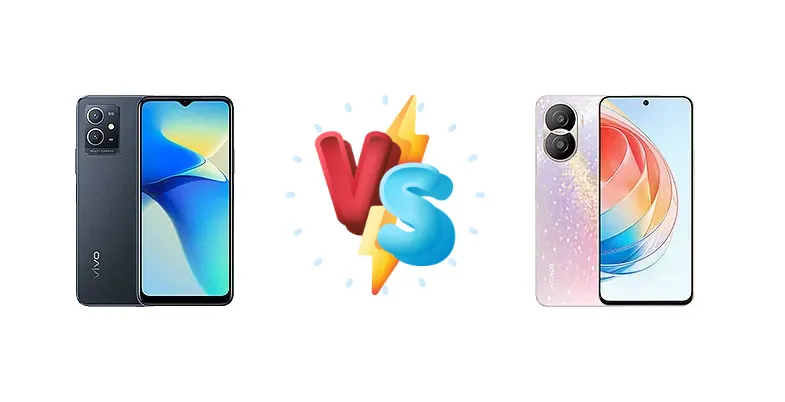
The vivo Y33e and Honor X40i both target the budget-conscious consumer seeking 5G connectivity. Both devices leverage the Mediatek Dimensity 700 chipset, creating a performance baseline. However, a critical divergence emerges in their charging capabilities, making this comparison about optimizing for time versus minimizing upfront cost.
🏆 Quick Verdict
For the average user prioritizing convenience, the Honor X40i is the clear winner. Its 44W wired charging significantly reduces charging times compared to the vivo Y33e’s sluggish 10W solution, despite both phones sharing the same processor and core functionality. The Y33e remains a viable option for those on an extremely tight budget.
| Network |
|---|
| 2G bands | GSM 850 / 900 / 1800 / 1900 | GSM 850 / 900 / 1800 / 1900 |
| 3G bands | HSDPA 850 / 900 / 2100 | HSDPA 850 / 900 / 2100 |
| 4G bands | 1, 3, 5, 8, 28, 34, 38, 39, 40, 41 | 1, 3, 5, 8, 34, 38, 39, 40, 41 |
| 5G bands | 1, 5, 8, 28, 41, 77, 78 SA/NSA | SA/NSA |
| Speed | HSPA, LTE, 5G | HSPA, LTE, 5G |
| Technology | GSM / CDMA / HSPA / CDMA2000 / LTE / 5G | GSM / CDMA / HSPA / CDMA2000 / LTE / 5G |
| | CDMA2000 1x | CDMA2000 1x |
| Launch |
|---|
| Announced | 2022, May 30 | 2022, July 13 |
| Status | Cancelled | Available. Released 2022, July 22 |
| Body |
|---|
| Build | Glass front, plastic frame, plastic back | - |
| Dimensions | 164 x 75.9 x 8.5 mm (6.46 x 2.99 x 0.33 in) | 162.9 x 74.5 x 7.4 mm (6.41 x 2.93 x 0.29 in) |
| SIM | Nano-SIM + Nano-SIM | Nano-SIM + Nano-SIM |
| Weight | 198 g (6.98 oz) | 175 g (6.17 oz) |
| Display |
|---|
| Resolution | 720 x 1600 pixels, 20:9 ratio (~270 ppi density) | 1080 x 2388 pixels (~391 ppi density) |
| Size | 6.51 inches, 102.3 cm2 (~82.2% screen-to-body ratio) | 6.7 inches, 108.7 cm2 (~89.6% screen-to-body ratio) |
| Type | IPS LCD | IPS LCD |
| Platform |
|---|
| CPU | Octa-core (2x2.2 GHz Cortex-A76 & 6x2.0 GHz Cortex-A55) | Octa-core (2x2.2 GHz Cortex-A76 & 6x2.0 GHz Cortex-A55) |
| Chipset | Mediatek Dimensity 700 (7 nm) | Mediatek Dimensity 700 (7 nm) |
| GPU | Mali-G57 MC2 | Mali-G57 MC2 |
| OS | Android 12, OriginOS Ocean | Android 12, Magic UI 6.1 |
| Memory |
|---|
| Card slot | microSDXC | No |
| Internal | 128GB 4GB RAM | 128GB 8GB RAM, 256GB 8GB RAM, 256GB 12GB RAM |
| Main Camera |
|---|
| Dual | 13 MP, f/2.2, 26mm (wide), PDAF
2 MP (macro) | 50 MP, f/1.8, (wide), PDAF
Auxiliary lens |
| Features | LED flash, HDR, panorama | LED flash, HDR, panorama |
| Single | 8 MP, f/2.0, (wide) | 8 MP, f/2.0, (wide) |
| Video | 1080p@30fps | 1080p@30fps |
| Selfie camera |
|---|
| Single | 8 MP, f/2.0, (wide) | 8 MP, f/2.0, (wide) |
| Video | 1080p@30fps | 1080p@30fps |
| Sound |
|---|
| 3.5mm jack | Yes | Yes |
| 35mm jack | Yes | Yes |
| Loudspeaker | Yes | Yes |
| Comms |
|---|
| Bluetooth | 5.1, A2DP, LE, aptX HD | 5.1, A2DP, LE |
| NFC | No | No |
| Positioning | GPS, GLONASS, GALILEO, BDS, QZSS | GPS, GLONASS, BDS |
| Radio | Unspecified | No |
| USB | USB Type-C, OTG | USB Type-C 2.0, OTG |
| WLAN | Wi-Fi 802.11 a/b/g/n/ac, dual-band, Wi-Fi Direct | Wi-Fi 802.11 a/b/g/n/ac, dual-band, Wi-Fi Direct |
| Features |
|---|
| Sensors | Fingerprint (side-mounted), accelerometer, proximity, compass | Fingerprint (side-mounted), accelerometer, compass |
| | - | Virtual proximity sensing |
| Battery |
|---|
| Charging | 10W wired | 44W wired |
| Type | 5000 mAh | Li-Po 4000 mAh |
| Misc |
|---|
| Colors | Black, Blue | Black, Silver, Green. Aurora |
| Models | V2166A | DIO-AN00 |
| Price | About 180 EUR | About 240 EUR |
vivo Y33e
- Lower price point (likely)
- Similar processing power to the Honor X40i
- Functional 5G connectivity
- Extremely slow 10W charging
- Likely lower build quality
- Potentially limited software support
Honor X40i
- Significantly faster 44W charging
- Potentially better build quality (Honor's brand reputation)
- More responsive user experience due to faster charging
- Higher price compared to the vivo Y33e
- Same Dimensity 700 chipset as the Y33e
- May include bloatware
Display Comparison
Neither vivo nor Honor provide detailed display specifications beyond the basic panel type. Given the price bracket, both likely utilize LCD panels. The absence of information regarding peak brightness, color gamut coverage, or refresh rates suggests a focus on cost reduction. Bezels are expected to be relatively substantial on both devices. Without further data, it’s safe to assume display quality is comparable and not a key differentiator.
Camera Comparison
Detailed camera specifications are lacking for both devices. It’s highly probable that both phones feature a multi-camera setup with a primary sensor and supporting lenses, potentially including a depth or macro sensor. Without knowing sensor sizes, lens apertures, or image processing algorithms, it’s difficult to assess camera quality. The presence of a 2MP macro camera on either device is unlikely to provide significant photographic value. Image quality will likely be adequate for social media sharing but not competitive with higher-end smartphones.
Performance
Both the vivo Y33e and Honor X40i are powered by the Mediatek Dimensity 700 (7nm). This chipset features an octa-core configuration with 2x2.2 GHz Cortex-A76 and 6x2.0 GHz Cortex-A55 cores, delivering similar CPU performance. The 7nm fabrication process offers a reasonable balance between performance and power efficiency. However, thermal management capabilities are unknown; sustained workloads could lead to throttling. RAM configurations are not specified, but the performance will be largely dictated by the chipset, not RAM speed. The identical chipset means gaming performance and app loading times will be very similar.
Battery Life
Battery capacity is not specified for either device. However, the critical difference lies in the charging technology. The Honor X40i boasts 44W wired charging, enabling significantly faster charging times compared to the vivo Y33e’s 10W charging. A full charge on the X40i could take under an hour, while the Y33e could require several hours. This disparity in charging speed directly impacts user convenience and usability, especially for those who frequently use their phones throughout the day.
Buying Guide
Buy the vivo Y33e if you absolutely need the lowest possible price and are willing to tolerate significantly longer charging times. It’s a good choice for users who primarily charge overnight or don’t heavily utilize their phone throughout the day. Buy the Honor X40i if you value faster charging, even at a slightly higher price point. This phone is ideal for users who need to quickly top up their battery during short breaks and demand more flexibility in their charging routine.
Frequently Asked Questions
❓ How much faster is the 44W charging on the Honor X40i compared to the 10W charging on the vivo Y33e?
The 44W charging on the Honor X40i is significantly faster. While exact times depend on battery capacity (which isn't specified), a 44W charger can typically charge a phone from 0-100% in under an hour. The 10W charger on the vivo Y33e could take 4-6 hours or even longer for a full charge, making it impractical for users who need quick top-ups.
❓ Will I notice a difference in performance between the two phones given they both have the Dimensity 700 chipset?
You likely won't notice a significant difference in raw performance. The Mediatek Dimensity 700 is the primary determinant of CPU and GPU capabilities, and both phones utilize the same chipset. However, the Honor X40i's faster charging could contribute to a more responsive user experience by reducing downtime and ensuring you're less frequently operating with a low battery.
❓ Are there any known issues with the Dimensity 700 chipset regarding overheating or throttling?
The Dimensity 700 is generally a thermally efficient chipset, but sustained heavy workloads (like prolonged gaming) can lead to some throttling to prevent overheating. Neither vivo nor Honor have specifically addressed thermal management in these models, so real-world performance under stress is uncertain. Expect some performance reduction during extended gaming sessions.