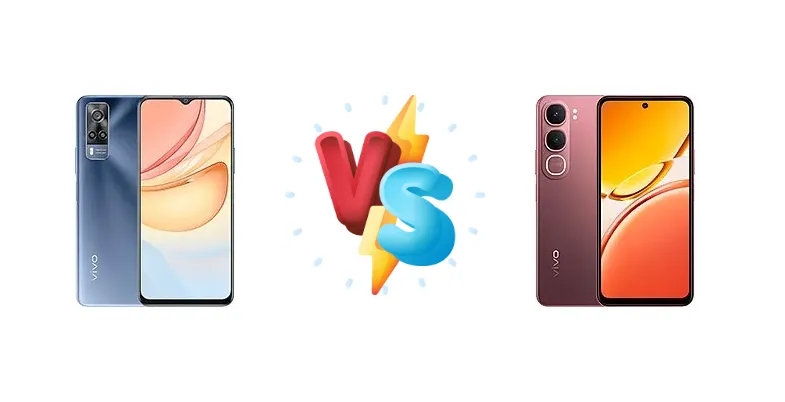
The vivo Y series consistently delivers affordable smartphones packed with features. Today, we're pitting two popular contenders against each other: the vivo Y33 and the vivo Y31. Both offer compelling value, but which one comes out on top?
🏆 Quick Verdict
The vivo Y31 is the clear winner. Its Snapdragon 4 Gen 2 chipset offers significantly better performance, faster charging (44W vs 18W), and a more modern 4nm process. While the Y33 has its merits, the Y31's upgrades make it the superior choice for most users.
| Network |
|---|
| 2G bands | GSM 850 / 900 / 1800 / 1900 | GSM 850 / 900 / 1800 / 1900 |
| 3G bands | HSDPA 850 / 900 / 1700(AWS) / 2100 | HSDPA 850 / 900 / 2100 |
| 4G bands | 1, 2, 3, 4, 5, 7, 8, 12, 17, 28, 38, 40, 41, 66 | 1, 3, 5, 8, 28, 38, 40, 41 |
| 5G bands | - | 1, 3, 5, 8, 28, 40, 77, 78 SA/NSA |
| Speed | HSPA, LTE | HSPA, LTE, 5G |
| Technology | GSM / HSPA / LTE | GSM / HSPA / LTE / 5G |
| Launch |
|---|
| Announced | 2021, October 04 | 2025, September 15 |
| Status | Available. Released 2021, October 04 | Available. Released 2025, September 15 |
| Body |
|---|
| Build | Glass front, plastic frame, plastic back | - |
| Dimensions | 164 x 75.5 x 8.4 mm (6.46 x 2.97 x 0.33 in) | 166.1 x 77 x 8.4 mm (6.54 x 3.03 x 0.33 in) |
| SIM | · Nano-SIM· Nano-SIM + Nano-SIM | Nano-SIM + Nano-SIM |
| Weight | 191 g (6.74 oz) | 209 g (7.37 oz) |
| Display |
|---|
| Protection | - | Guardian Glass (ion-strengthened) |
| Resolution | 1080 x 2408 pixels, 20:9 ratio (~401 ppi density) | 720 x 1608 pixels, 20:9 ratio (~264 ppi density) |
| Size | 6.58 inches, 104.3 cm2 (~84.2% screen-to-body ratio) | 6.68 inches, 107.4 cm2 (~84.0% screen-to-body ratio) |
| Type | IPS LCD | IPS LCD, 120Hz, 1000 nits (HBM) |
| Platform |
|---|
| CPU | Octa-core (2x2.0 GHz Cortex-A75 & 6x1.8 GHz Cortex-A55) | Octa-core (2x2.2 GHz Cortex-A78 & 6x1.95 GHz Cortex-A55) |
| Chipset | Mediatek MT6769V/CU Helio G80 (12 nm) | Qualcomm SM4450 Snapdragon 4 Gen 2 (4 nm) |
| GPU | Mali-G52 MC2 | Adreno 613 |
| OS | Android 11, Funtouch 11.1 | Android 15, Funtouch 15 |
| Memory |
|---|
| Card slot | microSDXC | microSDXC (uses shared SIM slot) |
| Internal | 128GB 4GB RAM | 128GB 4GB RAM, 128GB 6GB RAM |
| Main Camera |
|---|
| Features | LED flash, HDR, panorama | Ring-LED flash, panorama |
| Single | - | 50 MP, f/1.8, (wide), PDAF
Auxiliary lens |
| Triple | 48 MP, f/1.8, 26mm (wide), PDAF
2 MP (macro)
Auxiliary lens | 48 MP, f/1.8, (wide), 1/2.0", 0.8µm, PDAF
2 MP, f/2.4, (macro)
2 MP, f/2.4, (depth) |
| Video | 1080p@30fps, gyro-EIS | 1080p@30fps |
| Selfie camera |
|---|
| Features | - | HDR |
| Single | 16 MP, f/2.0, (wide) | 8 MP, f/2.0, (wide) |
| Video | 1080p@30fps | 1080p@30fps |
| Sound |
|---|
| 3.5mm jack | Yes | Yes |
| 35mm jack | Yes | No |
| Loudspeaker | Yes | Yes, with stereo speakers |
| Comms |
|---|
| Bluetooth | 5.0, A2DP, LE | 4.2, A2DP, LE |
| NFC | No | No |
| Positioning | GPS, GLONASS, GALILEO | GPS, GLONASS, GALILEO, BDS, QZSS |
| Radio | FM radio | No |
| USB | USB Type-C 2.0, OTG | USB Type-C 2.0, OTG |
| WLAN | Wi-Fi 802.11 a/b/g/n/ac, dual-band, Wi-Fi Direct | Wi-Fi 802.11 a/b/g/n/ac, dual-band |
| Features |
|---|
| Sensors | Fingerprint (side-mounted), accelerometer, gyro, proximity, compass | Fingerprint (side-mounted), accelerometer, proximity, compass |
| Battery |
|---|
| Charging | 18W wired, 70% in 66 min | 44W wired, 50% in 38 min
Reverse wired |
| Type | 5000 mAh | Li-Ion 6500 mAh |
| Misc |
|---|
| Colors | Black, Light Blue | Rose Red, Diamond Green |
| Models | V2057 | V2036, V2036_21 |
| Price | About 270 EUR | About 150 EUR |
| SAR | - | 1.13 W/kg (head) 0.99 W/kg (body) |
vivo Y33
- Potentially larger screen
- Established software (depending on updates)
- Decent battery life
- Slower performance
- Slow charging
- Older chipset
- Less future-proof
vivo Y31
- Faster performance (Snapdragon 4 Gen 2)
- Faster charging (44W)
- More modern chipset (4nm)
- Future-proof
- Slightly smaller screen (potentially)
- May have slightly less established software
Display Comparison
Both phones likely feature similar LCD displays, probably around 6.5-6.6 inches with a Full HD+ resolution. The Y33 might have a slightly larger display, but the Y31's display could benefit from better color accuracy due to the newer chipset's capabilities. Expect similar brightness levels.
Camera Comparison
Both phones likely feature a triple-camera setup, with a primary sensor around 50MP. Image quality will likely be comparable in good lighting conditions. However, the Y31's newer chipset may offer slightly better image processing and low-light performance. Video recording capabilities will likely be similar, around 1080p at 30fps.
Performance
This is where the Y31 shines. The Snapdragon 4 Gen 2 (4nm) is a substantial upgrade over the Helio G80 (12nm) in the Y33. Expect noticeably smoother multitasking, faster app loading times, and better gaming performance on the Y31. The Y33 will handle basic tasks adequately, but will struggle with more demanding applications.
Battery Life
Both phones likely have a 5000mAh battery. However, the Y31's 44W fast charging is a significant advantage, allowing it to charge much faster than the Y33's 18W charging. This translates to less time tethered to a charger.
Buying Guide
The vivo Y33 is a good option for users prioritizing a slightly larger screen and potentially a more established software experience (depending on updates). The vivo Y31 is ideal for those seeking better performance, faster charging, and a more future-proof chipset, even if it means a slightly smaller display.
Frequently Asked Questions
❓ Is the vivo Y31 worth the extra money compared to the Y33?
Yes, the Y31's performance and charging speed improvements make it worth the extra cost for most users. The Snapdragon 4 Gen 2 is a significant upgrade.
❓ Which phone has better battery life?
Both have a 5000mAh battery, so battery life will be similar in usage. However, the Y31 charges much faster.