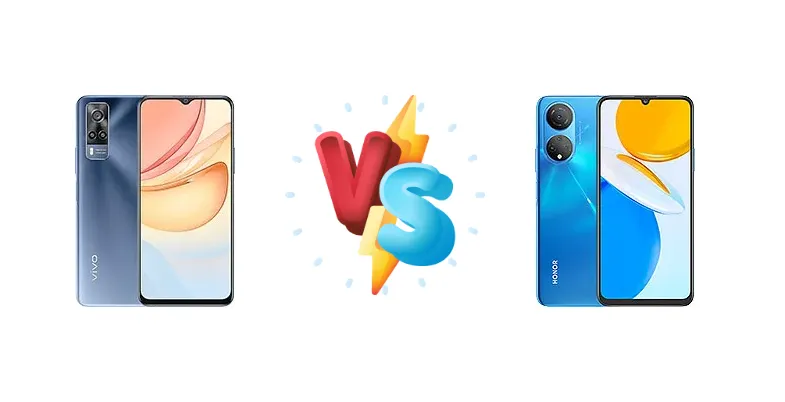
The budget smartphone market is fiercely competitive, and the vivo Y33 and Honor X7 are two strong contenders. Both offer compelling features at an affordable price, but which one comes out on top? This comprehensive comparison will delve into their specs, performance, and overall value to help you make an informed decision.
🏆 Quick Verdict
The Honor X7 edges out the vivo Y33 thanks to its more efficient 6nm Snapdragon 680 chipset, resulting in better performance and potentially improved battery life. While the Y33 has a slightly faster charging speed, the X7's overall package is more appealing for most users.
| Network |
|---|
| 2G bands | GSM 850 / 900 / 1800 / 1900 | GSM 850 / 900 / 1800 / 1900 |
| 3G bands | HSDPA 850 / 900 / 1700(AWS) / 2100 | HSDPA 850 / 900 / 2100 |
| 4G bands | 1, 2, 3, 4, 5, 7, 8, 12, 17, 28, 38, 40, 41, 66 | LTE |
| Speed | HSPA, LTE | HSPA, LTE |
| Technology | GSM / HSPA / LTE | GSM / HSPA / LTE |
| Launch |
|---|
| Announced | 2021, October 04 | 2022, March 30 |
| Status | Available. Released 2021, October 04 | Available. Released 2022, April 14 |
| Body |
|---|
| Build | Glass front, plastic frame, plastic back | Glass front, plastic back, plastic frame |
| Dimensions | 164 x 75.5 x 8.4 mm (6.46 x 2.97 x 0.33 in) | 167.6 x 77.2 x 8.6 mm (6.60 x 3.04 x 0.34 in) |
| SIM | · Nano-SIM· Nano-SIM + Nano-SIM | · Nano-SIM· Nano-SIM + Nano-SIM |
| Weight | 191 g (6.74 oz) | 198 g (6.98 oz) |
| Display |
|---|
| Resolution | 1080 x 2408 pixels, 20:9 ratio (~401 ppi density) | 720 x 1600 pixels, 20:9 ratio (~260 ppi density) |
| Size | 6.58 inches, 104.3 cm2 (~84.2% screen-to-body ratio) | 6.74 inches, 109.7 cm2 (~84.8% screen-to-body ratio) |
| Type | IPS LCD | IPS LCD, 90Hz |
| Platform |
|---|
| CPU | Octa-core (2x2.0 GHz Cortex-A75 & 6x1.8 GHz Cortex-A55) | Octa-core (4x2.4 GHz Kryo 265 Gold & 4x1.9 GHz Kryo 265 Silver) |
| Chipset | Mediatek MT6769V/CU Helio G80 (12 nm) | Qualcomm SM6225 Snapdragon 680 4G (6 nm) |
| GPU | Mali-G52 MC2 | Adreno 610 |
| OS | Android 11, Funtouch 11.1 | Android 11, Magic UI 4.2 |
| Memory |
|---|
| Card slot | microSDXC | microSDXC (uses shared SIM slot) |
| Internal | 128GB 4GB RAM | 128GB 4GB RAM, 128GB 6GB RAM |
| | - | eMMC 5.1 |
| Main Camera |
|---|
| Dual | - | 48 MP, f/1.8, (wide), PDAF
5 MP, f/2.2, (ultrawide)
2 MP (macro)
Auxiliary lens |
| Features | LED flash, HDR, panorama | LED flash, HDR, panorama |
| Single | - | 8 MP, f/2.0, (wide) |
| Triple | 48 MP, f/1.8, 26mm (wide), PDAF
2 MP (macro)
Auxiliary lens | - |
| Video | 1080p@30fps, gyro-EIS | 1080p@30fps |
| Selfie camera |
|---|
| Single | 16 MP, f/2.0, (wide) | 8 MP, f/2.0, (wide) |
| Video | 1080p@30fps | 1080p@30fps |
| Sound |
|---|
| 3.5mm jack | Yes | Yes |
| 35mm jack | Yes | Yes |
| Loudspeaker | Yes | Yes |
| Comms |
|---|
| Bluetooth | 5.0, A2DP, LE | 5.1, A2DP, LE |
| NFC | No | Yes (market/region dependent) |
| Positioning | GPS, GLONASS, GALILEO | GPS, BDS |
| Radio | FM radio | No |
| USB | USB Type-C 2.0, OTG | USB Type-C 2.0, OTG |
| WLAN | Wi-Fi 802.11 a/b/g/n/ac, dual-band, Wi-Fi Direct | Wi-Fi 802.11 a/b/g/n/ac, dual-band, Wi-Fi Direct |
| Features |
|---|
| Sensors | Fingerprint (side-mounted), accelerometer, gyro, proximity, compass | Fingerprint (side-mounted), accelerometer, compass |
| | - | Virtual proximity sensing |
| Battery |
|---|
| Charging | 18W wired, 70% in 66 min | 22.5W wired |
| Type | 5000 mAh | Li-Po 5000 mAh |
| Misc |
|---|
| Colors | Black, Light Blue | Ocean Blue, Titanium Silver |
| Models | V2057 | CMA-LX2, CMA-LX1, CMA-LX3 |
| Price | About 270 EUR | About 90 EUR |
vivo Y33
- Faster charging (18W)
- Familiar UI
- Decent main camera
- Less efficient chipset
- Lower resolution display
- Slower performance
Honor X7
- More efficient 6nm chipset
- Higher resolution display
- 90Hz refresh rate
- Slightly better camera performance
- Slower charging than some competitors
- Design may not appeal to everyone
Display Comparison
Both phones feature large 6.56-inch displays, but the Honor X7 boasts a slightly higher resolution (1080 x 2400 vs 720 x 1600 on the Y33). This translates to a sharper image on the X7. Both use IPS LCD panels, so expect decent color accuracy but not exceptional vibrancy. The X7 also has a slightly higher refresh rate (90Hz vs 60Hz on the Y33), leading to smoother scrolling and animations.
Camera Comparison
The vivo Y33 typically features a 50MP main camera, 2MP macro, and 2MP depth sensor. The Honor X7 has a 48MP main camera, 2MP macro, and 2MP depth sensor. While megapixel count isn't everything, the X7's image processing often produces more detailed and vibrant photos, especially in good lighting conditions. Both phones offer decent selfie cameras, but the X7's front camera might have a slight edge in low-light performance.
Performance
Here's where the Honor X7 truly shines. The Snapdragon 680, built on a 6nm process, is significantly more efficient than the Y33's Helio G80 (12nm). This means better performance in everyday tasks, smoother multitasking, and improved gaming capabilities. The X7's CPU architecture also offers a performance advantage. The Y33 is adequate for basic use, but will struggle with demanding applications.
Battery Life
The Honor X7 packs a larger 5000mAh battery compared to the Y33's 5000mAh. However, the X7's more efficient chipset allows it to deliver longer battery life. While both phones offer all-day battery life for moderate users, the X7 is likely to last longer under heavier usage. The Y33 charges at 18W, while the X7 supports 22.5W charging, offering slightly faster charging speeds.
Buying Guide
The vivo Y33 is a good choice for users prioritizing slightly faster charging and a familiar user interface. The Honor X7 is ideal for those seeking better performance, efficiency, and a modern design, especially if gaming or multitasking are important.
Frequently Asked Questions
❓ Which phone is better for gaming?
The Honor X7 is significantly better for gaming due to its more powerful and efficient Snapdragon 680 chipset.
❓ Does the vivo Y33 have 5G?
No, neither the vivo Y33 nor the Honor X7 support 5G connectivity. They are both 4G devices.