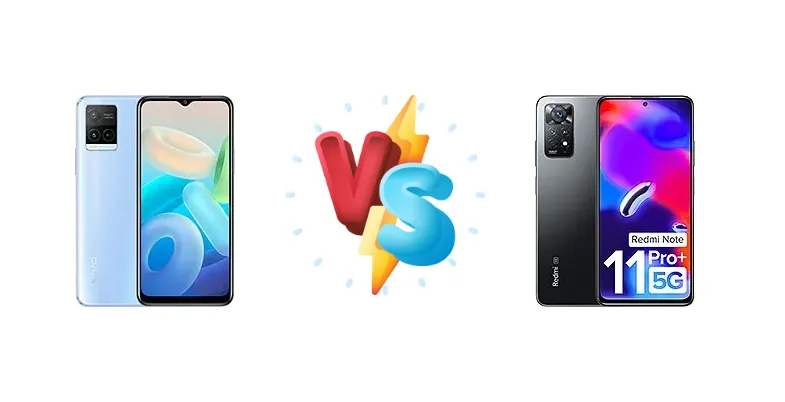
The sub-₹20,000 (approximately $240 USD) smartphone market in India is fiercely competitive. The vivo Y32 and Xiaomi Redmi Note 11 Pro+ 5G represent two distinct approaches to winning over budget-conscious consumers. The Y32 prioritizes affordability and efficiency with the Snapdragon 680, while the Redmi Note 11 Pro+ 5G aims for a more premium experience with the Snapdragon 695 and blazing-fast 67W charging. This comparison dissects their key differences to determine which device delivers the best value.
🏆 Quick Verdict
For the average user prioritizing fast charging and a more responsive experience, the Xiaomi Redmi Note 11 Pro+ 5G (India) is the clear winner. Its 67W charging dramatically reduces downtime, and the Snapdragon 695 offers a noticeable performance uplift over the Y32’s Snapdragon 680. However, the vivo Y32 remains a compelling option for those on a tighter budget who value efficiency.
| Network |
|---|
| 2G bands | GSM 850 / 900 / 1800 / 1900 | GSM 850 / 900 / 1800 / 1900 - SIM 1 & SIM 2 |
| 3G bands | HSDPA 850 / 900 / 2100 | HSDPA 850 / 900 / 1900 / 2100 |
| 4G bands | 1, 3, 5, 8, 34, 38, 39, 40, 41 | 1, 3, 5, 8, 40, 41 |
| 5G bands | - | 1, 3, 5, 8, 28, 40, 78 SA/NSA |
| Speed | HSPA, LTE | HSPA, LTE-A (CA), 5G |
| Technology | GSM / CDMA / HSPA / CDMA2000 / LTE | GSM / HSPA / LTE / 5G |
| | CDMA2000 1x | - |
| Launch |
|---|
| Announced | 2021, December 18 | 2022, March 09 |
| Status | Available. Released 2021, December 31 | Available. Released 2022, March 15 |
| Body |
|---|
| Build | Glass front, plastic back, plastic frame | Glass front (Gorilla Glass 5), glass back |
| Dimensions | 164.3 x 76.1 x 8 mm (6.47 x 3.00 x 0.31 in) | 164.2 x 76.1 x 8.1 mm (6.46 x 3.00 x 0.32 in) |
| SIM | Nano-SIM + Nano-SIM | Hybrid Dual SIM (Nano-SIM, dual stand-by) |
| Weight | 182 g (6.42 oz) | 202 g (7.13 oz) |
| | - | IP53, dust and splash resistant |
| Display |
|---|
| Protection | - | Corning Gorilla Glass 5 |
| Resolution | 720 x 1600 pixels, 20:9 ratio (~270 ppi density) | 1080 x 2400 pixels, 20:9 ratio (~395 ppi density) |
| Size | 6.51 inches, 102.3 cm2 (~81.8% screen-to-body ratio) | 6.67 inches, 107.4 cm2 (~86.0% screen-to-body ratio) |
| Type | IPS LCD | Super AMOLED, 120Hz, 700 nits, 1200 nits (peak) |
| Platform |
|---|
| CPU | Octa-core (4x2.4 GHz Kryo 265 Gold & 4x1.9 GHz Kryo 265 Silver) | Octa-core (2x2.2 GHz Kryo 660 Gold & 6x1.7 GHz Kryo 660 Silver) |
| Chipset | Qualcomm SM6225 Snapdragon 680 4G (6 nm) | Qualcomm SM6375 Snapdragon 695 5G (6 nm) |
| GPU | Adreno 610 | Adreno 619 |
| OS | Android 11, OriginOS 1.0 | Android 11, MIUI 13 |
| Memory |
|---|
| Card slot | microSDXC | microSDXC (uses shared SIM slot) |
| Internal | 64GB 4GB RAM, 128GB 4GB RAM, 128GB 6GB RAM, 128GB 8GB RAM | 64GB 6GB RAM, 128GB 6GB RAM, 128GB 8GB RAM, 256GB 8GB RAM |
| | UFS 2.1 | UFS 2.2 |
| Main Camera |
|---|
| Dual | 13 MP, f/2.2, (wide), AF
2 MP (macro) | - |
| Features | LED flash, HDR, panorama | LED flash, HDR, panorama |
| Single | 8 MP, f/1.8 | - |
| Triple | - | 108 MP, f/1.9, 26mm (wide), 1/1.52", 0.7µm, PDAF
8 MP, f/2.2, 118˚ (ultrawide)
2 MP, f/2.4, (macro) |
| Video | 1080p@30fps | 1080p@30fps |
| Selfie camera |
|---|
| Single | 8 MP, f/1.8 | 16 MP, f/2.5, (wide), 1/3.06" 1.0µm |
| Video | 1080p@30fps | 1080p@30fps |
| Sound |
|---|
| 3.5mm jack | Yes | Yes |
| 35mm jack | Yes | - |
| Loudspeaker | Yes | Yes, with stereo speakers |
| | - | 24-bit/192kHz audio |
| Comms |
|---|
| Bluetooth | 5.0, A2DP, LE, aptX Adaptive | 5.1, A2DP, LE |
| Infrared port | - | Yes |
| NFC | No | No |
| Positioning | GPS, GLONASS, GALILEO, BDS, QZSS | GPS, GLONASS, BDS, GALILEO |
| Radio | No | Unspecified |
| USB | USB Type-C 2.0, OTG | USB Type-C 2.0, OTG |
| WLAN | Wi-Fi 802.11 a/b/g/n/ac, dual-band, Wi-Fi Direct | Wi-Fi 802.11 a/b/g/n/ac, dual-band, Wi-Fi Direct |
| Features |
|---|
| Sensors | Fingerprint (side-mounted), accelerometer, proximity, compass | Fingerprint (side-mounted), accelerometer, gyro, proximity, compass |
| Battery |
|---|
| Charging | 18W wired
5W reverse wired | 67W wired, PD3.0, QC3, 50% in 15 min, 100% in 42 min (advertised) |
| Type | 5000 mAh | Li-Po 5000 mAh, non-removable |
| Misc |
|---|
| Colors | Dark Blue, Light Blue | Mirage Blue, Phantom White, Stealth Black |
| Models | V2158A | 2201116SI |
| Price | About 140 EUR | About 250 EUR |
vivo Y32
- More affordable price point
- Potentially better battery efficiency due to the Snapdragon 680
- Reliable Qualcomm chipset
- Significantly slower charging speed (18W)
- Less powerful processor for demanding tasks
- Lacks 5G connectivity
Xiaomi Redmi Note 11 Pro+ 5G (India)
- Blazing-fast 67W charging
- More powerful Snapdragon 695 5G processor
- 5G connectivity for faster data speeds
- Higher price compared to the vivo Y32
- Potentially slightly lower battery life due to more powerful processor
- May run warmer under heavy load
Display Comparison
While both devices likely feature LCD panels (data not provided), the core difference lies in their processing power. Display quality details like resolution and refresh rate are missing, but the focus here is on the chipsets driving the visuals. The Snapdragon 695 in the Redmi Note 11 Pro+ 5G will provide a smoother experience when scrolling and navigating the UI, even if the panels are similar.
Camera Comparison
Without detailed camera specifications, it’s difficult to make a definitive judgment. However, the Redmi Note 11 Pro+ 5G’s positioning suggests a more capable camera system. The Snapdragon 695’s ISP (Image Signal Processor) is more advanced than the 680’s, potentially leading to better image processing, especially in low-light conditions. The Redmi Note 11 Pro+ 5G is likely to offer more features and potentially higher resolution sensors, though this remains speculative without further data.
Performance
The Xiaomi Redmi Note 11 Pro+ 5G’s Snapdragon 695 5G represents a significant step up from the vivo Y32’s Snapdragon 680 4G. Both are built on a 6nm process, but the 695 features Kryo 660 cores clocked up to 2.2 GHz, compared to the 680’s Kryo 265 cores at 2.4 GHz. While the 680 has a slightly higher peak clock speed, the 695’s architecture and core configuration provide better sustained performance and 5G connectivity. This translates to faster app loading times, smoother multitasking, and the ability to handle more demanding games on the Redmi Note 11 Pro+ 5G.
Battery Life
The Redmi Note 11 Pro+ 5G’s 67W charging is the standout feature here. Advertised figures claim a 50% charge in 15 minutes and a full charge in 42 minutes. This is a game-changer for users who frequently find themselves needing to top up their battery quickly. The vivo Y32’s 18W charging, while adequate, is significantly slower. While battery capacity isn’t specified for either device, the faster charging of the Redmi Note 11 Pro+ 5G effectively mitigates any potential capacity disadvantage.
Buying Guide
Buy the vivo Y32 if you need a reliable, long-lasting phone for basic tasks like calling, messaging, and light social media use, and battery life is paramount. Buy the Xiaomi Redmi Note 11 Pro+ 5G (India) if you prefer a faster, more versatile device with significantly quicker charging, and are willing to spend a bit more for a smoother user experience and potential for more demanding applications.
Frequently Asked Questions
❓ Will the Snapdragon 695 in the Redmi Note 11 Pro+ 5G handle demanding games like PUBG Mobile smoothly?
The Snapdragon 695 is capable of running PUBG Mobile at medium settings with reasonable frame rates. While it won't deliver a flagship-level gaming experience, it offers a noticeable improvement over the Snapdragon 680, allowing for smoother gameplay and fewer stutters. Expect to adjust graphics settings for optimal performance.
❓ How much faster is the 67W charging on the Redmi Note 11 Pro+ 5G compared to the 18W charging on the vivo Y32 in real-world use?
The difference is substantial. The Redmi Note 11 Pro+ 5G can go from 0% to 50% in just 15 minutes, and a full charge in around 42 minutes (as advertised). The vivo Y32’s 18W charging will likely take over 2 hours to fully charge the battery, making it less convenient for users who need a quick top-up.
❓ Does the Redmi Note 11 Pro+ 5G support VoLTE on all Indian carriers?
The Redmi Note 11 Pro+ 5G (India) is designed to support VoLTE on all major Indian carriers, including Jio, Airtel, and Vi. However, it's always recommended to check the latest compatibility information on Xiaomi's official website or with your carrier to ensure seamless connectivity.