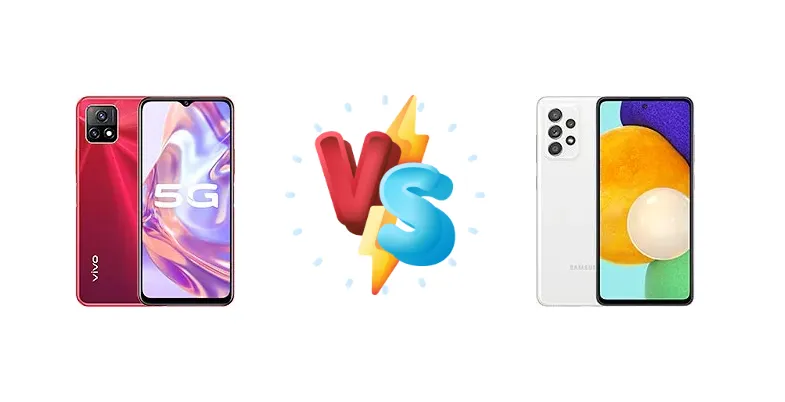
The vivo Y31s and Samsung Galaxy A52 5G represent compelling options in the increasingly competitive budget 5G smartphone market. While both aim to deliver 5G connectivity at an accessible price point, they diverge significantly in their internal hardware and feature sets. This comparison dissects these differences to determine which device offers the best value for your money.
🏆 Quick Verdict
For the average user prioritizing a smoother overall experience and a brighter, more vibrant display, the Samsung Galaxy A52 5G emerges as the superior choice. Its Snapdragon 750G chipset and 787 nit display offer a noticeable advantage over the vivo Y31s' Snapdragon 480 and less detailed screen.
| Network |
|---|
| 2G bands | GSM 850 / 900 / 1800 / 1900 | GSM 850 / 900 / 1800 / 1900 |
| 3G bands | HSDPA 850 / 900 / 1700(AWS) / 2100 | HSDPA 850 / 900 / 1700(AWS) / 1900 / 2100 |
| 4G bands | 1, 3, 4, 5, 8, 28, 34, 38, 39, 40, 41 | 1, 2, 3, 4, 5, 7, 8, 12, 17, 20, 26, 28, 32, 38, 40, 41, 66 |
| 5G bands | 1, 3, 28, 41, 77, 78 SA/NSA | 1, 3, 5, 7, 8, 20, 28, 38, 40, 41, 66, 78 SA/NSA/Sub6 |
| Speed | HSPA, LTE, 5G | HSPA, LTE, 5G |
| Technology | GSM / CDMA / HSPA / CDMA2000 / LTE / 5G | GSM / HSPA / LTE / 5G |
| | CDMA2000 1x | - |
| Launch |
|---|
| Announced | 2021, January 12 | 2021, March 17 |
| Status | Available. Released 2021, January 15 | Available. Released 2021, March 19 |
| Body |
|---|
| Build | - | Glass front (Gorilla Glass 5), plastic back |
| Dimensions | 164.2 x 75.4 x 8.4 mm (6.46 x 2.97 x 0.33 in) | 159.9 x 75.1 x 8.4 mm (6.30 x 2.96 x 0.33 in) |
| SIM | Nano-SIM + Nano-SIM | · Nano-SIM· Nano-SIM + Nano-SIM |
| Weight | 185.5 g (6.56 oz) | 189 g (6.67 oz) |
| | - | IP67 dust/water resistant (up to 1m for 30 min) |
| Display |
|---|
| Protection | - | Corning Gorilla Glass 5 |
| Resolution | 1080 x 2408 pixels, 20:9 ratio (~400 ppi density) | 1080 x 2400 pixels, 20:9 ratio (~407 ppi density) |
| Size | 6.58 inches, 104.8 cm2 (~84.7% screen-to-body ratio) | 6.5 inches, 101.0 cm2 (~84.1% screen-to-body ratio) |
| Type | IPS LCD, 90Hz | Super AMOLED, 120Hz, HDR10+, 800 nits (HBM) |
| | - | Always-on display |
| Platform |
|---|
| CPU | Octa-core (2x2.0 GHz Kryo 460 & 6x1.8 GHz Kryo 460) | Octa-core (2x2.2 GHz Kryo 570 & 6x1.8 GHz Kryo 570) |
| Chipset | Qualcomm SM4350 Snapdragon 480 5G (8 nm) | Qualcomm SM7225 Snapdragon 750G 5G (8 nm) |
| GPU | Adreno 619 | Adreno 619 |
| OS | Android 11, Funtouch 10.5 | Android 11, upgradable to Android 14, One UI 6.1 |
| Memory |
|---|
| Card slot | No | microSDXC (uses shared SIM slot) |
| Internal | 64GB 4GB RAM, 128GB 4GB RAM, 128GB 6GB RAM | 128GB 4GB RAM, 128GB 6GB RAM, 128GB 8GB RAM, 256GB 4GB RAM, 256GB 8GB RAM |
| | UFS 2.1 | - |
| Main Camera |
|---|
| Dual | 13 MP, f/2.2, (wide), PDAF
Auxiliary lens | - |
| Features | LED flash, HDR, panorama | LED flash, panorama, HDR |
| Quad | - | 64 MP, f/1.8, 26mm (wide), 1/1.7X", 0.8µm, PDAF, OIS
12 MP, f/2.2, 123˚ (ultrawide), 1.12µm
5 MP (macro)
Auxiliary lens |
| Video | 4K@30fps, 1080p@30fps | 4K@30fps, 1080p@30/60fps; gyro-EIS |
| Selfie camera |
|---|
| Features | HDR | HDR |
| Single | 8 MP, f/2.0, (wide) | 32 MP, f/2.2, 26mm (wide), 1/2.8", 0.8µm |
| Video | 1080p@30fps | 4K@30fps, 1080p@30fps |
| Sound |
|---|
| 3.5mm jack | Yes | Yes |
| 35mm jack | Yes | Yes |
| Loudspeaker | Yes | Yes, with stereo speakers |
| Comms |
|---|
| Bluetooth | 5.1, A2DP, LE, aptX HD | 5.0, A2DP, LE |
| NFC | No | Yes (market/region dependent) |
| Positioning | GPS, GLONASS, BDS, GALILEO | GPS, GLONASS, GALILEO, BDS |
| Radio | No | FM radio (market/region dependent) |
| USB | USB Type-C 2.0, OTG | USB Type-C 2.0, OTG |
| WLAN | Wi-Fi 802.11 a/b/g/n/ac/6, dual-band, Wi-Fi Direct | Wi-Fi 802.11 a/b/g/n/ac, dual-band, Wi-Fi Direct |
| Features |
|---|
| Sensors | Fingerprint (side-mounted), accelerometer, proximity, compass | Fingerprint (under display, optical), accelerometer, gyro, compass |
| | - | Virtual proximity sensing |
| Battery |
|---|
| Charging | 18W wired | 25W wired, 50% in 30 min |
| Type | 5000 mAh | Li-Po 4500 mAh |
| Misc |
|---|
| Colors | Red, Gray, Aurora | Awesome Black, Awesome White, Awesome Violet, Awesome Blue |
| Models | V2054A, V2068A | SM-A526B, SM-A526B/DS, SM-A5260, SM-A526W, SM-A526U, SM-A526U1 |
| Price | About 190 EUR | $ 137.39 / £ 280.00 / € 115.49 |
| SAR | - | 0.74 W/kg (head) 0.53 W/kg (body) |
| SAR EU | - | 1.05 W/kg (head) 1.42 W/kg (body) |
| Tests |
|---|
| Battery life | - |
Endurance rating 111h
|
| Camera | - |
Photo / Video |
| Display | - |
Contrast ratio: Infinite (nominal) |
| Loudspeaker | - |
-27.5 LUFS (Good)
|
| Performance | - |
AnTuTu: 334981 (v8), 386474 (v9)
GeekBench: 1820 (v5.1)
GFXBench: 16fps (ES 3.1 onscreen) |
vivo Y31s
- More affordable price point
- 5G connectivity
- Compact and lightweight design (likely)
- Less powerful processor
- Lower display brightness and quality
- Basic camera system
Samsung Galaxy A52 5G
- Faster Snapdragon 750G processor
- Brighter and more vibrant display
- Faster 25W charging
- Higher price tag
- Potentially larger and heavier design
- May include bloatware (typical for Samsung)
Display Comparison
The Samsung Galaxy A52 5G boasts a significantly brighter display, reaching a measured 787 nits, compared to the vivo Y31s, for which peak brightness data is unavailable. This difference translates to superior visibility in direct sunlight. While both phones likely utilize LCD panels (given their price points), the A52 5G’s higher brightness and likely better color calibration provide a more immersive viewing experience. The A52 5G’s ‘Infinite’ contrast ratio (nominal) suggests a more dynamic range, though this is typical marketing language. The Y31s’ display specs are less defined, suggesting a more basic panel.
Camera Comparison
Both devices are listed as having Photo/Video capabilities, but detailed camera specifications are lacking. However, given Samsung’s history, the A52 5G likely features a more sophisticated camera system with a larger main sensor and potentially Optical Image Stabilization (OIS). The Y31s, positioned as a budget device, likely relies on simpler sensors and image processing. The absence of detail suggests the Y31s camera is a basic offering, while the A52 5G likely provides more versatile and higher-quality photos and videos. We can assume both phones include a standard array of camera modes, but the A52 5G’s image processing algorithms will likely deliver more refined results.
Performance
The core difference lies in the chipsets: the vivo Y31s utilizes the Qualcomm SM4350 Snapdragon 480 5G, while the Samsung Galaxy A52 5G features the SM7225 Snapdragon 750G 5G. Both are 8nm chips, but the 750G’s Kryo 570 cores (2x2.2 GHz & 6x1.8 GHz) offer a performance advantage over the 480’s Kryo 460 cores (2x2.0 GHz & 6x1.8 GHz). This translates to faster app loading times, smoother multitasking, and improved gaming performance on the A52 5G. While both support 5G, the 750G’s more powerful modem may offer slightly better 5G connectivity in fringe areas. RAM configurations are not specified, but the A52 5G likely benefits from faster LPDDR4X RAM, further enhancing performance.
Battery Life
Both the vivo Y31s and Samsung Galaxy A52 5G share an endurance rating of 111 hours, indicating comparable battery life under similar usage conditions. However, the A52 5G’s 25W wired charging (50% in 30 minutes) is significantly faster than the Y31s’ 18W charging. This means the A52 5G can be topped up more quickly, minimizing downtime. While both phones offer all-day battery life for moderate users, the A52 5G’s faster charging provides a crucial convenience advantage.
Buying Guide
Buy the vivo Y31s if you need a functional 5G phone on a very tight budget and prioritize basic connectivity over performance and display quality. It's a good option for users who primarily use their phone for calls, texts, and light social media. Buy the Samsung Galaxy A52 5G if you prefer a more refined user experience, a significantly better display for media consumption, and a more capable processor for gaming and multitasking. It’s ideal for users who want a phone that can handle a wider range of tasks without feeling sluggish.
Frequently Asked Questions
❓ Is the Snapdragon 480 in the vivo Y31s powerful enough for casual gaming?
The Snapdragon 480 is capable of handling less demanding mobile games at lower settings. However, for graphically intensive titles like PUBG or Call of Duty Mobile, you'll likely experience noticeable lag and frame drops. The Snapdragon 750G in the A52 5G provides a much smoother gaming experience.
❓ Does the Samsung Galaxy A52 5G suffer from thermal throttling during extended gaming sessions?
While the Snapdragon 750G is a capable chip, prolonged gaming can lead to some thermal throttling. However, Samsung’s thermal management system is generally effective at mitigating this issue, preventing significant performance drops. The Y31s, with its less powerful processor, is less likely to throttle but also offers a lower peak performance ceiling.
❓ How does the 5G performance differ between the vivo Y31s and the Samsung Galaxy A52 5G?
Both phones support 5G, but the Snapdragon 750G in the A52 5G has a more advanced 5G modem. This can translate to slightly faster download and upload speeds, as well as better connectivity in areas with weaker 5G signals. The difference is likely to be minimal in areas with strong 5G coverage.
❓ Is the camera on the vivo Y31s suitable for taking photos in low-light conditions?
Given the Y31s' positioning as a budget device, its camera is unlikely to perform well in low-light conditions. Expect noisy images with limited detail. The Samsung Galaxy A52 5G, with its potentially larger sensor and image stabilization, will deliver significantly better low-light performance.