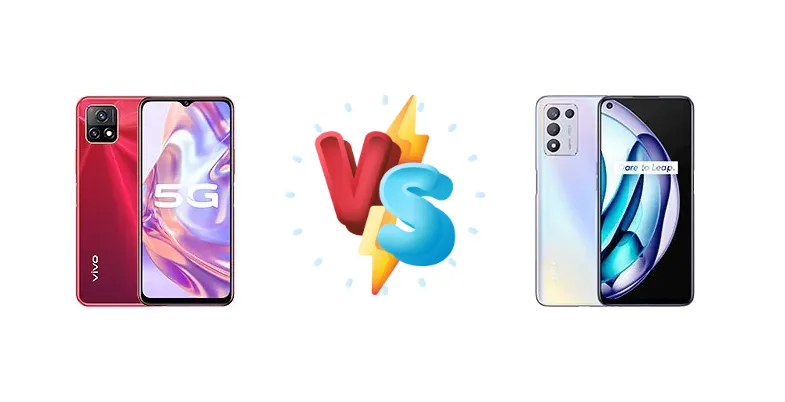
The Realme Q3t and vivo Y31s both aim to deliver affordable 5G connectivity, but they take drastically different approaches. The vivo Y31s prioritizes a lower entry price with the Snapdragon 480, while the Realme Q3t steps up to the more powerful Snapdragon 778G. This comparison dissects the trade-offs between these two devices, helping you determine which best suits your needs.
🏆 Quick Verdict
For most users, the Realme Q3t is the clear winner. Its Snapdragon 778G chipset provides a substantial performance boost for gaming and demanding applications, and the 30W charging significantly reduces downtime. While the Y31s offers a lower price, the Q3t’s superior experience justifies the extra cost.
| Network |
|---|
| 2G bands | GSM 850 / 900 / 1800 / 1900 | GSM 850 / 900 / 1800 / 1900 |
| 3G bands | HSDPA 850 / 900 / 1700(AWS) / 2100 | HSDPA 850 / 900 / 1700(AWS) / 1900 / 2100 |
| 4G bands | 1, 3, 4, 5, 8, 28, 34, 38, 39, 40, 41 | LTE |
| 5G bands | 1, 3, 28, 41, 77, 78 SA/NSA | SA/NSA |
| Speed | HSPA, LTE, 5G | HSPA, LTE, 5G |
| Technology | GSM / CDMA / HSPA / CDMA2000 / LTE / 5G | GSM / CDMA / HSPA / EVDO / LTE / 5G |
| | CDMA2000 1x | CDMA2000 1xEV-DO |
| Launch |
|---|
| Announced | 2021, January 12 | 2021, November 10 |
| Status | Available. Released 2021, January 15 | Available. Released 2021, November 15 |
| Body |
|---|
| Dimensions | 164.2 x 75.4 x 8.4 mm (6.46 x 2.97 x 0.33 in) | - |
| SIM | Nano-SIM + Nano-SIM | Nano-SIM + Nano-SIM |
| Weight | 185.5 g (6.56 oz) | - |
| Display |
|---|
| Resolution | 1080 x 2408 pixels, 20:9 ratio (~400 ppi density) | 1080 x 2412 pixels, 20:9 ratio (~400 ppi density) |
| Size | 6.58 inches, 104.8 cm2 (~84.7% screen-to-body ratio) | 6.6 inches, 104.8 cm2 |
| Type | IPS LCD, 90Hz | IPS LCD, 144Hz, 600 nits |
| Platform |
|---|
| CPU | Octa-core (2x2.0 GHz Kryo 460 & 6x1.8 GHz Kryo 460) | Octa-core (1x2.4 GHz Cortex-A78 & 3x2.2 GHz Cortex-A78 & 4x1.9 GHz Cortex-A55) |
| Chipset | Qualcomm SM4350 Snapdragon 480 5G (8 nm) | Qualcomm SM7325 Snapdragon 778G 5G (6 nm) |
| GPU | Adreno 619 | Adreno 642L |
| OS | Android 11, Funtouch 10.5 | Android 11, Realme UI 2.0 |
| Memory |
|---|
| Card slot | No | Unspecified |
| Internal | 64GB 4GB RAM, 128GB 4GB RAM, 128GB 6GB RAM | 256GB 8GB RAM |
| | UFS 2.1 | - |
| Main Camera |
|---|
| Dual | 13 MP, f/2.2, (wide), PDAF
Auxiliary lens | - |
| Features | LED flash, HDR, panorama | LED flash, HDR, panorama |
| Single | - | 16 MP, f/2.1, 26mm (wide) |
| Triple | - | 48 MP, f/1.8, 26mm (wide), PDAF
2 MP (macro)
Auxiliary lens |
| Video | 4K@30fps, 1080p@30fps | 4K@30fps, 1080p@30/60fps |
| Selfie camera |
|---|
| Features | HDR | HDR, panorama |
| Single | 8 MP, f/2.0, (wide) | 16 MP, f/2.1, 26mm (wide) |
| Video | 1080p@30fps | 1080p@30fps |
| Sound |
|---|
| 3.5mm jack | Yes | Yes |
| 35mm jack | Yes | Yes |
| Loudspeaker | Yes | Yes |
| | - | 24-bit/192kHz audio |
| Comms |
|---|
| Bluetooth | 5.1, A2DP, LE, aptX HD | 5.2, A2DP, LE |
| NFC | No | No |
| Positioning | GPS, GLONASS, BDS, GALILEO | GPS, GLONASS, BDS, GALILEO, QZSS |
| Radio | No | No |
| USB | USB Type-C 2.0, OTG | USB Type-C 2.0, OTG |
| WLAN | Wi-Fi 802.11 a/b/g/n/ac/6, dual-band, Wi-Fi Direct | Wi-Fi 802.11 a/b/g/n/ac/6, dual-band, Wi-Fi Direct |
| Features |
|---|
| Sensors | Fingerprint (side-mounted), accelerometer, proximity, compass | Fingerprint (side-mounted), accelerometer, gyro, proximity, compass |
| Battery |
|---|
| Charging | 18W wired | 30W wired, 50% in 25 min |
| Type | 5000 mAh | 5000 mAh |
| Misc |
|---|
| Colors | Red, Gray, Aurora | Aurora, Dark Blue |
| Models | V2054A, V2068A | - |
| Price | About 190 EUR | About 290 EUR |
vivo Y31s
- Lower price point makes it accessible.
- 5G connectivity for future-proofed data speeds.
- Sufficient for basic smartphone tasks.
- Snapdragon 480 struggles with demanding games.
- Slow 18W charging.
- Potentially limited software support.
Realme Q3t
- Significantly faster Snapdragon 778G processor.
- 30W fast charging for quick power-ups.
- Improved gaming performance and multitasking.
- Likely better camera image processing.
- Higher price compared to the vivo Y31s.
- Potentially slightly lower battery life due to more powerful chipset.
Display Comparison
Neither device’s display specifications are provided, so a direct comparison is limited. However, given the Q3t’s positioning, it likely features a higher refresh rate panel (potentially 90Hz or 120Hz) compared to the Y31s’ standard 60Hz. The Q3t’s more premium chipset suggests a potentially brighter panel with better color accuracy, enhancing media consumption. Bezels are likely comparable, given both target the budget segment.
Camera Comparison
Without detailed camera specs, analysis is limited. However, the Q3t’s more powerful ISP (Image Signal Processor) within the Snapdragon 778G will likely result in better image processing, particularly in low-light conditions. The Q3t is more likely to feature a larger main sensor, enabling better dynamic range and detail. While both phones likely include standard features like HDR, the Q3t’s superior processing power will allow for more effective noise reduction and sharper images. The Y31s will likely rely more heavily on software processing to compensate for a potentially less capable sensor.
Performance
The core difference lies in the chipsets. The Realme Q3t’s Snapdragon 778G (6nm) is a significant leap over the vivo Y31s’ Snapdragon 480 (8nm). The 778G features a Cortex-A78 prime core clocked at 2.4GHz, alongside three additional A78 cores, offering substantially better multi-core and single-core performance. The 480 relies on Kryo 460 cores, which are less efficient and powerful. This translates to smoother multitasking, faster app launches, and a far superior gaming experience on the Q3t. The 6nm process node of the 778G also contributes to better thermal efficiency, reducing throttling during sustained loads. The Q3t will handle graphically intensive games at higher settings with greater stability.
Battery Life
Battery capacity isn’t specified for either device. However, the Realme Q3t’s 30W charging is a major advantage, promising a 50% charge in just 25 minutes. The vivo Y31s’ 18W charging is considerably slower. While the Snapdragon 778G is more powerful, its 6nm process helps mitigate some of the increased power draw. The Q3t’s faster charging is crucial for users who need to quickly top up their battery, while the Y31s will require significantly longer to reach a full charge.
Buying Guide
Buy the vivo Y31s if you need a basic, reliable 5G smartphone for everyday tasks like browsing, social media, and light communication, and your budget is extremely tight. Buy the Realme Q3t if you prioritize smooth gaming, faster app loading times, and quicker charging, and are willing to spend a bit more for a noticeably improved user experience.
Frequently Asked Questions
❓ Will the Realme Q3t overheat during prolonged gaming sessions?
The Snapdragon 778G’s 6nm process and Realme’s thermal management solutions should prevent significant overheating. While some warmth is expected during intensive gaming, the Q3t is designed to maintain stable performance for extended periods, unlike the Snapdragon 480 which is more prone to throttling.
❓ Is the Snapdragon 480 in the vivo Y31s sufficient for playing PUBG Mobile?
The Snapdragon 480 can run PUBG Mobile, but likely at lower graphics settings and frame rates to maintain a playable experience. Expect occasional stuttering and frame drops, especially in intense firefights. The Realme Q3t will provide a much smoother and more consistent PUBG Mobile experience.
❓ Does the Realme Q3t support VoLTE and VoWiFi on all carriers?
Carrier compatibility can vary. It's crucial to check with your specific carrier to confirm VoLTE and VoWiFi support for the Realme Q3t model number available in your region. While the Snapdragon 778G supports these technologies, implementation depends on carrier certification.
❓ How does the 30W charging on the Realme Q3t compare to other fast charging standards?
Realme’s 30W Dart Charge is a proprietary standard, but it’s comparable to other 30W fast charging solutions. It’s faster than the 18W charging on the vivo Y31s and provides a significant convenience boost, allowing you to quickly replenish the battery when needed.