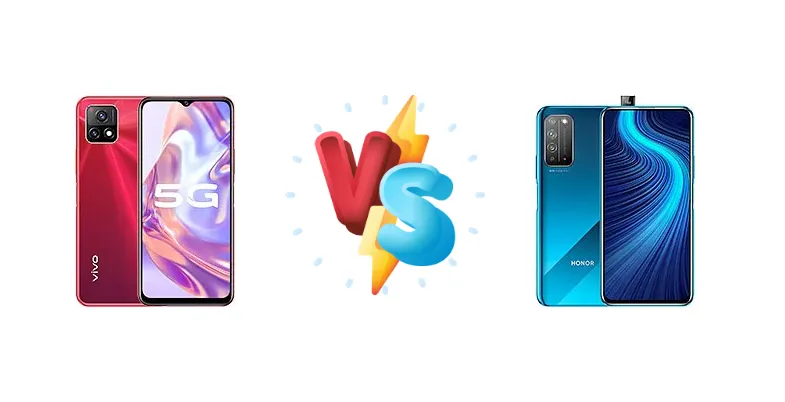
The vivo Y31s and Honor X10 5G represent distinct approaches to the affordable 5G smartphone market. The Y31s leverages Qualcomm's Snapdragon 480, aiming for efficiency and widespread 5G compatibility, while the X10 5G boasts Huawei's Kirin 820, prioritizing raw processing power. This comparison dissects their key differences to determine which device delivers the best value.
🏆 Quick Verdict
For the average user prioritizing everyday tasks and future-proofing with 5G, the Honor X10 5G emerges as the stronger contender. Its Kirin 820 chipset offers significantly better performance than the Snapdragon 480, justifying the slight price premium and providing a smoother user experience, especially with demanding applications.
| Network |
|---|
| 2G bands | GSM 850 / 900 / 1800 / 1900 | GSM 850 / 900 / 1800 / 1900 |
| 3G bands | HSDPA 850 / 900 / 1700(AWS) / 2100 | HSDPA 800 / 850 / 900 / 1700(AWS) / 1900 / 2100 |
| 4G bands | 1, 3, 4, 5, 8, 28, 34, 38, 39, 40, 41 | 1, 2, 3, 4, 5, 8, 18, 19, 26, 34, 38, 39, 40, 41 |
| 5G bands | 1, 3, 28, 41, 77, 78 SA/NSA | 1, 3, 38, 41, 77, 78, 79, 80, 84 SA/NSA |
| Speed | HSPA, LTE, 5G | HSPA 42.2/5.76 Mbps, LTE (4CA) Cat12 600/50 Mbps, 5G 2.3 Gbps DL |
| Technology | GSM / CDMA / HSPA / CDMA2000 / LTE / 5G | GSM / CDMA / HSPA / EVDO / LTE / 5G |
| | CDMA2000 1x | CDMA2000 1xEV-DO |
| Launch |
|---|
| Announced | 2021, January 12 | 2020, May 20. Released 2020, May 26 |
| Status | Available. Released 2021, January 15 | Discontinued |
| Body |
|---|
| Build | - | Glass front (Aluminosilicate glass) |
| Dimensions | 164.2 x 75.4 x 8.4 mm (6.46 x 2.97 x 0.33 in) | 163.7 x 76.5 x 8.8 mm (6.44 x 3.01 x 0.35 in) |
| SIM | Nano-SIM + Nano-SIM | Nano-SIM + Nano-SIM |
| Weight | 185.5 g (6.56 oz) | 203 g (7.16 oz) |
| Display |
|---|
| Protection | - | Aluminosilicate glass |
| Resolution | 1080 x 2408 pixels, 20:9 ratio (~400 ppi density) | 1080 x 2400 pixels, 20:9 ratio (~397 ppi density) |
| Size | 6.58 inches, 104.8 cm2 (~84.7% screen-to-body ratio) | 6.63 inches, 106.1 cm2 (~84.7% screen-to-body ratio) |
| Type | IPS LCD, 90Hz | IPS LCD, 90Hz |
| Platform |
|---|
| CPU | Octa-core (2x2.0 GHz Kryo 460 & 6x1.8 GHz Kryo 460) | Octa-core (1x2.36 GHz Cortex-A76 & 3x2.22 GHz Cortex-A76 & 4x1.84 GHz Cortex-A55) |
| Chipset | Qualcomm SM4350 Snapdragon 480 5G (8 nm) | Kirin 820 5G (7 nm) |
| GPU | Adreno 619 | Mali-G57 (6-core) |
| OS | Android 11, Funtouch 10.5 | Android 10, Magic UI 3.1, no Google Play Services |
| Memory |
|---|
| Card slot | No | Nano Memory (uses shared SIM slot) |
| Internal | 64GB 4GB RAM, 128GB 4GB RAM, 128GB 6GB RAM | 64GB 6GB RAM, 128GB 6GB RAM, 128GB 8GB RAM |
| | UFS 2.1 | - |
| Main Camera |
|---|
| Dual | 13 MP, f/2.2, (wide), PDAF
Auxiliary lens | - |
| Features | LED flash, HDR, panorama | LED flash, panorama, HDR |
| Triple | - | 40 MP, f/1.8, 26mm (wide), 1/1.7", PDAF
8 MP, f/2.4, 17mm, 120˚ (ultrawide)
Auxiliary lens |
| Video | 4K@30fps, 1080p@30fps | 4K@30fps, 1080p@30fps, 720p@960fps, gyro-EIS |
| Selfie camera |
|---|
| Features | HDR | HDR |
| Single | 8 MP, f/2.0, (wide) | Motorized pop-up 16 MP, f/2.2, 24mm (wide), 1/3.06", 1.0µm |
| Video | 1080p@30fps | 1080p@30fps |
| Sound |
|---|
| 3.5mm jack | Yes | Yes |
| 35mm jack | Yes | Yes |
| Loudspeaker | Yes | Yes |
| Comms |
|---|
| Bluetooth | 5.1, A2DP, LE, aptX HD | 5.1, A2DP, LE |
| NFC | No | No |
| Positioning | GPS, GLONASS, BDS, GALILEO | GPS, GLONASS, BDS |
| Radio | No | No |
| USB | USB Type-C 2.0, OTG | USB Type-C 2.0, OTG |
| WLAN | Wi-Fi 802.11 a/b/g/n/ac/6, dual-band, Wi-Fi Direct | Wi-Fi 802.11 a/b/g/n/ac, dual-band, Wi-Fi Direct |
| Features |
|---|
| Sensors | Fingerprint (side-mounted), accelerometer, proximity, compass | Fingerprint (side-mounted), accelerometer, gyro, proximity, compass |
| Battery |
|---|
| Charging | 18W wired | 22.5W wired
5W reverse wired |
| Type | 5000 mAh | Li-Po 4300 mAh |
| Misc |
|---|
| Colors | Red, Gray, Aurora | Blue, Orange, Black, Silver |
| Models | V2054A, V2068A | TEL-AN00, TEL-TN00, TEL-AN00a, TEL-AN10 |
| Price | About 190 EUR | About 250 EUR |
vivo Y31s
- More affordable price point
- Potentially better battery life due to Snapdragon 480's efficiency
- Widespread 5G band support (typical of Snapdragon)
- Significantly weaker processing performance
- Slower charging speed
- Less capable ISP for camera processing
Honor X10 5G
- Superior processing power with Kirin 820
- Faster 22.5W charging
- 5W reverse wired charging
- More advanced ISP for better camera performance
- Higher price compared to vivo Y31s
- Potentially slightly lower battery life under heavy load
- May have limited software updates due to Huawei's situation
Display Comparison
Neither device boasts a standout display. While specific panel details (like OLED vs LCD) are missing, the focus here is on processing power. The difference in display quality is likely minimal. Both will offer adequate viewing experiences for everyday use, but neither is geared towards media consumption enthusiasts. Bezels are likely comparable given the market segment.
Camera Comparison
Without detailed camera specs beyond the chipsets, a direct comparison is limited. However, the Kirin 820’s integrated ISP (Image Signal Processor) is generally more capable than the Snapdragon 480’s, suggesting potentially better image processing and dynamic range in the Honor X10 5G. The X10 5G is likely to offer more sophisticated camera features and better low-light performance. The presence of a dedicated ISP in the Kirin 820 allows for more complex image processing algorithms.
Performance
The core difference lies in the chipsets. The Honor X10 5G’s Kirin 820 5G (7nm) is a substantial upgrade over the vivo Y31s’ Snapdragon 480 5G (8nm). The Kirin 820’s octa-core configuration, featuring a Cortex-A76 prime core clocked at 2.36 GHz, provides significantly more processing power than the Snapdragon 480’s 2.0 GHz Kryo 460 cores. This translates to faster app loading times, smoother multitasking, and a more responsive user interface. The Kirin 820 also benefits from a more advanced GPU, offering superior graphics performance for gaming. The 7nm process node of the Kirin 820 also contributes to better thermal efficiency, potentially reducing throttling during sustained workloads.
Battery Life
The Honor X10 5G’s 22.5W wired charging is faster than the vivo Y31s’ 18W charging. While battery capacity isn’t specified, the faster charging speed on the X10 5G means less downtime. The 5W reverse wired charging on the X10 5G is a useful feature for topping up accessories. The Snapdragon 480’s efficiency might partially offset the slower charging, but the Kirin 820’s superior processing power will likely consume more energy during intensive tasks.
Buying Guide
Buy the vivo Y31s if you need a highly affordable 5G phone with a focus on battery efficiency and basic functionality. It's ideal for users who primarily browse the web, use social media, and make calls. Buy the Honor X10 5G if you prefer a more responsive and capable device for multitasking, gaming, and content creation. The Kirin 820 provides a noticeable performance boost for power users.
Frequently Asked Questions
❓ Does the Kirin 820 in the Honor X10 5G experience significant throttling under sustained gaming loads?
While the Kirin 820 is a capable chipset, Huawei's chipsets have historically been prone to thermal throttling. However, the 7nm process node and the X10 5G's cooling solution should mitigate this to some extent. Expect some performance reduction during extended gaming sessions, but it shouldn't be severe enough to render games unplayable.
❓ Is the Snapdragon 480 in the vivo Y31s powerful enough for playing popular games like PUBG Mobile or Call of Duty Mobile?
The Snapdragon 480 can run PUBG Mobile and Call of Duty Mobile, but you'll likely need to lower the graphics settings to achieve a smooth frame rate. Don't expect a high-end gaming experience; it's best suited for casual gaming at medium settings. The Kirin 820 in the Honor X10 5G will provide a significantly better gaming experience.
❓ What is the impact of Huawei's restrictions on software updates for the Honor X10 5G?
Due to US sanctions, the Honor X10 5G may receive fewer software updates and security patches compared to devices from other manufacturers. While Honor is now independent, the long-term software support remains a concern for some users. Consider this if timely updates are a priority.
❓ How does the 5G performance differ between the Snapdragon 480 and Kirin 820?
Both chipsets support 5G connectivity, but the Snapdragon 480 generally offers broader 5G band support, making it more compatible with different 5G networks globally. However, in areas with strong 5G coverage, the difference in actual speeds is likely to be minimal.