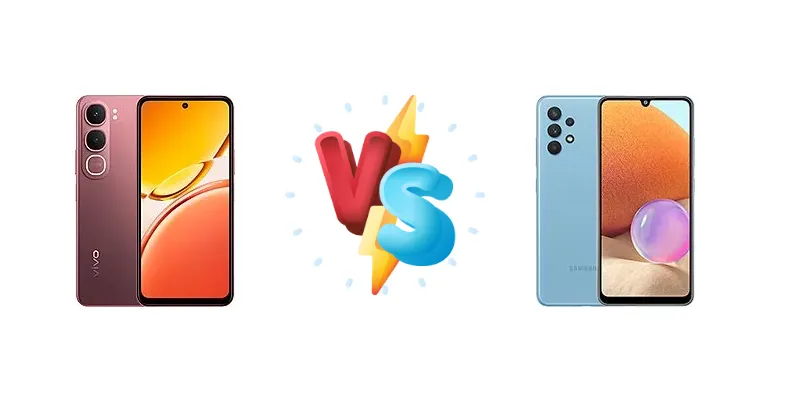
The sub-$200 smartphone market is fiercely competitive, and the vivo Y31 and Samsung Galaxy A32 represent compelling options. The Y31 arrives with a more modern Qualcomm Snapdragon 4 Gen 2 chipset, while the A32 relies on the older MediaTek Helio G80. This comparison dives deep into the specifications to determine which device delivers the best value for your money.
🏆 Quick Verdict
For most users, the vivo Y31 emerges as the stronger contender. Its Snapdragon 4 Gen 2 chipset, built on a 4nm process, offers a noticeable performance advantage and improved efficiency over the Galaxy A32’s Helio G80. The significantly faster 44W charging is a major convenience factor, offsetting the similar battery endurance ratings.
| Network |
|---|
| 2G bands | GSM 850 / 900 / 1800 / 1900 | GSM 850 / 900 / 1800 / 1900 |
| 3G bands | HSDPA 850 / 900 / 2100 | HSDPA 850 / 900 / 1900 / 2100 |
| 4G bands | 1, 3, 5, 8, 28, 38, 40, 41 | 1, 2, 3, 5, 7, 8, 20, 28, 38, 40, 41 |
| 5G bands | 1, 3, 5, 8, 28, 40, 77, 78 SA/NSA | - |
| Speed | HSPA, LTE, 5G | HSPA, LTE |
| Technology | GSM / HSPA / LTE / 5G | GSM / HSPA / LTE |
| Launch |
|---|
| Announced | 2025, September 15 | 2021, February 25 |
| Status | Available. Released 2025, September 15 | Available. Released 2021, February 25 |
| Body |
|---|
| Build | - | Glass front (Gorilla Glass 5), plastic frame, plastic back |
| Dimensions | 166.1 x 77 x 8.4 mm (6.54 x 3.03 x 0.33 in) | 158.9 x 73.6 x 8.4 mm (6.26 x 2.90 x 0.33 in) |
| SIM | Nano-SIM + Nano-SIM | · Nano-SIM· Nano-SIM + Nano-SIM |
| Weight | 209 g (7.37 oz) | 184 g (6.49 oz) |
| Display |
|---|
| Protection | Guardian Glass (ion-strengthened) | Corning Gorilla Glass 5 |
| Resolution | 720 x 1608 pixels, 20:9 ratio (~264 ppi density) | 1080 x 2400 pixels, 20:9 ratio (~411 ppi density) |
| Size | 6.68 inches, 107.4 cm2 (~84.0% screen-to-body ratio) | 6.4 inches, 98.9 cm2 (~84.6% screen-to-body ratio) |
| Type | IPS LCD, 120Hz, 1000 nits (HBM) | Super AMOLED, 90Hz, 800 nits (HBM) |
| Platform |
|---|
| CPU | Octa-core (2x2.2 GHz Cortex-A78 & 6x1.95 GHz Cortex-A55) | Octa-core (2x2.0 GHz Cortex-A75 & 6x1.8 GHz Cortex-A55) |
| Chipset | Qualcomm SM4450 Snapdragon 4 Gen 2 (4 nm) | Mediatek MT6769V/CU Helio G80 (12 nm) |
| GPU | Adreno 613 | Mali-G52 MC2 |
| OS | Android 15, Funtouch 15 | Android 11, upgradable to Android 13, One UI 5 |
| Memory |
|---|
| Card slot | microSDXC (uses shared SIM slot) | microSDXC (dedicated slot) |
| Internal | 128GB 4GB RAM, 128GB 6GB RAM | 64GB 4GB RAM, 64GB 6GB RAM, 128GB 4GB RAM, 128GB 6GB RAM, 128GB 8GB RAM |
| Main Camera |
|---|
| Features | Ring-LED flash, panorama | LED flash, panorama, HDR |
| Quad | - | 64 MP, f/1.8, 26mm (wide), PDAF
8 MP, f/2.2, 123˚, (ultrawide), 1/4.0", 1.12µm
5 MP (macro)
Auxiliary lens |
| Single | 50 MP, f/1.8, (wide), PDAF
Auxiliary lens | 20 MP, f/2.2, (wide) |
| Triple | 48 MP, f/1.8, (wide), 1/2.0", 0.8µm, PDAF
2 MP, f/2.4, (macro)
2 MP, f/2.4, (depth) | - |
| Video | 1080p@30fps | 1080p@30fps |
| Selfie camera |
|---|
| Features | HDR | - |
| Single | 8 MP, f/2.0, (wide) | 20 MP, f/2.2, (wide) |
| Video | 1080p@30fps | 1080p@30fps |
| Sound |
|---|
| 3.5mm jack | Yes | Yes |
| 35mm jack | No | Yes |
| Loudspeaker | Yes, with stereo speakers | Yes |
| Comms |
|---|
| Bluetooth | 4.2, A2DP, LE | 5.0, A2DP, LE |
| NFC | No | Yes (market/region dependent) |
| Positioning | GPS, GLONASS, GALILEO, BDS, QZSS | GPS, GLONASS, BDS, GALILEO |
| Radio | No | FM radio, RDS, recording |
| USB | USB Type-C 2.0, OTG | USB Type-C 2.0, OTG |
| WLAN | Wi-Fi 802.11 a/b/g/n/ac, dual-band | Wi-Fi 802.11 a/b/g/n/ac, dual-band, Wi-Fi Direct |
| Features |
|---|
| Sensors | Fingerprint (side-mounted), accelerometer, proximity, compass | Fingerprint (under display, optical), accelerometer, gyro, compass |
| | - | Virtual proximity sensing |
| Battery |
|---|
| Charging | 44W wired, 50% in 38 min
Reverse wired | 15W wired |
| Type | Li-Ion 6500 mAh | Li-Ion 5000 mAh |
| Misc |
|---|
| Colors | Rose Red, Diamond Green | Awesome Black, Awesome White, Awesome Blue, Awesome Violet |
| Models | V2036, V2036_21 | SM-A325F, SM-A325F/DS, SM-A325M, SM-A325N |
| Price | About 150 EUR | € 124.99 / £ 89.38 |
| SAR | 1.13 W/kg (head) 0.99 W/kg (body) | - |
| SAR EU | - | 0.45 W/kg (head) 1.30 W/kg (body) |
| Tests |
|---|
| Battery life | - |
Endurance rating 119h
|
| Camera | - |
Photo / Video |
| Display | - |
Contrast ratio: Infinite (nominal) |
| Loudspeaker | - |
-30.3 LUFS (Below average)
|
| Performance | - |
AnTuTu: 286666 (v8)
GeekBench: 1277 (v5.1)
GFXBench: 8.1fps (ES 3.1 onscreen) |
vivo Y31
- Faster Snapdragon 4 Gen 2 processor
- Significantly faster 44W charging
- More efficient 4nm fabrication process
- Display brightness specifications unknown
- Camera details limited
Samsung Galaxy A32
- Brighter 814 nit display
- Established Samsung brand reputation
- Similar battery endurance
- Older and less efficient Helio G80 processor
- Slower 15W charging
- 12nm fabrication process
Display Comparison
The Samsung Galaxy A32 boasts a notably brighter display, reaching a measured 814 nits. This is a significant advantage for outdoor visibility, where the Y31’s display specifications are not provided and likely fall short. While the A32’s contrast ratio is listed as ‘Infinite (nominal)’ – a common marketing term – the actual contrast performance will depend on the panel type. The lack of information on the Y31’s panel technology makes a direct comparison difficult, but the A32’s brightness is a clear win for users who spend significant time outdoors.
Camera Comparison
Both devices offer photo and video capabilities, but detailed camera specifications are limited. Without sensor size or aperture information, a direct comparison is challenging. However, the prevalence of 2MP macro lenses on both devices suggests they offer limited utility. The image processing style will likely differ between the two brands, with Samsung typically favoring more saturated colors. The Y31’s newer ISP (Image Signal Processor) within the Snapdragon 4 Gen 2 may offer improved noise reduction and dynamic range, but this remains speculative without detailed camera samples.
Performance
The vivo Y31’s Qualcomm Snapdragon 4 Gen 2 (4nm) represents a substantial leap forward in efficiency and performance compared to the Samsung Galaxy A32’s MediaTek Helio G80 (12nm). The 4nm fabrication process allows for higher transistor density and lower power consumption, translating to less thermal throttling during sustained workloads. While both CPUs feature an octa-core configuration with similar core arrangements (2x high-performance, 6x efficiency), the Snapdragon 4 Gen 2’s Cortex-A78 cores offer a performance edge over the A32’s Cortex-A75 cores. This difference will be most noticeable in demanding applications and gaming.
Battery Life
Both the vivo Y31 and Samsung Galaxy A32 achieve an endurance rating of 119 hours, indicating similar overall battery life. However, the Y31’s 44W wired charging capability is a game-changer. It can reach 50% charge in just 38 minutes, significantly faster than the A32’s 15W charging. This faster charging speed mitigates any potential concerns about the Y31’s battery capacity being smaller than the A32’s, offering greater convenience for users who need to quickly top up their device. The Y31 also supports reverse wired charging, a feature absent on the A32.
Buying Guide
Buy the vivo Y31 if you prioritize performance for everyday tasks and light gaming, and value fast charging. This phone is ideal for users who frequently switch between apps or enjoy mobile gaming on a budget. Buy the Samsung Galaxy A32 if a brighter display is paramount, particularly for outdoor use, and you prefer the Samsung ecosystem. It’s a solid choice for media consumption and basic smartphone functions.
Frequently Asked Questions
❓ Does the MediaTek Helio G80 in the Galaxy A32 struggle with demanding games like PUBG?
The Helio G80 is capable of running PUBG, but you’ll likely need to lower the graphics settings to achieve a smooth frame rate. The Snapdragon 4 Gen 2 in the Y31 offers a performance advantage and should handle PUBG at higher settings with less stuttering, thanks to its more efficient CPU and GPU architecture.
❓ How much faster is the 44W charging on the vivo Y31 compared to the 15W charging on the Galaxy A32 in real-world use?
The Y31’s 44W charging can take the battery from 0% to 50% in approximately 38 minutes. The Galaxy A32’s 15W charging will take significantly longer – likely over 1.5 to 2 hours to reach the same level. This difference is substantial and provides a much more convenient charging experience with the Y31.
❓ Is the lack of detailed camera specs on the vivo Y31 a major concern?
While detailed specs are missing, the Snapdragon 4 Gen 2’s integrated ISP is generally more advanced than the one found in the Helio G80. This suggests the Y31 may offer better image processing, particularly in low-light conditions. However, without sample photos, it’s difficult to definitively assess the camera quality.