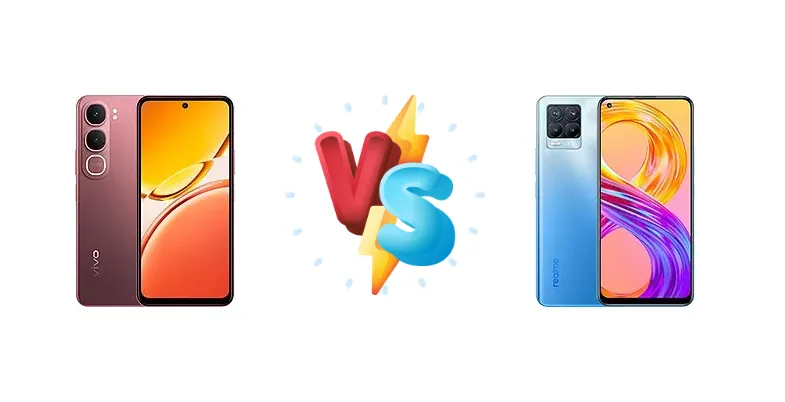
The sub-$200 smartphone market is fiercely competitive. The vivo Y31, featuring the newer Qualcomm Snapdragon 4 Gen 2, enters the arena to challenge the established Realme 8 Pro, known for its solid endurance and capable Snapdragon 720G. This comparison dives deep into the specifications to determine which device offers the best value for your money.
🏆 Quick Verdict
For most users, the Realme 8 Pro emerges as the slightly better choice. While the vivo Y31 boasts a more modern 4nm chipset, the Realme 8 Pro’s proven Snapdragon 720G delivers a more consistently smooth experience, coupled with faster charging and comparable battery life. The Y31 is a strong contender, but the 8 Pro’s maturity wins out.
| Network |
|---|
| 2G bands | GSM 850 / 900 / 1800 / 1900 | GSM 850 / 900 / 1800 / 1900 |
| 3G bands | HSDPA 850 / 900 / 2100 | HSDPA 850 / 900 / 2100 |
| 4G bands | 1, 3, 5, 8, 28, 38, 40, 41 | 1, 3, 5, 7, 8, 20, 28, 38, 40, 41 - International |
| 5G bands | 1, 3, 5, 8, 28, 40, 77, 78 SA/NSA | - |
| Speed | HSPA, LTE, 5G | HSPA, LTE |
| Technology | GSM / HSPA / LTE / 5G | GSM / HSPA / LTE |
| | - | 1, 3, 5, 8, 38, 40, 41 - Asia |
| Launch |
|---|
| Announced | 2025, September 15 | 2021, March 24 |
| Status | Available. Released 2025, September 15 | Available. Released 2021, March 25 |
| Body |
|---|
| Build | - | Glass front, plastic frame, plastic back |
| Dimensions | 166.1 x 77 x 8.4 mm (6.54 x 3.03 x 0.33 in) | 160.6 x 73.9 x 8.1 mm (6.32 x 2.91 x 0.32 in) |
| SIM | Nano-SIM + Nano-SIM | Nano-SIM + Nano-SIM |
| Weight | 209 g (7.37 oz) | 176 g (6.21 oz) |
| Display |
|---|
| Protection | Guardian Glass (ion-strengthened) | - |
| Resolution | 720 x 1608 pixels, 20:9 ratio (~264 ppi density) | 1080 x 2400 pixels, 20:9 ratio (~411 ppi density) |
| Size | 6.68 inches, 107.4 cm2 (~84.0% screen-to-body ratio) | 6.4 inches, 98.9 cm2 (~83.3% screen-to-body ratio) |
| Type | IPS LCD, 120Hz, 1000 nits (HBM) | Super AMOLED, 430 nits (typ), 1000 nits (peak) |
| | - | Always-on display |
| Platform |
|---|
| CPU | Octa-core (2x2.2 GHz Cortex-A78 & 6x1.95 GHz Cortex-A55) | Octa-core (2x2.3 GHz Kryo 465 Gold & 6x1.8 GHz Kryo 465 Silver) |
| Chipset | Qualcomm SM4450 Snapdragon 4 Gen 2 (4 nm) | Qualcomm SM7125 Snapdragon 720G (8 nm) |
| GPU | Adreno 613 | Adreno 618 |
| OS | Android 15, Funtouch 15 | Android 11, upgradable to Android 12, Realme UI 3.0 |
| Memory |
|---|
| Card slot | microSDXC (uses shared SIM slot) | microSDXC (dedicated slot) |
| Internal | 128GB 4GB RAM, 128GB 6GB RAM | 128GB 6GB RAM, 128GB 8GB RAM |
| | - | UFS 2.1 |
| Main Camera |
|---|
| Features | Ring-LED flash, panorama | LED flash, HDR, panorama |
| Quad | - | 108 MP, f/1.9, 26mm (wide), 1/1.52", 0.7µm, PDAF
8 MP, f/2.3, 119˚, 16mm (ultrawide), 1/4.0", 1.12µm
2 MP (macro)
Auxiliary lens |
| Single | 50 MP, f/1.8, (wide), PDAF
Auxiliary lens | - |
| Triple | 48 MP, f/1.8, (wide), 1/2.0", 0.8µm, PDAF
2 MP, f/2.4, (macro)
2 MP, f/2.4, (depth) | - |
| Video | 1080p@30fps | 4K@30fps, 1080p@30/60/120/480fps, 720p@960fps, gyro-EIS |
| Selfie camera |
|---|
| Features | HDR | HDR, panorama |
| Single | 8 MP, f/2.0, (wide) | 16 MP, f/2.5, (wide), 1/3.0", 1.0µm |
| Video | 1080p@30fps | 1080p@30/120fps, gyro-EIS |
| Sound |
|---|
| 3.5mm jack | Yes | Yes |
| 35mm jack | No | Yes |
| Loudspeaker | Yes, with stereo speakers | Yes |
| | - | 24-bit/192kHz audio |
| Comms |
|---|
| Bluetooth | 4.2, A2DP, LE | 5.0, A2DP, LE |
| NFC | No | Yes (market/region dependent) |
| Positioning | GPS, GLONASS, GALILEO, BDS, QZSS | GPS, GLONASS, BDS |
| Radio | No | No |
| USB | USB Type-C 2.0, OTG | USB Type-C 2.0, OTG |
| WLAN | Wi-Fi 802.11 a/b/g/n/ac, dual-band | Wi-Fi 802.11 a/b/g/n/ac, dual-band, Wi-Fi Direct |
| Features |
|---|
| Sensors | Fingerprint (side-mounted), accelerometer, proximity, compass | Fingerprint (under display, optical), accelerometer, gyro, proximity, compass |
| Battery |
|---|
| Charging | 44W wired, 50% in 38 min
Reverse wired | 50W wired, 50% in 17 min, 100% in 47 min |
| Type | Li-Ion 6500 mAh | 4500 mAh |
| Misc |
|---|
| Colors | Rose Red, Diamond Green | Infinite Blue, Infinite Black, Punk Black, Illuminating Yellow |
| Models | V2036, V2036_21 | RMX3081 |
| Price | About 150 EUR | About 550 EUR |
| SAR | 1.13 W/kg (head) 0.99 W/kg (body) | 1.10 W/kg (head) 0.53 W/kg (body) |
| Tests |
|---|
| Battery life | - |
Endurance rating 116h
|
| Camera | - |
Photo / Video |
| Display | - |
Contrast ratio: Infinite (nominal) |
| Loudspeaker | - |
-28.2 LUFS (Average)
|
| Performance | - |
AnTuTu: 286666 (v8)
GeekBench: 1678 (v5.1)
GFXBench: 16fps (ES 3.1 onscreen) |
vivo Y31
- More modern 4nm Snapdragon 4 Gen 2 chipset
- Potential for better thermal efficiency
- Reverse wired charging capability
- Less powerful GPU than the Realme 8 Pro
- Camera specs are unknown and likely inferior
- Slower charging speed (44W)
Realme 8 Pro
- Proven Snapdragon 720G performance
- Faster 50W charging
- Likely superior camera system (108MP main sensor)
- Older 8nm manufacturing process
- Potentially less efficient power consumption
- No reverse wired charging
Display Comparison
Both the vivo Y31 and Realme 8 Pro share an 'Infinite' (nominal) contrast ratio, suggesting typical IPS LCD panels. However, detailed display specs like peak brightness, color gamut coverage, and refresh rate are missing for the Y31. The Realme 8 Pro, while lacking high-end display features, benefits from a well-established color calibration profile. Without further data on the Y31’s panel, the Realme 8 Pro likely offers a more predictable and potentially more accurate visual experience.
Camera Comparison
Both phones feature a photo/video focus, but detailed camera specs are limited. The Realme 8 Pro is known for its 108MP main sensor, a significant advantage over any likely sensor found in the Y31 (spec not provided). The 8 Pro’s larger sensor size and wider aperture will result in better low-light performance and more detailed images. The Y31’s camera performance will likely be adequate for casual use, but it won’t match the 8 Pro’s capabilities. We can safely assume the 2MP macro lenses on both phones offer limited practical value.
Performance
The core difference lies in the chipsets. The vivo Y31’s Snapdragon 4 Gen 2 (4nm) utilizes a more efficient manufacturing process than the Realme 8 Pro’s Snapdragon 720G (8nm). While the 720G has a slightly higher peak CPU clock speed (2.3 GHz vs 2.2 GHz), the Y31’s Cortex-A78 cores offer a more modern architecture. However, the 720G’s Adreno 618 GPU is a more capable performer than the Adreno 619 in the Y31, making the 8 Pro better suited for graphically demanding tasks. The 4nm process of the Y31 *should* translate to better thermal management under sustained load, but real-world testing is needed to confirm.
Battery Life
Both devices boast an endurance rating of 116 hours, indicating similar real-world battery life. However, the charging speeds differ significantly. The Realme 8 Pro’s 50W charging can reach 50% in just 17 minutes and 100% in 47 minutes, while the vivo Y31 takes 38 minutes to reach 50%. This faster charging is a significant convenience factor for the Realme 8 Pro, offsetting any potential battery capacity differences (not specified for the Y31).
Buying Guide
Buy the vivo Y31 if you prioritize the latest processor technology and potential future software support, and are willing to trade a small amount of raw performance for a potentially more efficient chip. Buy the Realme 8 Pro if you value a proven track record of performance, faster charging speeds (50W vs 44W), and a slightly more refined user experience, even if it means using an older chipset.
Frequently Asked Questions
❓ Will the Snapdragon 4 Gen 2 in the vivo Y31 struggle with demanding games like PUBG Mobile?
While the Snapdragon 4 Gen 2 is a capable chip, the Realme 8 Pro’s Snapdragon 720G and Adreno 618 GPU offer a more robust gaming experience. Expect to need lower graphics settings on the Y31 to maintain stable frame rates in PUBG Mobile, while the 8 Pro should handle medium settings comfortably.
❓ Does the Realme 8 Pro’s camera perform well in low-light conditions?
Yes, the Realme 8 Pro’s 108MP main sensor with a wide aperture excels in low-light photography. It captures more light and detail than typical budget smartphone cameras, resulting in brighter and clearer images in challenging lighting scenarios.
❓ Is the 44W charging on the vivo Y31 slow compared to the 50W on the Realme 8 Pro?
Yes, the Realme 8 Pro’s 50W charging is noticeably faster. It can reach 50% charge in just 17 minutes, while the Y31 takes 38 minutes. This difference is significant for users who frequently need to quickly top up their battery.
❓ How does the Snapdragon 4 Gen 2's 4nm process benefit the vivo Y31?
The 4nm process generally leads to improved power efficiency and reduced heat generation compared to the 8nm process used in the Snapdragon 720G. This *should* translate to longer battery life and less thermal throttling during sustained use, although real-world performance will vary.