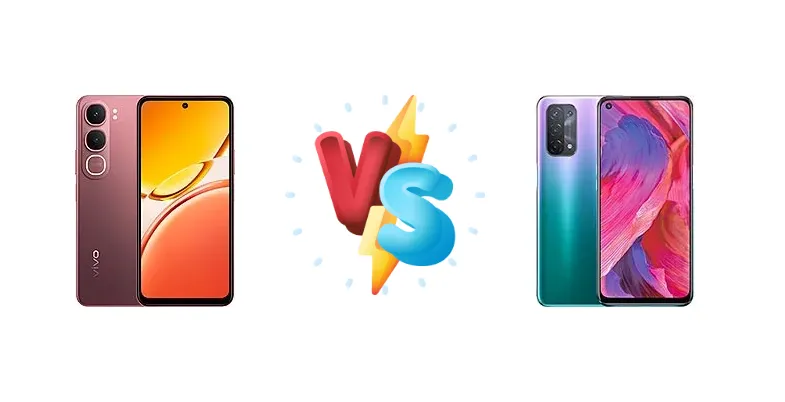
The sub-$300 smartphone market is fiercely competitive, and the vivo Y31 and Oppo A54 5G represent compelling options for users seeking 5G connectivity without breaking the bank. However, they take different approaches to achieving this, with the Y31 prioritizing processing efficiency and fast charging, while the A54 5G focuses on established 5G connectivity. This comparison dissects their key differences to help you choose the right device.
🏆 Quick Verdict
For most users, the vivo Y31 emerges as the stronger choice. Its newer Snapdragon 4 Gen 2 chipset, built on a more efficient 4nm process, delivers superior performance and thermal management. The significantly faster 44W charging is a game-changer for convenience, offsetting the A54 5G's existing 5G modem.
| Network |
|---|
| 2G bands | GSM 850 / 900 / 1800 / 1900 | GSM 850 / 900 / 1800 / 1900 |
| 3G bands | HSDPA 850 / 900 / 2100 | HSDPA 850 / 900 / 1900 / 2100 |
| 4G bands | 1, 3, 5, 8, 28, 38, 40, 41 | 1, 2, 3, 4, 5, 7, 8, 12, 17, 18, 19, 20, 26, 28, 38, 39, 40, 41, 66 |
| 5G bands | 1, 3, 5, 8, 28, 40, 77, 78 SA/NSA | 1, 3, 5, 7, 8, 20, 28, 38, 40, 41, 77, 78 SA/NSA |
| Speed | HSPA, LTE, 5G | HSPA, LTE, 5G |
| Technology | GSM / HSPA / LTE / 5G | GSM / HSPA / LTE / 5G |
| Launch |
|---|
| Announced | 2025, September 15 | 2021, April 14 |
| Status | Available. Released 2025, September 15 | Available. Released 2021, April 14 |
| Body |
|---|
| Dimensions | 166.1 x 77 x 8.4 mm (6.54 x 3.03 x 0.33 in) | 162.9 x 74.7 x 8.4 mm (6.41 x 2.94 x 0.33 in) |
| SIM | Nano-SIM + Nano-SIM | · Nano-SIM· Nano-SIM + Nano-SIM |
| Weight | 209 g (7.37 oz) | 190 g (6.70 oz) |
| Display |
|---|
| Protection | Guardian Glass (ion-strengthened) | - |
| Resolution | 720 x 1608 pixels, 20:9 ratio (~264 ppi density) | 1080 x 2400 pixels, 20:9 ratio (~405 ppi density) |
| Size | 6.68 inches, 107.4 cm2 (~84.0% screen-to-body ratio) | 6.5 inches, 102.0 cm2 (~83.8% screen-to-body ratio) |
| Type | IPS LCD, 120Hz, 1000 nits (HBM) | IPS LCD, 90Hz, 480 nits (typ) |
| Platform |
|---|
| CPU | Octa-core (2x2.2 GHz Cortex-A78 & 6x1.95 GHz Cortex-A55) | Octa-core (2x2.0 GHz Kryo 460 & 6x1.8 GHz Kryo 460) |
| Chipset | Qualcomm SM4450 Snapdragon 4 Gen 2 (4 nm) | Qualcomm SM4350 Snapdragon 480 5G (8 nm) |
| GPU | Adreno 613 | Adreno 619 |
| OS | Android 15, Funtouch 15 | Android 11, ColorOS 11.1 |
| Memory |
|---|
| Card slot | microSDXC (uses shared SIM slot) | microSDXC |
| Internal | 128GB 4GB RAM, 128GB 6GB RAM | 64GB 4GB RAM, 128GB 4GB RAM |
| | - | UFS 2.1 (single lane) |
| Main Camera |
|---|
| Features | Ring-LED flash, panorama | LED flash, panorama |
| Quad | - | 48 MP, f/1.7, 26mm (wide), 1/2.0", 0.8µm, PDAF
8 MP, f/2.2, 119˚ (ultrawide), 1/4.0", 1.12µm
2 MP (macro)
Auxiliary lens |
| Single | 50 MP, f/1.8, (wide), PDAF
Auxiliary lens | 16 MP, f/2.0, 26mm (wide) |
| Triple | 48 MP, f/1.8, (wide), 1/2.0", 0.8µm, PDAF
2 MP, f/2.4, (macro)
2 MP, f/2.4, (depth) | - |
| Video | 1080p@30fps | 1080p@30fps, gyro-EIS |
| Selfie camera |
|---|
| Features | HDR | Panorama |
| Single | 8 MP, f/2.0, (wide) | 16 MP, f/2.0, 26mm (wide) |
| Video | 1080p@30fps | 1080p@30fps |
| Sound |
|---|
| 3.5mm jack | Yes | Yes |
| 35mm jack | No | Yes |
| Loudspeaker | Yes, with stereo speakers | Yes |
| Comms |
|---|
| Bluetooth | 4.2, A2DP, LE | 5.1, A2DP, LE, aptX HD |
| NFC | No | Yes (market/region dependent) |
| Positioning | GPS, GLONASS, GALILEO, BDS, QZSS | GPS, GLONASS, BDS, QZSS |
| Radio | No | No |
| USB | USB Type-C 2.0, OTG | USB Type-C 2.0, OTG |
| WLAN | Wi-Fi 802.11 a/b/g/n/ac, dual-band | Wi-Fi 802.11 a/b/g/n/ac, dual-band, Wi-Fi Direct |
| Features |
|---|
| Sensors | Fingerprint (side-mounted), accelerometer, proximity, compass | Fingerprint (side-mounted), accelerometer, gyro, proximity, compass |
| Battery |
|---|
| Charging | 44W wired, 50% in 38 min
Reverse wired | 10W wired |
| Type | Li-Ion 6500 mAh | Li-Po 5000 mAh |
| Misc |
|---|
| Colors | Rose Red, Diamond Green | Fluid Black, Fantastic Purple, Space Silver |
| Models | V2036, V2036_21 | CPH2195, OPG02 |
| Price | About 150 EUR | About 120 EUR |
| SAR | 1.13 W/kg (head) 0.99 W/kg (body) | - |
vivo Y31
- Significantly faster 44W charging
- More efficient Snapdragon 4 Gen 2 (4nm)
- Potentially better sustained performance due to thermal efficiency
- Reverse wired charging capability
- 5G compatibility may vary by region/carrier
- Camera specs are unknown, potential for lower quality
Oppo A54 5G
- Confirmed 5G connectivity
- Potentially wider carrier compatibility
- Established Snapdragon 480 5G platform
- Generally lower price point
- Slow 10W charging
- Less efficient Snapdragon 480 5G (8nm)
- Potential for throttling under sustained load
- Older chipset architecture
Display Comparison
Neither device boasts a standout display. Both likely utilize LCD panels, common in this price bracket. The focus here is on the internal hardware. Display specs are not provided, so we can only assume similar quality. However, the chipset's ability to efficiently drive the display is where the Y31 gains an advantage, potentially offering smoother animations and transitions.
Camera Comparison
Without detailed camera specifications, a direct comparison is difficult. However, both phones likely feature a primary camera supplemented by auxiliary lenses of limited utility. The image signal processor (ISP) within the Snapdragon 4 Gen 2 is likely more advanced, potentially leading to better image processing, noise reduction, and dynamic range in the Y31. The A54 5G's ISP is adequate, but the Y31 has the edge in computational photography.
Performance
The core difference lies in the chipsets. The vivo Y31’s Qualcomm SM4450 Snapdragon 4 Gen 2 (4nm) is a significant leap forward. The 4nm fabrication process inherently provides better power efficiency and thermal performance compared to the Oppo A54 5G’s Snapdragon 480 5G (8nm). While the A54 5G’s CPU clock speeds (2.0 GHz Kryo 460) are close to the Y31’s Cortex-A78 cores (2.2 GHz), the architectural improvements and process node of the Snapdragon 4 Gen 2 translate to a noticeable performance advantage in sustained workloads. The Y31’s CPU configuration (2x2.2 GHz Cortex-A78 & 6x1.95 GHz Cortex-A55) suggests a stronger focus on single-core performance, beneficial for everyday tasks, while the 480 5G's Kryo 460 cores are optimized for efficiency. The Y31 will likely exhibit less throttling during extended gaming or video recording.
Battery Life
The Oppo A54 5G’s 10W charging is a major drawback. The vivo Y31’s 44W wired charging is a game-changer, capable of reaching 50% charge in just 38 minutes. While battery capacity isn't specified for either device, the Snapdragon 4 Gen 2’s superior efficiency means the Y31 will likely deliver comparable or better battery life despite potentially having a smaller battery. The convenience of rapid charging significantly outweighs any potential capacity difference.
Buying Guide
Buy the vivo Y31 if you prioritize a smoother, more responsive user experience, especially with multitasking and moderately demanding apps, and value the convenience of incredibly fast charging. Buy the Oppo A54 5G if your absolute top priority is confirmed 5G compatibility with your carrier and you're willing to trade performance and charging speed for that assurance. The A54 5G is also a reasonable choice if you find it at a significantly lower price point.
Frequently Asked Questions
❓ Will the Snapdragon 4 Gen 2 in the vivo Y31 handle popular games like PUBG Mobile or Call of Duty Mobile?
The Snapdragon 4 Gen 2 is capable of running PUBG Mobile and Call of Duty Mobile at medium settings. While it won't deliver a flagship-level experience, the improved CPU and GPU performance compared to the Snapdragon 480 5G, combined with better thermal management, will result in more stable frame rates and less noticeable lag during extended gaming sessions.
❓ Is the 10W charging on the Oppo A54 5G realistically usable in 2024?
10W charging is significantly slower than modern standards. Expect a full charge to take well over 3 hours. While it's functional, it's a major inconvenience for users accustomed to fast charging. The vivo Y31's 44W charging is a far more practical solution, offering a full charge in under an hour.
❓ Does the Oppo A54 5G guarantee 5G connectivity with all carriers?
While the Snapdragon 480 5G supports 5G, compatibility varies by carrier and region. Check with your specific carrier to confirm that the Oppo A54 5G is certified to work on their 5G network before purchasing. The vivo Y31's 5G compatibility should also be verified with your carrier.