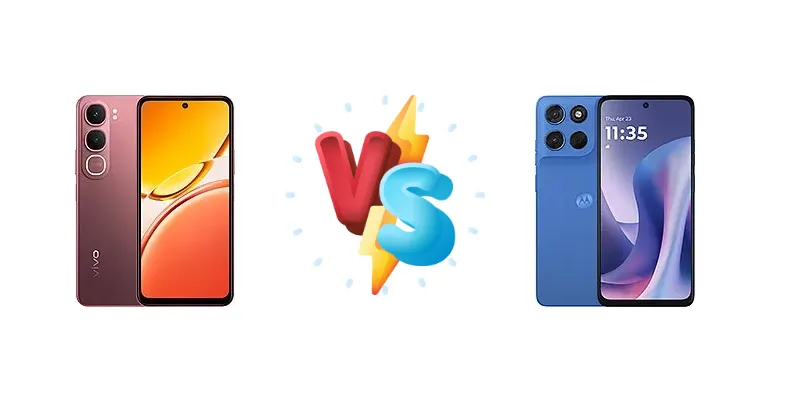
The vivo Y31 and Motorola Moto G100S represent compelling options in the increasingly competitive sub-$300 smartphone market. Both leverage Qualcomm's Snapdragon platform, but target slightly different priorities. The Y31 emphasizes efficiency with the Snapdragon 4 Gen 2, while the G100S aims for a performance boost with the Snapdragon 6s Gen 4. This comparison dissects the key differences to help you determine which device best aligns with your needs.
🏆 Quick Verdict
For the average user prioritizing sustained performance and faster application loading, the Motorola Moto G100S emerges as the stronger choice. Its Snapdragon 6s Gen 4, with its higher clocked Cortex-A78 cores, delivers a noticeable advantage. However, the vivo Y31’s 44W charging offers a significant convenience factor.
| Network |
|---|
| 2G bands | GSM 850 / 900 / 1800 / 1900 | GSM 850 / 900 / 1800 / 1900 |
| 3G bands | HSDPA 850 / 900 / 2100 | HSDPA 850 / 900 / 1900 / 2100 |
| 4G bands | 1, 3, 5, 8, 28, 38, 40, 41 | LTE |
| 5G bands | 1, 3, 5, 8, 28, 40, 77, 78 SA/NSA | SA/NSA |
| Speed | HSPA, LTE, 5G | HSPA, LTE, 5G |
| Technology | GSM / HSPA / LTE / 5G | GSM / HSPA / LTE / 5G |
| Launch |
|---|
| Announced | 2025, September 15 | 2025, November 03 |
| Status | Available. Released 2025, September 15 | Available. Released 2025, November 03 |
| Body |
|---|
| Build | - | Glass front, plastic frame, silicone polymer (eco leather) back |
| Dimensions | 166.1 x 77 x 8.4 mm (6.54 x 3.03 x 0.33 in) | 166.2 x 76.5 x 8.6 mm (6.54 x 3.01 x 0.34 in) |
| SIM | Nano-SIM + Nano-SIM | Nano-SIM + Nano-SIM |
| Weight | 209 g (7.37 oz) | 210 g (7.41 oz) |
| Display |
|---|
| Protection | Guardian Glass (ion-strengthened) | - |
| Resolution | 720 x 1608 pixels, 20:9 ratio (~264 ppi density) | 1080 x 2400 pixels, 20:9 ratio (~392 ppi density) |
| Size | 6.68 inches, 107.4 cm2 (~84.0% screen-to-body ratio) | 6.72 inches, 109.0 cm2 (~85.8% screen-to-body ratio) |
| Type | IPS LCD, 120Hz, 1000 nits (HBM) | IPS LCD, 120Hz, 1050 nits (peak) |
| Platform |
|---|
| CPU | Octa-core (2x2.2 GHz Cortex-A78 & 6x1.95 GHz Cortex-A55) | Octa-core (4x2.4 GHz Cortex-A78 & 4x1.8 GHz Cortex-A55) |
| Chipset | Qualcomm SM4450 Snapdragon 4 Gen 2 (4 nm) | Qualcomm SM6435-AA Snapdragon 6s Gen 4 (4 nm) |
| GPU | Adreno 613 | Adreno |
| OS | Android 15, Funtouch 15 | Android 15 |
| Memory |
|---|
| Card slot | microSDXC (uses shared SIM slot) | No |
| Internal | 128GB 4GB RAM, 128GB 6GB RAM | 128GB 8GB RAM, 256GB 8GB RAM |
| Main Camera |
|---|
| Dual | - | 50 MP, f/1.9 (wide), 1/1.95", 0.8µm, PDAF
8 MP, f/2.2, 118˚ (ultrawide), 1/4.0", 1.12µm |
| Features | Ring-LED flash, panorama | LED flash, HDR, panorama |
| Single | 50 MP, f/1.8, (wide), PDAF
Auxiliary lens | - |
| Triple | 48 MP, f/1.8, (wide), 1/2.0", 0.8µm, PDAF
2 MP, f/2.4, (macro)
2 MP, f/2.4, (depth) | - |
| Video | 1080p@30fps | 1440p@30fps, 1080p@30fps |
| Selfie camera |
|---|
| Features | HDR | HDR |
| Single | 8 MP, f/2.0, (wide) | 8 MP, f/2.2, (wide), 1/4.0", 1.12µm |
| Video | 1080p@30fps | 1440p@30fps, 1080p@30fps |
| Sound |
|---|
| 3.5mm jack | Yes | - |
| 35mm jack | No | Yes |
| Loudspeaker | Yes, with stereo speakers | Yes, with stereo speakers |
| Comms |
|---|
| Bluetooth | 4.2, A2DP, LE | 5.1, A2DP, LE |
| NFC | No | Yes |
| Positioning | GPS, GLONASS, GALILEO, BDS, QZSS | GPS, GALILEO, GLONASS, BDS, QZSS |
| Radio | No | No |
| USB | USB Type-C 2.0, OTG | USB Type-C 2.0, OTG |
| WLAN | Wi-Fi 802.11 a/b/g/n/ac, dual-band | Wi-Fi 802.11 a/b/g/n/ac, dual-band |
| Features |
|---|
| Sensors | Fingerprint (side-mounted), accelerometer, proximity, compass | Fingerprint (side-mounted), accelerometer, gyro, proximity, compass |
| Battery |
|---|
| Charging | 44W wired, 50% in 38 min
Reverse wired | 30W wired |
| Type | Li-Ion 6500 mAh | Si/C Li-Ion 7000 mAh |
| Misc |
|---|
| Colors | Rose Red, Diamond Green | Black, Blue |
| Models | V2036, V2036_21 | - |
| Price | About 150 EUR | About 120 EUR |
| SAR | 1.13 W/kg (head) 0.99 W/kg (body) | - |
vivo Y31
- Faster 44W charging significantly reduces downtime.
- Snapdragon 4 Gen 2 offers excellent power efficiency.
- Potentially longer battery life due to efficient chipset.
- Less powerful CPU compared to the Moto G100S.
- May struggle with demanding games and applications.
Motorola Moto G100S
- More powerful Snapdragon 6s Gen 4 for smoother performance.
- Superior CPU performance for multitasking and gaming.
- Potentially better image processing capabilities.
- Slower 30W charging.
- May experience more battery drain under heavy load.
Display Comparison
Neither device's display specifications are provided, so a direct comparison is limited. However, given the price bracket, we can assume both utilize LCD panels. The Motorola, being positioned slightly higher, *may* offer a higher peak brightness. The absence of information regarding refresh rates suggests both likely operate at the standard 60Hz. Color accuracy will likely be similar, leaning towards the 'good enough' range for casual viewing.
Camera Comparison
Without specific camera sensor details, a detailed comparison is challenging. However, the Motorola’s positioning suggests a potentially more capable main sensor. The Snapdragon 6s Gen 4 also includes a more advanced ISP (Image Signal Processor) than the Snapdragon 4 Gen 2, leading to better image processing, particularly in low-light conditions. Expect both phones to include standard features like HDR and portrait modes, but the Motorola is likely to deliver more detailed and dynamic images. We anticipate both phones will include lower-resolution auxiliary cameras of limited utility.
Performance
The core difference lies in the chipsets. The Motorola Moto G100S boasts the Snapdragon 6s Gen 4, featuring four 2.4 GHz Cortex-A78 cores alongside four 1.8 GHz Cortex-A55 cores. This contrasts with the vivo Y31’s Snapdragon 4 Gen 2, which uses two 2.2 GHz Cortex-A78 cores and six 1.95 GHz Cortex-A55 cores. The higher clock speeds and core count on the Motorola translate to a tangible performance advantage in CPU-intensive tasks. Both chips are built on a 4nm process, suggesting comparable efficiency, but the Motorola’s more powerful cores will draw more power under load. The Snapdragon 6s Gen 4 will likely offer a smoother experience with graphically demanding games and applications.
Battery Life
The vivo Y31’s 44W wired charging is a clear advantage over the Motorola Moto G100S’s 30W charging. The Y31 claims a 50% charge in 38 minutes, while the G100S will take considerably longer. While battery capacity isn’t specified, the faster charging of the Y31 mitigates any potential disadvantage from a smaller battery. The Snapdragon 4 Gen 2’s efficiency also contributes to potentially longer battery life during typical usage, even with a smaller capacity.
Buying Guide
Buy the vivo Y31 if you prioritize battery life and rapid charging, and your primary use case revolves around everyday tasks like social media, messaging, and light web browsing. You'll benefit from the efficient Snapdragon 4 Gen 2. Buy the Motorola Moto G100S if you need a phone capable of handling more demanding applications, occasional gaming, and multitasking, and are willing to trade some charging speed for a performance uplift.
Frequently Asked Questions
❓ Will the Motorola Moto G100S overheat during extended gaming sessions?
While the Snapdragon 6s Gen 4 is a capable chip, sustained high performance can generate heat. The 4nm process helps mitigate this, but throttling is possible during prolonged, graphically intensive gaming. The phone's thermal design will play a crucial role, but without testing, it's difficult to predict the extent of throttling.
❓ Is the 44W charging on the vivo Y31 compatible with Power Delivery (PD) chargers?
vivo's 44W charging utilizes its proprietary FlashCharge technology. While it *may* work with some PD chargers, optimal charging speeds are best achieved using the included charger or a compatible vivo FlashCharge adapter. Using a standard PD charger may result in slower charging times.
❓ How does the Snapdragon 4 Gen 2 in the vivo Y31 handle multitasking compared to the Motorola?
The Snapdragon 6s Gen 4 in the Motorola Moto G100S has a clear advantage in multitasking due to its higher core count and clock speeds. While the Y31 can handle basic multitasking, the G100S will provide a smoother experience when switching between multiple apps or running demanding applications simultaneously.