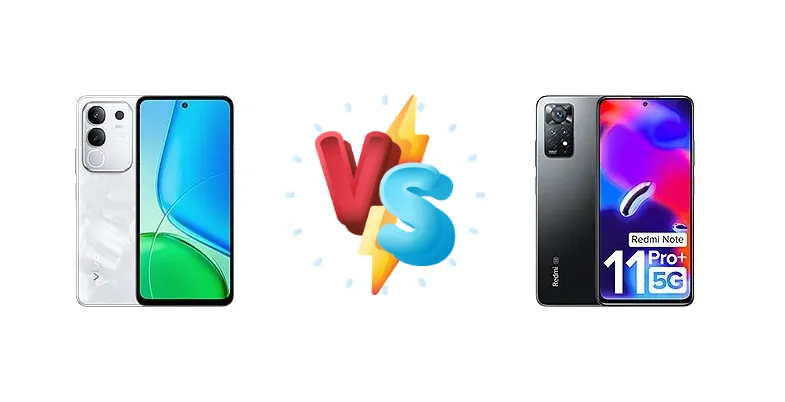
The mid-range 5G smartphone market is fiercely competitive, and the vivo Y31 Pro and Xiaomi Redmi Note 11 Pro+ 5G (India) represent compelling options. While both aim to deliver a balanced experience, they take different approaches to processing power and charging speed. This comparison dissects their key specifications to determine which device offers the best value for your money.
🏆 Quick Verdict
For users prioritizing raw performance and future-proofing, the vivo Y31 Pro, with its Dimensity 7300 chipset, emerges as the winner. While the Redmi Note 11 Pro+ 5G boasts faster 67W charging, the Y31 Pro’s more modern and efficient processor provides a noticeable advantage in demanding tasks and sustained performance.
| Network |
|---|
| 2G bands | GSM 850 / 900 / 1800 / 1900 | GSM 850 / 900 / 1800 / 1900 - SIM 1 & SIM 2 |
| 3G bands | HSDPA 850 / 900 / 2100 | HSDPA 850 / 900 / 1900 / 2100 |
| 4G bands | 1, 3, 5, 8, 28, 38, 40, 41 | 1, 3, 5, 8, 40, 41 |
| 5G bands | 1, 3, 5, 8, 28, 40, 77, 78 SA/NSA | 1, 3, 5, 8, 28, 40, 78 SA/NSA |
| Speed | HSPA, LTE, 5G | HSPA, LTE-A (CA), 5G |
| Technology | GSM / HSPA / LTE / 5G | GSM / HSPA / LTE / 5G |
| Launch |
|---|
| Announced | 2025, September 15 | 2022, March 09 |
| Status | Available. Released 2025, September 15 | Available. Released 2022, March 15 |
| Body |
|---|
| Build | Glass front, plastic back, plastic frame | Glass front (Gorilla Glass 5), glass back |
| Dimensions | 165.7 x 76.3 x 8.1 mm (6.52 x 3.00 x 0.32 in) | 164.2 x 76.1 x 8.1 mm (6.46 x 3.00 x 0.32 in) |
| SIM | Nano-SIM + Nano-SIM | Hybrid Dual SIM (Nano-SIM, dual stand-by) |
| Weight | 204 g or 208 g (7.20 oz) | 202 g (7.13 oz) |
| | - | IP53, dust and splash resistant |
| Display |
|---|
| Protection | - | Corning Gorilla Glass 5 |
| Resolution | 1080 x 2408 pixels, 20:9 ratio (~393 ppi density) | 1080 x 2400 pixels, 20:9 ratio (~395 ppi density) |
| Size | 6.72 inches, 108.8 cm2 (~86.0% screen-to-body ratio) | 6.67 inches, 107.4 cm2 (~86.0% screen-to-body ratio) |
| Type | IPS LCD, 120Hz, 960Hz PWM, 1050 nits (HBM) | Super AMOLED, 120Hz, 700 nits, 1200 nits (peak) |
| Platform |
|---|
| CPU | Octa-core (4x2.5 GHz Cortex-A78 & 4x2.0 GHz Cortex-A55) | Octa-core (2x2.2 GHz Kryo 660 Gold & 6x1.7 GHz Kryo 660 Silver) |
| Chipset | Mediatek Dimensity 7300 (4 nm) | Qualcomm SM6375 Snapdragon 695 5G (6 nm) |
| GPU | Mali-G615 MC2 | Adreno 619 |
| OS | Android 15, Funtouch 15 | Android 11, MIUI 13 |
| Memory |
|---|
| Card slot | No | microSDXC (uses shared SIM slot) |
| Internal | 128GB 8GB RAM, 256GB 8GB RAM | 64GB 6GB RAM, 128GB 6GB RAM, 128GB 8GB RAM, 256GB 8GB RAM |
| | - | UFS 2.2 |
| Main Camera |
|---|
| Dual | 50 MP, f/1.8, (wide), PDAF
Auxiliary lens | - |
| Features | Ring-LED flash, panorama | LED flash, HDR, panorama |
| Triple | - | 108 MP, f/1.9, 26mm (wide), 1/1.52", 0.7µm, PDAF
8 MP, f/2.2, 118˚ (ultrawide)
2 MP, f/2.4, (macro) |
| Video | 4K@30fps, 1080p@30fps, gyro-EIS | 1080p@30fps |
| Selfie camera |
|---|
| Single | 8 MP, (wide) | 16 MP, f/2.5, (wide), 1/3.06" 1.0µm |
| Video | 1080p@30fps | 1080p@30fps |
| Sound |
|---|
| 3.5mm jack | - | Yes |
| 35mm jack | No | - |
| Loudspeaker | Yes, with stereo speakers | Yes, with stereo speakers |
| | - | 24-bit/192kHz audio |
| Comms |
|---|
| Bluetooth | 5.4, A2DP, LE | 5.1, A2DP, LE |
| Infrared port | Yes | Yes |
| NFC | No | No |
| Positioning | GPS, GLONASS, GALILEO, BDS, QZSS | GPS, GLONASS, BDS, GALILEO |
| Radio | No | Unspecified |
| USB | USB Type-C 2.0, OTG | USB Type-C 2.0, OTG |
| WLAN | Wi-Fi 802.11 a/b/g/n/ac, dual-band | Wi-Fi 802.11 a/b/g/n/ac, dual-band, Wi-Fi Direct |
| Features |
|---|
| Sensors | Fingerprint (side-mounted), accelerometer, gyro, proximity, compass | Fingerprint (side-mounted), accelerometer, gyro, proximity, compass |
| Battery |
|---|
| Charging | 44W wired, 50% in 40 min
Reverse wired | 67W wired, PD3.0, QC3, 50% in 15 min, 100% in 42 min (advertised) |
| Type | Li-Ion 6500 mAh | Li-Po 5000 mAh, non-removable |
| Misc |
|---|
| Colors | Dreamy White, Mocha Brown | Mirage Blue, Phantom White, Stealth Black |
| Models | - | 2201116SI |
| Price | About 180 EUR | About 250 EUR |
| SAR | 0.98 W/kg (head) 0.94 W/kg (body) | - |
vivo Y31 Pro
- More powerful and efficient Dimensity 7300 chipset
- Potentially better image processing capabilities
- Improved thermal management for sustained performance
- Slower charging speed (44W vs 67W)
- Display technology potentially inferior to Redmi
Xiaomi Redmi Note 11 Pro+ 5G (India)
- Significantly faster 67W charging
- Potentially superior AMOLED display (historically)
- Convenient charging speeds for quick top-ups
- Less powerful Snapdragon 695 chipset
- Less efficient 6nm process node
- Potentially weaker image processing
Display Comparison
Display specifications are not provided, so a direct comparison is limited. However, given the price segments, both likely feature 6.6-6.7 inch FHD+ displays. The Redmi Note 11 Pro+ 5G historically features AMOLED panels, which would offer superior contrast and color accuracy compared to a potential LCD on the Y31 Pro. Bezels are likely comparable, but the panel technology is a key differentiator, favoring the Redmi if it maintains its AMOLED tradition.
Camera Comparison
Camera details beyond the main sensor are absent. However, the chipset’s ISP capabilities play a crucial role. The Dimensity 7300 generally offers more advanced image processing features, potentially leading to better dynamic range and low-light performance. Without sensor size information, it’s difficult to definitively declare a winner, but the Dimensity 7300’s processing power gives the Y31 Pro an edge. The Redmi Note 11 Pro+ 5G may rely more on software enhancements to compensate for a potentially less capable ISP.
Performance
The core difference lies in the chipsets. The vivo Y31 Pro’s Mediatek Dimensity 7300 (4nm) represents a significant leap over the Xiaomi Redmi Note 11 Pro+ 5G’s Qualcomm Snapdragon 695 5G (6nm). The 4nm process node of the Dimensity 7300 translates to improved power efficiency and thermal management, allowing for sustained peak performance. The Dimensity 7300’s CPU configuration – 4x2.5 GHz Cortex-A78 & 4x2.0 GHz Cortex-A55 – offers a more potent combination of performance and efficiency compared to the Snapdragon 695’s 2x2.2 GHz Kryo 660 Gold & 6x1.7 GHz Kryo 660 Silver. This means the Y31 Pro will likely exhibit faster app loading times, smoother multitasking, and better responsiveness in graphically intensive games.
Battery Life
Battery capacity is not specified, but the charging speeds are a clear point of differentiation. The Redmi Note 11 Pro+ 5G’s 67W charging is significantly faster than the Y31 Pro’s 44W charging, promising a 50% charge in just 15 minutes and a full charge in 42 minutes (advertised). While the Y31 Pro reaches 50% in 40 minutes, the Redmi’s overall charging time is considerably quicker. However, the Dimensity 7300’s superior efficiency may offset the battery capacity difference, potentially resulting in comparable real-world battery life despite the charging speed gap.
Buying Guide
Buy the vivo Y31 Pro if you need a phone capable of handling demanding applications, multitasking, and potentially some light gaming with a more efficient processor. Buy the Xiaomi Redmi Note 11 Pro+ 5G (India) if you prioritize extremely fast charging and are less concerned with having the absolute latest chipset, and value the convenience of a quicker top-up.
Frequently Asked Questions
❓ Will the Snapdragon 695 in the Redmi Note 11 Pro+ 5G struggle with demanding games like Genshin Impact?
The Snapdragon 695 is a capable chipset, but it's not designed for high-end gaming. While you can run Genshin Impact, expect to use lower graphics settings and potentially experience frame drops during intense scenes. The Dimensity 7300 in the Y31 Pro will provide a smoother gaming experience overall.
❓ How much faster is the 67W charging on the Redmi Note 11 Pro+ 5G in real-world use compared to the 44W on the vivo Y31 Pro?
The 67W charging on the Redmi Note 11 Pro+ 5G will noticeably reduce your charging time. While the Y31 Pro takes 40 minutes to reach 50%, the Redmi achieves this in just 15 minutes. A full charge on the Redmi takes approximately 42 minutes, compared to a longer duration on the Y31 Pro. This is a significant advantage for users who frequently need to quickly top up their battery.
❓ Does the Dimensity 7300 in the vivo Y31 Pro generate more heat during prolonged use compared to the Snapdragon 695?
Despite being more powerful, the Dimensity 7300’s 4nm process node is more efficient than the Snapdragon 695’s 6nm node. This means it generates less heat for a given level of performance. Therefore, the Y31 Pro is likely to experience less thermal throttling during extended gaming sessions or demanding tasks.