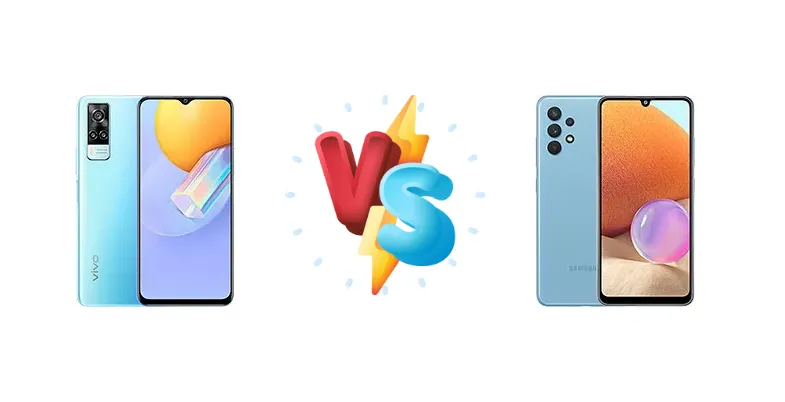
The sub-$200 smartphone market is fiercely competitive. Both the vivo Y31 (2021) and the Samsung Galaxy A32 aim to deliver essential features at an accessible price. However, they take different approaches – the vivo leverages Qualcomm’s Snapdragon 662, while Samsung opts for MediaTek’s Helio G80. This comparison dissects their strengths and weaknesses to determine which device offers the best overall experience.
🏆 Quick Verdict
For most users, the Samsung Galaxy A32 emerges as the slightly better choice. Its significantly brighter 814 nit display provides a superior viewing experience, especially outdoors, and the comparable battery endurance offsets the slower 15W charging. While the Snapdragon 662 in the vivo Y31 is efficient, the A32’s display advantage is a key differentiator.
| Network |
|---|
| 2G bands | GSM 850 / 900 / 1800 / 1900 | GSM 850 / 900 / 1800 / 1900 |
| 3G bands | HSDPA 850 / 900 / 2100 | HSDPA 850 / 900 / 1900 / 2100 |
| 4G bands | 1, 3, 5, 8, 38, 40, 41 | 1, 2, 3, 5, 7, 8, 20, 28, 38, 40, 41 |
| Speed | HSPA, LTE | HSPA, LTE |
| Technology | GSM / HSPA / LTE | GSM / HSPA / LTE |
| Launch |
|---|
| Announced | 2021, January 20 | 2021, February 25 |
| Status | Available. Released 2021, January 20 | Available. Released 2021, February 25 |
| Body |
|---|
| Build | - | Glass front (Gorilla Glass 5), plastic frame, plastic back |
| Dimensions | 163.9 x 75.3 x 8.4 mm (6.45 x 2.96 x 0.33 in) | 158.9 x 73.6 x 8.4 mm (6.26 x 2.90 x 0.33 in) |
| SIM | Nano-SIM + Nano-SIM | · Nano-SIM· Nano-SIM + Nano-SIM |
| Weight | 188 g (6.63 oz) | 184 g (6.49 oz) |
| Display |
|---|
| Protection | - | Corning Gorilla Glass 5 |
| Resolution | 1080 x 2408 pixels, 20:9 ratio (~401 ppi density) | 1080 x 2400 pixels, 20:9 ratio (~411 ppi density) |
| Size | 6.58 inches, 104.3 cm2 (~84.5% screen-to-body ratio) | 6.4 inches, 98.9 cm2 (~84.6% screen-to-body ratio) |
| Type | IPS LCD | Super AMOLED, 90Hz, 800 nits (HBM) |
| Platform |
|---|
| CPU | Octa-core (4x2.0 GHz Kryo 260 Gold & 4x1.8 GHz Kryo 260 Silver) | Octa-core (2x2.0 GHz Cortex-A75 & 6x1.8 GHz Cortex-A55) |
| Chipset | Qualcomm SM6115 Snapdragon 662 (11 nm) | Mediatek MT6769V/CU Helio G80 (12 nm) |
| GPU | Adreno 610 | Mali-G52 MC2 |
| OS | Android 11, Funtouch 11 | Android 11, upgradable to Android 13, One UI 5 |
| Memory |
|---|
| Card slot | microSDXC (dedicated slot) | microSDXC (dedicated slot) |
| Internal | 64GB 4GB RAM, 128GB 4GB RAM, 128GB 6GB RAM, 128GB 8GB RAM | 64GB 4GB RAM, 64GB 6GB RAM, 128GB 4GB RAM, 128GB 6GB RAM, 128GB 8GB RAM |
| Main Camera |
|---|
| Features | LED flash, HDR, panorama | LED flash, panorama, HDR |
| Quad | - | 64 MP, f/1.8, 26mm (wide), PDAF
8 MP, f/2.2, 123˚, (ultrawide), 1/4.0", 1.12µm
5 MP (macro)
Auxiliary lens |
| Single | - | 20 MP, f/2.2, (wide) |
| Triple | 48 MP, f/1.8, (wide), 1/2.0", 0.8µm, PDAF
2 MP (macro)
Auxiliary lens | - |
| Video | 4K@30fps, 1080p@30fps, gyro-EIS | 1080p@30fps |
| Selfie camera |
|---|
| Features | HDR | - |
| Single | 16 MP, f/2.0, (wide), 1/3.06" 1.0µm | 20 MP, f/2.2, (wide) |
| Video | 1080p@30fps | 1080p@30fps |
| Sound |
|---|
| 3.5mm jack | - | Yes |
| 35mm jack | Yes | Yes |
| Loudspeaker | Yes | Yes |
| Comms |
|---|
| Bluetooth | 5.0, A2DP, LE | 5.0, A2DP, LE |
| NFC | No | Yes (market/region dependent) |
| Positioning | GPS, GLONASS, GALILEO, BDS | GPS, GLONASS, BDS, GALILEO |
| Radio | FM radio | FM radio, RDS, recording |
| USB | USB Type-C 2.0, OTG | USB Type-C 2.0, OTG |
| WLAN | Wi-Fi 802.11 a/b/g/n/ac, dual-band, Wi-Fi Direct | Wi-Fi 802.11 a/b/g/n/ac, dual-band, Wi-Fi Direct |
| Features |
|---|
| Sensors | Fingerprint (side-mounted), accelerometer, gyro, proximity, compass | Fingerprint (under display, optical), accelerometer, gyro, compass |
| | - | Virtual proximity sensing |
| Battery |
|---|
| Charging | 18W wired, 70% in 67 min | 15W wired |
| Type | 5000 mAh | Li-Ion 5000 mAh |
| Misc |
|---|
| Colors | Racing Black, Ocean Blue | Awesome Black, Awesome White, Awesome Blue, Awesome Violet |
| Models | V2036, V2036_21 | SM-A325F, SM-A325F/DS, SM-A325M, SM-A325N |
| Price | About 190 EUR | € 124.99 / £ 89.38 |
| SAR EU | - | 0.45 W/kg (head) 1.30 W/kg (body) |
| Tests |
|---|
| Battery life | - |
Endurance rating 119h
|
| Camera | - |
Photo / Video |
| Display | - |
Contrast ratio: Infinite (nominal) |
| Loudspeaker | - |
-30.3 LUFS (Below average)
|
| Performance | - |
AnTuTu: 286666 (v8)
GeekBench: 1277 (v5.1)
GFXBench: 8.1fps (ES 3.1 onscreen) |
vivo Y31 (2021)
- More efficient Snapdragon 662 chipset
- Faster 18W charging
- Potentially better sustained performance
- Likely dimmer display
- Less established brand recognition
Samsung Galaxy A32
- Significantly brighter 814 nit display
- Samsung’s established software ecosystem
- Comparable battery endurance
- Slower 15W charging
- Less efficient Helio G80 chipset
Display Comparison
The Samsung Galaxy A32 boasts a substantial advantage in display quality, achieving a measured peak brightness of 814 nits. This is a critical difference compared to the vivo Y31, which lacks published brightness data but is expected to be considerably dimmer based on its market positioning. The A32’s ‘Infinite’ contrast ratio (nominal) suggests a typical IPS panel, while the Y31’s panel characteristics are less defined. For users who frequently use their phones outdoors or in brightly lit environments, the A32’s superior brightness is a significant benefit.
Camera Comparison
Both devices feature photo and video capabilities, but detailed camera specifications are limited. Without sensor size or aperture information, a direct comparison is difficult. However, the prevalence of 2MP macro lenses on both devices suggests they offer limited practical value. Image processing will likely be a key differentiator, with Samsung’s software typically prioritizing vibrant colors and contrast, while vivo often aims for a more natural look. The absence of OIS on either device indicates a reliance on software stabilization.
Performance
The vivo Y31’s Qualcomm Snapdragon 662, fabricated on an 11nm process, features an octa-core CPU with a Kryo 260 Gold/Silver configuration. This contrasts with the Samsung Galaxy A32’s MediaTek Helio G80 (12nm), utilizing a Cortex-A75/A55 setup. While both are octa-core, the Snapdragon 662’s newer architecture generally translates to slightly better sustained performance and efficiency. However, the 12nm process of the Helio G80 may offer a slight edge in raw clock speed, but at the cost of thermal efficiency. Both phones are adequate for everyday tasks, but demanding games may require lower settings on either device.
Battery Life
Both the vivo Y31 (2021) and the Samsung Galaxy A32 share an endurance rating of 119 hours, indicating comparable battery life under typical usage scenarios. However, their charging speeds differ. The vivo Y31 supports 18W wired charging, claiming a 70% charge in 67 minutes, while the Galaxy A32 is limited to 15W. While the A32 charges slower, the equivalent endurance rating suggests the difference in daily usage is minimal. The Snapdragon 662’s efficiency may contribute to the Y31’s slightly faster charging completion, but the A32’s overall endurance remains competitive.
Buying Guide
Buy the vivo Y31 (2021) if you prioritize a slightly more modern chipset architecture and are comfortable with a dimmer display. It’s a solid option for everyday tasks and light gaming. Buy the Samsung Galaxy A32 if you value a vibrant, easily visible screen, and appreciate Samsung’s established software ecosystem and brand recognition. It’s ideal for media consumption and general use.
Frequently Asked Questions
❓ Does the MediaTek Helio G80 in the Galaxy A32 tend to overheat during prolonged gaming sessions?
The Helio G80 is known to throttle under sustained load, meaning performance may decrease after extended gaming. While not severe, users should expect some reduction in frame rates during longer sessions. The 12nm process contributes to this, making thermal management a potential concern.
❓ Is the 18W charging on the vivo Y31 significantly faster in real-world use compared to the Galaxy A32’s 15W?
While the vivo Y31 charges at a higher wattage, the difference in charging time isn’t dramatic. Both phones offer comparable battery endurance, meaning the slower charging speed of the Galaxy A32 is unlikely to be a major inconvenience for most users. The 70% in 67 minutes claim for the Y31 is a good indicator, but real-world results may vary.
❓ Are the 2MP macro cameras on either phone worth using?
Generally, 2MP macro cameras on budget smartphones offer limited image quality. They often lack detail and sharpness, and are best avoided in favor of the main camera. Don't base your purchasing decision on the presence of a macro lens.
❓ Which phone is better for watching videos on the go?
The Samsung Galaxy A32 is the clear winner for video consumption. Its significantly brighter display (814 nits) ensures excellent visibility even in bright sunlight, providing a much more enjoyable viewing experience than the vivo Y31.