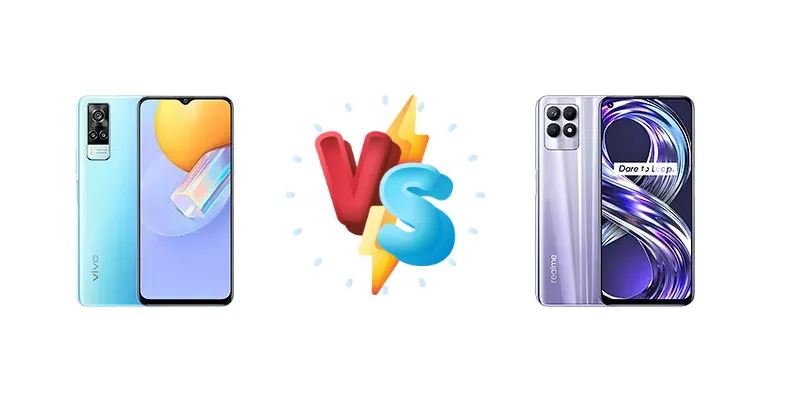
The sub-$200 smartphone market is fiercely competitive. Both the vivo Y31 (2021) and the Realme 8i aim to deliver a solid experience without breaking the bank, but they take different approaches. The Y31 relies on Qualcomm’s Snapdragon 662, prioritizing efficiency, while the 8i boasts MediaTek’s Helio G96, geared towards gaming and multimedia. This comparison dives deep into the specifics to determine which device offers the best value.
🏆 Quick Verdict
For the average user prioritizing consistent performance and a smooth experience, the Realme 8i emerges as the better choice. Its Helio G96 chipset, despite being less efficient, provides a noticeable performance uplift in demanding tasks, and the measured 540 nits brightness offers a more usable outdoor experience. However, the Y31 remains a viable option for those seeking a more power-efficient device.
| Network |
|---|
| 2G bands | GSM 850 / 900 / 1800 / 1900 | GSM 850 / 900 / 1800 / 1900 |
| 3G bands | HSDPA 850 / 900 / 2100 | HSDPA 850 / 900 / 2100 |
| 4G bands | 1, 3, 5, 8, 38, 40, 41 | 1, 3, 5, 8, 38, 40, 41 |
| Speed | HSPA, LTE | HSPA, LTE |
| Technology | GSM / HSPA / LTE | GSM / HSPA / LTE |
| Launch |
|---|
| Announced | 2021, January 20 | 2021, September 09 |
| Status | Available. Released 2021, January 20 | Available. Released 2021, September 14 |
| Body |
|---|
| Build | - | Glass front, plastic frame, plastic back |
| Dimensions | 163.9 x 75.3 x 8.4 mm (6.45 x 2.96 x 0.33 in) | 164.1 x 75.5 x 8.5 mm (6.46 x 2.97 x 0.33 in) |
| SIM | Nano-SIM + Nano-SIM | Nano-SIM + Nano-SIM |
| Weight | 188 g (6.63 oz) | 194 g (6.84 oz) |
| Display |
|---|
| Resolution | 1080 x 2408 pixels, 20:9 ratio (~401 ppi density) | 1080 x 2412 pixels, 20:9 ratio (~400 ppi density) |
| Size | 6.58 inches, 104.3 cm2 (~84.5% screen-to-body ratio) | 6.6 inches, 104.8 cm2 (~84.6% screen-to-body ratio) |
| Type | IPS LCD | IPS LCD, 120Hz, 600 nits (peak) |
| Platform |
|---|
| CPU | Octa-core (4x2.0 GHz Kryo 260 Gold & 4x1.8 GHz Kryo 260 Silver) | Octa-core (2x2.05 GHz Cortex-A76 & 6x2.0 GHz Cortex-A55) |
| Chipset | Qualcomm SM6115 Snapdragon 662 (11 nm) | Mediatek MT6781 Helio G96 (12 nm) |
| GPU | Adreno 610 | Mali-G57 MC2 |
| OS | Android 11, Funtouch 11 | Android 11, Realme UI 2.0 |
| Memory |
|---|
| Card slot | microSDXC (dedicated slot) | microSDXC (dedicated slot) |
| Internal | 64GB 4GB RAM, 128GB 4GB RAM, 128GB 6GB RAM, 128GB 8GB RAM | 64GB 4GB RAM, 128GB 4GB RAM, 128GB 6GB RAM |
| | - | UFS 2.1 |
| Main Camera |
|---|
| Features | LED flash, HDR, panorama | LED flash, HDR, panorama |
| Single | - | 16 MP, f/2.1, (wide), 1/3.0", 1.0µm |
| Triple | 48 MP, f/1.8, (wide), 1/2.0", 0.8µm, PDAF
2 MP (macro)
Auxiliary lens | 50 MP, f/1.8, 26mm (wide), 1/2.76", 0.64µm, PDAF
2 MP (macro)
Auxiliary lens |
| Video | 4K@30fps, 1080p@30fps, gyro-EIS | 1080p@30fps |
| Selfie camera |
|---|
| Features | HDR | Panorama |
| Single | 16 MP, f/2.0, (wide), 1/3.06" 1.0µm | 16 MP, f/2.1, (wide), 1/3.0", 1.0µm |
| Video | 1080p@30fps | 1080p@30fps |
| Sound |
|---|
| 3.5mm jack | - | Yes |
| 35mm jack | Yes | Yes |
| Loudspeaker | Yes | Yes |
| Comms |
|---|
| Bluetooth | 5.0, A2DP, LE | 5.1, A2DP, LE |
| NFC | No | Yes (market/region dependent) |
| Positioning | GPS, GLONASS, GALILEO, BDS | GPS, GLONASS, GALILEO, BDS |
| Radio | FM radio | No |
| USB | USB Type-C 2.0, OTG | USB Type-C 2.0, OTG |
| WLAN | Wi-Fi 802.11 a/b/g/n/ac, dual-band, Wi-Fi Direct | Wi-Fi 802.11 a/b/g/n/ac, dual-band |
| Features |
|---|
| Sensors | Fingerprint (side-mounted), accelerometer, gyro, proximity, compass | Fingerprint (side-mounted), accelerometer, gyro, proximity, compass |
| Battery |
|---|
| Charging | 18W wired, 70% in 67 min | 18W wired |
| Type | 5000 mAh | 5000 mAh |
| Misc |
|---|
| Colors | Racing Black, Ocean Blue | Space Black, Space Purple |
| Models | V2036, V2036_21 | RMX3151 |
| Price | About 190 EUR | About 440 EUR |
| Tests |
|---|
| Battery life | - |
Endurance rating 131h
|
| Camera | - |
Photo / Video |
| Loudspeaker | - |
-28.4 LUFS (Average)
|
vivo Y31 (2021)
- Potentially better battery efficiency due to the Snapdragon 662's 11nm process.
- Stable and reliable Qualcomm chipset.
- Faster charging to 70% in 67 minutes.
- Less powerful CPU and GPU compared to the Realme 8i.
- Display brightness and contrast likely inferior to the Realme 8i.
Realme 8i
- More powerful MediaTek Helio G96 chipset for gaming and multitasking.
- Brighter display (540 nits) for better outdoor visibility.
- Higher contrast ratio (1244:1) for a more vibrant image.
- Less power-efficient chipset, potentially leading to shorter battery life.
- Helio G96 may generate more heat under sustained load.
Display Comparison
The Realme 8i features a brighter display, measured at 540 nits, compared to the unstated brightness of the vivo Y31. This difference is significant for outdoor use, where the 8i will remain more readable in direct sunlight. While both likely utilize IPS LCD panels, the 1244:1 contrast ratio of the Realme 8i suggests deeper blacks and a more vibrant image. The Y31’s display specifications are less defined, making it difficult to assess its color accuracy or viewing angles relative to the 8i.
Camera Comparison
Both phones feature a 'Photo / Video' capability, but detailed camera specifications are lacking. Without sensor size or aperture information, a direct comparison is difficult. However, the Realme 8i’s brand positioning suggests a greater emphasis on camera features, potentially offering more sophisticated image processing algorithms. The inclusion of a 2MP macro camera on both devices is largely a marketing tactic, offering limited practical benefit due to the small sensor size and lack of optical image stabilization (OIS).
Performance
The Realme 8i’s MediaTek Helio G96 (12nm) offers a performance advantage over the vivo Y31’s Qualcomm Snapdragon 662 (11nm). The G96’s Cortex-A76 cores, clocked at 2.05 GHz, provide a more substantial boost in single-core performance compared to the Snapdragon 662’s Kryo 260 Gold cores at 2.0 GHz. While both are octa-core CPUs, the architectural differences translate to smoother multitasking and faster app loading times on the 8i. The 12nm process node of the G96 is less efficient than the 11nm node of the Snapdragon 662, potentially leading to more heat generation under sustained load.
Battery Life
Both the vivo Y31 (2021) and Realme 8i share an 18W wired charging capability, with the Y31 reaching 70% charge in 67 minutes. Both devices also have an endurance rating of 131 hours. This suggests similar battery capacities and power consumption profiles. The Snapdragon 662’s greater efficiency in the Y31 might offset the G96’s higher power draw, resulting in comparable real-world battery life despite the chipset differences.
Buying Guide
Buy the vivo Y31 (2021) if you need a reliable, everyday phone with a focus on battery longevity and a stable software experience. It’s ideal for users who primarily browse the web, use social media, and make calls. Buy the Realme 8i if you prefer a phone capable of handling more demanding games and applications, and if you value a brighter display for outdoor visibility. It’s a better fit for multimedia enthusiasts and casual gamers.
Frequently Asked Questions
❓ Will the Helio G96 in the Realme 8i overheat during prolonged gaming sessions?
The Helio G96 is known to generate more heat than the Snapdragon 662. While the Realme 8i likely incorporates thermal management solutions, extended gaming at high settings may lead to noticeable warming. Reducing graphics settings can mitigate this issue.
❓ Is the 18W charging speed sufficient for quick top-ups on either device?
While 18W charging isn't the fastest available, it's adequate for these budget phones. The vivo Y31 (2021) reaches 70% charge in 67 minutes, suggesting a reasonable charging time. The Realme 8i should offer similar charging speeds, though specific data isn't provided.
❓ How does the Snapdragon 662 handle multitasking compared to the Helio G96?
The Helio G96’s Cortex-A76 cores provide a noticeable advantage in multitasking. While the Snapdragon 662 is capable, the G96 will handle more demanding apps and switching between them more smoothly.
❓ Are the 2MP macro cameras on either phone worth using?
Generally, 2MP macro cameras on budget phones offer limited image quality. The small sensor size and lack of OIS result in soft, noisy images. They are best used for casual snapshots in good lighting conditions.