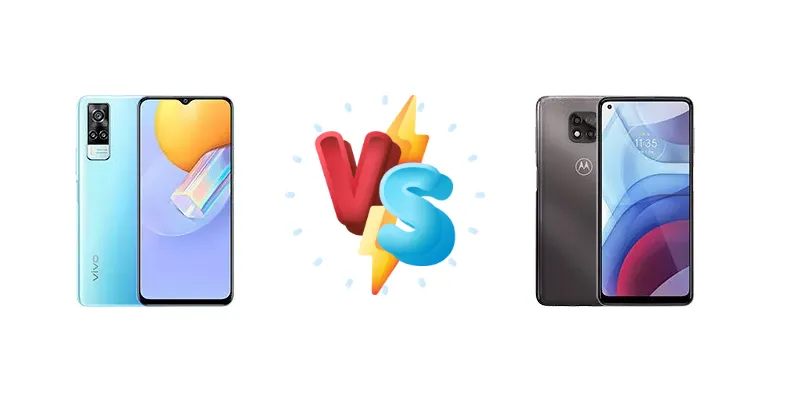
The budget smartphone market is fiercely competitive, and the vivo Y31 (2021) and Motorola Moto G Power (2021) represent compelling options for users prioritizing value. Both devices are powered by the Qualcomm Snapdragon 662, but subtle differences in charging capabilities and potential software experiences create a clear distinction for specific user profiles.
🏆 Quick Verdict
For the average user seeking the best balance of features and value, the Motorola Moto G Power (2021) emerges as the slightly better choice. While both phones share the same chipset, the Moto G Power’s larger battery capacity, despite slower charging, provides a more substantial advantage in real-world endurance.
| Network |
|---|
| 2G bands | GSM 850 / 900 / 1800 / 1900 | GSM 850 / 900 / 1800 / 1900 |
| 3G bands | HSDPA 850 / 900 / 2100 | HSDPA 850 / 900 / 1700(AWS) / 1900 / 2100 |
| 4G bands | 1, 3, 5, 8, 38, 40, 41 | 1, 2, 3, 4, 5, 7, 8, 12, 13, 14, 17, 25, 26, 29, 30, 38, 41, 66, 71 |
| Speed | HSPA, LTE | HSPA, LTE |
| Technology | GSM / HSPA / LTE | GSM / CDMA / HSPA / EVDO / LTE |
| | - | CDMA2000 1xEV-DO |
| Launch |
|---|
| Announced | 2021, January 20 | 2021, January 08 |
| Status | Available. Released 2021, January 20 | Available. Released 2021, January 14 |
| Body |
|---|
| Build | - | Glass front, plastic back, plastic frame |
| Dimensions | 163.9 x 75.3 x 8.4 mm (6.45 x 2.96 x 0.33 in) | 165.3 x 75.9 x 9.5 mm (6.51 x 2.99 x 0.37 in) |
| SIM | Nano-SIM + Nano-SIM | Nano-SIM |
| Weight | 188 g (6.63 oz) | 206.5 g (7.30 oz) |
| | - | Water-repellent coating |
| Display |
|---|
| Resolution | 1080 x 2408 pixels, 20:9 ratio (~401 ppi density) | 720 x 1600 pixels, 20:9 ratio (~266 ppi density) |
| Size | 6.58 inches, 104.3 cm2 (~84.5% screen-to-body ratio) | 6.6 inches, 105.2 cm2 (~83.8% screen-to-body ratio) |
| Type | IPS LCD | IPS LCD |
| Platform |
|---|
| CPU | Octa-core (4x2.0 GHz Kryo 260 Gold & 4x1.8 GHz Kryo 260 Silver) | Octa-core (4x2.0 GHz Kryo 260 Gold & 4x1.8 GHz Kryo 260 Silver) |
| Chipset | Qualcomm SM6115 Snapdragon 662 (11 nm) | Qualcomm SM6115 Snapdragon 662 (11 nm) |
| GPU | Adreno 610 | Adreno 610 |
| OS | Android 11, Funtouch 11 | Android 10 |
| Memory |
|---|
| Card slot | microSDXC (dedicated slot) | microSDXC (dedicated slot) |
| Internal | 64GB 4GB RAM, 128GB 4GB RAM, 128GB 6GB RAM, 128GB 8GB RAM | 32GB 3GB RAM, 64GB 4GB RAM |
| | - | eMMC 5.1 |
| Main Camera |
|---|
| Features | LED flash, HDR, panorama | LED flash, HDR, panorama |
| Triple | 48 MP, f/1.8, (wide), 1/2.0", 0.8µm, PDAF
2 MP (macro)
Auxiliary lens | 48 MP, f/1.7, (wide), 1/2.0", 0.8µm, PDAF
2 MP (macro)
Auxiliary lens |
| Video | 4K@30fps, 1080p@30fps, gyro-EIS | 1080p@30/60fps, gyro-EIS |
| Selfie camera |
|---|
| Features | HDR | HDR |
| Single | 16 MP, f/2.0, (wide), 1/3.06" 1.0µm | 8 MP, f/2.0, 1.12µm |
| Video | 1080p@30fps | 1080p@30fps, gyro-EIS |
| Sound |
|---|
| 3.5mm jack | - | Yes |
| 35mm jack | Yes | Yes |
| Loudspeaker | Yes | Yes |
| Comms |
|---|
| Bluetooth | 5.0, A2DP, LE | 5.0, A2DP, LE |
| NFC | No | No |
| Positioning | GPS, GLONASS, GALILEO, BDS | GPS, GLONASS, GALILEO |
| Radio | FM radio | FM radio |
| USB | USB Type-C 2.0, OTG | USB Type-C 2.0 |
| WLAN | Wi-Fi 802.11 a/b/g/n/ac, dual-band, Wi-Fi Direct | Wi-Fi 802.11 a/b/g/n/ac, dual-band, Wi-Fi Direct |
| Features |
|---|
| Sensors | Fingerprint (side-mounted), accelerometer, gyro, proximity, compass | Fingerprint (side-mounted), accelerometer, gyro, proximity, compass, barometer |
| Battery |
|---|
| Charging | 18W wired, 70% in 67 min | 15W wired |
| Type | 5000 mAh | Li-Po 5000 mAh |
| Misc |
|---|
| Colors | Racing Black, Ocean Blue | Flash Gray, Polar Silver |
| Models | V2036, V2036_21 | - |
| Price | About 190 EUR | About 60 EUR |
vivo Y31 (2021)
- Faster 18W charging for quicker top-ups.
- Potentially more streamlined software experience (depending on vivo's Funtouch OS version).
- Similar performance to Moto G Power due to identical chipset.
- Likely smaller battery capacity compared to Moto G Power.
- Software experience (Funtouch OS) can be polarizing.
Motorola Moto G Power (2021)
- Likely larger battery capacity for extended usage.
- Motorola's near-stock Android experience is preferred by many.
- Strong reputation for battery life in the Moto G Power series.
- Slower 15W charging.
- May receive fewer software updates compared to some competitors.
Display Comparison
Both the vivo Y31 and Moto G Power (2021) likely feature LCD panels, common in this price bracket. However, specific details like resolution and peak brightness are not provided. The absence of high refresh rate technology is expected. The real-world impact will be similar viewing experiences, with neither phone excelling in display quality compared to higher-tier devices. Bezels are likely comparable, focusing on maximizing screen real estate within the budget constraints.
Camera Comparison
Camera specifications are not detailed enough to draw significant conclusions. Both phones likely feature a multi-camera setup, but the quality will heavily depend on sensor size, lens aperture, and image processing algorithms. The inclusion of a 2MP macro camera on either device is largely a marketing tactic, offering limited practical benefit due to the small sensor size and low resolution. Without knowing the main sensor resolution and aperture, it's difficult to assess low-light performance or dynamic range.
Performance
The core of both devices is the Qualcomm Snapdragon 662 (11 nm) paired with an Octa-core CPU configuration (4x2.0 GHz Kryo 260 Gold & 4x1.8 GHz Kryo 260 Silver). This means performance will be virtually identical for everyday tasks like browsing, social media, and light gaming. The 11nm process node offers a reasonable balance between power efficiency and performance. RAM configurations, not specified, will influence multitasking capabilities; however, the chipset itself is the primary performance bottleneck. Thermal management will likely be adequate for the intended use cases, as the Snapdragon 662 isn't a power-hungry processor.
Battery Life
This is where the most significant difference lies. While battery capacity isn't specified for either device, the Moto G Power’s name suggests a larger battery than the Y31. The Moto G Power features 15W wired charging, while the vivo Y31 supports 18W wired charging, reaching 70% charge in 67 minutes. The faster charging on the Y31 is advantageous for quick top-ups, but the larger battery capacity of the Moto G Power likely translates to significantly longer overall usage time between charges. The trade-off is clear: convenience versus endurance.
Buying Guide
Buy the vivo Y31 (2021) if you prioritize faster charging speeds and a potentially more streamlined software experience. Its 18W charging allows for quicker top-ups, beneficial for users who can't afford extended downtime. Buy the Motorola Moto G Power (2021) if you prioritize maximum battery life and are willing to trade off charging speed. The Moto G Power is ideal for users who heavily rely on their phone throughout the day and need a device that can consistently last beyond a single charge.
Frequently Asked Questions
❓ Does the Snapdragon 662 in either phone struggle with demanding games like PUBG Mobile?
The Snapdragon 662 is a capable chipset for casual gaming, but it will likely require reduced graphics settings and frame rates for smoother gameplay in demanding titles like PUBG Mobile. Expect playable performance at medium settings, but don't anticipate a high-end gaming experience.
❓ How does Motorola's software update policy compare to vivo's for these devices?
Motorola generally provides fewer major Android updates compared to some other manufacturers. However, their near-stock Android experience often results in faster security patch delivery. Vivo's Funtouch OS, while feature-rich, may have a slower update cycle and a more customized user interface that some users may not prefer.
❓ Is the 18W charging on the vivo Y31 significantly faster in real-world use?
While 18W is faster than 15W, the difference in charging time won't be dramatic. The vivo Y31 reaching 70% in 67 minutes is a reasonable charging speed, but a larger battery on the Moto G Power might still provide longer overall usage despite the slower charging rate.