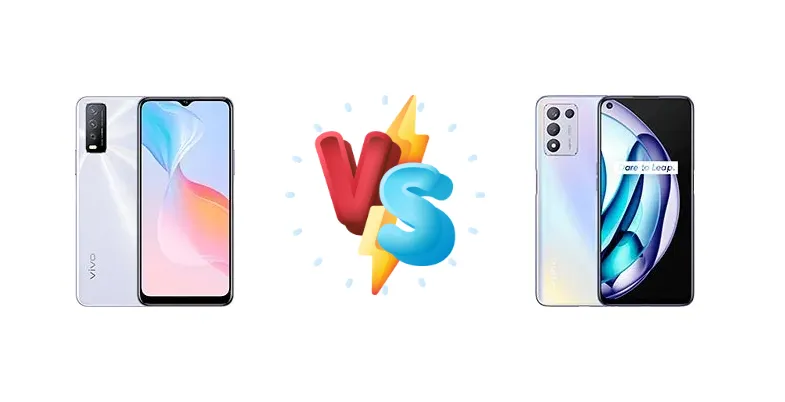
The Realme Q3t and vivo Y30g represent distinct approaches to the budget smartphone market. The Q3t aims for a compelling mid-range experience with 5G connectivity and a powerful chipset, while the Y30g focuses on affordability, offering a functional experience at a lower price point. This comparison dissects their key differences to help you determine which device best suits your needs.
🏆 Quick Verdict
For most users, the Realme Q3t is the clear winner. Its Snapdragon 778G chipset provides a substantial performance leap over the vivo Y30g’s Helio P65, enabling smoother multitasking, faster app loading, and a more enjoyable gaming experience. The 30W charging is also a significant advantage, offsetting the slightly smaller battery capacity.
| Network |
|---|
| 2G bands | GSM 850 / 900 / 1800 / 1900 | GSM 850 / 900 / 1800 / 1900 |
| 3G bands | HSDPA 850 / 900 / 2100 | HSDPA 850 / 900 / 1700(AWS) / 1900 / 2100 |
| 4G bands | 1, 3, 5, 8, 34, 38, 39, 40, 41 | LTE |
| 5G bands | - | SA/NSA |
| Speed | HSPA, LTE | HSPA, LTE, 5G |
| Technology | GSM / CDMA / HSPA / LTE | GSM / CDMA / HSPA / EVDO / LTE / 5G |
| | CDMA 800 & TD-SCDMA | CDMA2000 1xEV-DO |
| Launch |
|---|
| Announced | 2021, March 30 | 2021, November 10 |
| Status | Available. Released 2021, March 30 | Available. Released 2021, November 15 |
| Body |
|---|
| Build | Glass front, plastic back, plastic frame | - |
| Dimensions | 164.4 x 76.3 x 8.4 mm (6.47 x 3.00 x 0.33 in) | - |
| SIM | Nano-SIM + Nano-SIM | Nano-SIM + Nano-SIM |
| Weight | 191.4 g (6.77 oz) | - |
| Display |
|---|
| Resolution | 720 x 1600 pixels, 20:9 ratio (~270 ppi density) | 1080 x 2412 pixels, 20:9 ratio (~400 ppi density) |
| Size | 6.51 inches, 102.3 cm2 (~81.6% screen-to-body ratio) | 6.6 inches, 104.8 cm2 |
| Type | IPS LCD | IPS LCD, 144Hz, 600 nits |
| Platform |
|---|
| CPU | Octa-core (2x2.0 GHz Cortex-A75 & 6x1.7 GHz Cortex-A55) | Octa-core (1x2.4 GHz Cortex-A78 & 3x2.2 GHz Cortex-A78 & 4x1.9 GHz Cortex-A55) |
| Chipset | Mediatek MT6768 Helio P65 (12 nm) | Qualcomm SM7325 Snapdragon 778G 5G (6 nm) |
| GPU | Mali-G52 MC2 | Adreno 642L |
| OS | Android 11, OriginOS 1.0 | Android 11, Realme UI 2.0 |
| Memory |
|---|
| Card slot | microSDXC | Unspecified |
| Internal | 128GB 8GB RAM | 256GB 8GB RAM |
| | eMMC 5.1 | - |
| Main Camera |
|---|
| Dual | 13 MP, f/2.2, (wide), PDAF
Auxiliary lens | - |
| Features | LED flash, panorama | LED flash, HDR, panorama |
| Single | 8 MP, f/1.8, (wide) | 16 MP, f/2.1, 26mm (wide) |
| Triple | - | 48 MP, f/1.8, 26mm (wide), PDAF
2 MP (macro)
Auxiliary lens |
| Video | 1080p@30fps | 4K@30fps, 1080p@30/60fps |
| Selfie camera |
|---|
| Features | - | HDR, panorama |
| Single | 8 MP, f/1.8, (wide) | 16 MP, f/2.1, 26mm (wide) |
| Video | 1080p@30fps | 1080p@30fps |
| Sound |
|---|
| 3.5mm jack | Yes | Yes |
| 35mm jack | Yes | Yes |
| Loudspeaker | Yes | Yes |
| | - | 24-bit/192kHz audio |
| Comms |
|---|
| Bluetooth | 5.0, A2DP, LE, aptX HD | 5.2, A2DP, LE |
| NFC | No | No |
| Positioning | GPS, GLONASS, BDS, GALILEO, QZSS | GPS, GLONASS, BDS, GALILEO, QZSS |
| Radio | Unspecified | No |
| USB | microUSB 2.0, OTG | USB Type-C 2.0, OTG |
| WLAN | Wi-Fi 802.11 a/b/g/n/ac, dual-band, Wi-Fi Direct | Wi-Fi 802.11 a/b/g/n/ac/6, dual-band, Wi-Fi Direct |
| Features |
|---|
| Sensors | Fingerprint (side-mounted), accelerometer, proximity, compass | Fingerprint (side-mounted), accelerometer, gyro, proximity, compass |
| Battery |
|---|
| Charging | 18W wired | 30W wired, 50% in 25 min |
| Type | 5000 mAh | 5000 mAh |
| Misc |
|---|
| Colors | Obsidian Black, Dawn White, Aqua Blue | Aurora, Dark Blue |
| Models | V2066BA | - |
| Price | About 200 EUR | About 290 EUR |
vivo Y30g
- Extremely affordable price point
- Functional for basic smartphone tasks
- Decent battery life for light usage
- Outdated Helio P65 chipset
- Slow 18W charging
- Likely lower-quality display
Realme Q3t
- Powerful Snapdragon 778G 5G chipset
- Fast 30W charging (50% in 25 min)
- Likely superior display quality
- Higher price compared to the vivo Y30g
- Battery capacity not specified (potential trade-off)
- May be slightly larger and heavier
Display Comparison
Neither device’s display specifications are provided, so a direct comparison is limited. However, given the Q3t’s positioning, it likely features a higher-quality panel with a faster refresh rate. The Y30g, being a more budget-oriented device, likely utilizes a standard 60Hz LCD. Bezels are expected to be larger on the Y30g, contributing to a less immersive viewing experience. Color accuracy is also likely to be superior on the Q3t.
Camera Comparison
Without detailed camera specifications, a precise comparison is difficult. However, the Q3t, being a more premium device, likely features a larger main sensor and more sophisticated image processing algorithms. The Y30g likely relies on a more basic camera setup. The presence of Optical Image Stabilization (OIS) on the Q3t, while not confirmed, is more probable, leading to sharper images and smoother videos, especially in low-light conditions. The Y30g’s camera is likely adequate for casual snapshots, but will fall short in challenging lighting scenarios.
Performance
The performance gap between these two devices is substantial. The Realme Q3t’s Snapdragon 778G (6nm) is a significant upgrade over the vivo Y30g’s Helio P65 (12nm). The 778G features a Cortex-A78 prime core clocked at 2.4GHz, alongside three additional A78 cores, offering a considerable boost in CPU performance. The Helio P65 relies on older Cortex-A75 cores, resulting in slower processing speeds. The 6nm process node of the Snapdragon 778G also translates to improved power efficiency and reduced thermal throttling during sustained workloads, benefiting gamers and power users. The Q3t will handle demanding apps and games with ease, while the Y30g may struggle with more intensive tasks.
Battery Life
The Realme Q3t’s 30W wired charging is a major advantage, capable of charging the battery to 50% in just 25 minutes. The vivo Y30g’s 18W charging is considerably slower. While battery capacity isn’t specified, the faster charging of the Q3t effectively mitigates any potential difference in overall battery life. Users who frequently top up their phones will greatly benefit from the Q3t’s faster charging speed.
Buying Guide
Buy the vivo Y30g if you prioritize extreme affordability and basic smartphone functionality – calls, texts, and light social media use. It’s a suitable choice for first-time smartphone users or those on a very tight budget. Buy the Realme Q3t if you value performance, 5G connectivity, and faster charging. It’s ideal for users who enjoy mobile gaming, stream videos, or frequently multitask.
Frequently Asked Questions
❓ Will the Helio P65 in the vivo Y30g struggle with modern mobile games like PUBG or Call of Duty?
Yes, the Helio P65 is a relatively older and less powerful chipset. While it can run these games, you'll likely need to lower graphics settings significantly to achieve playable frame rates. Expect stuttering and lag, especially in intense scenes. The Realme Q3t’s Snapdragon 778G will provide a much smoother and more enjoyable gaming experience.
❓ How much faster is the 30W charging on the Realme Q3t compared to the 18W charging on the vivo Y30g in real-world use?
The 30W charging on the Q3t will noticeably reduce your charging times. While a full 0-100% time isn't specified, the claim of 50% in 25 minutes is a significant advantage. The Y30g’s 18W charging will take considerably longer – likely over an hour to reach a full charge. This makes the Q3t ideal for users who need to quickly top up their battery.
❓ Does the Realme Q3t support 5G connectivity, and will I actually see a speed difference compared to 4G?
Yes, the Realme Q3t utilizes the Snapdragon 778G, which includes an integrated 5G modem. If you have 5G coverage in your area and a compatible SIM card, you'll experience significantly faster download and upload speeds compared to 4G. This is particularly beneficial for streaming high-resolution video, downloading large files, and online gaming.