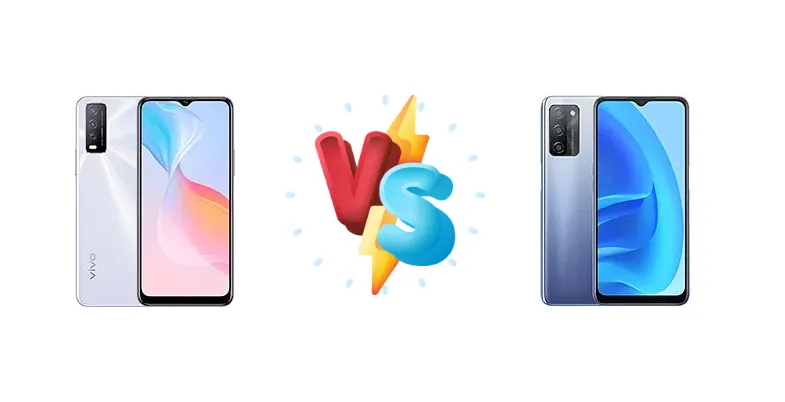
The Oppo A55s and vivo Y30g represent compelling options in the sub-$200 smartphone market. While both aim to deliver essential features at an accessible price, they diverge significantly in their core processing power. This comparison dissects the key differences, focusing on how the chipset choice impacts real-world performance and user experience.
🏆 Quick Verdict
For most users, the Oppo A55s is the superior choice. Its Mediatek Dimensity 700 chipset provides a substantial performance advantage over the vivo Y30g’s Helio P65, translating to smoother multitasking, faster app loading, and improved gaming. While the Y30g offers faster 18W charging, the A55s’ performance gains outweigh this benefit for the average user.
| Network |
|---|
| 2G bands | GSM 850 / 900 / 1800 / 1900 | GSM 850 / 900 / 1800 / 1900 |
| 3G bands | HSDPA 850 / 900 / 2100 | HSDPA 800 / 850 / 900 / 1700(AWS) / 1900 / 2100 |
| 4G bands | 1, 3, 5, 8, 34, 38, 39, 40, 41 | 1, 3, 5, 8, 34, 38, 39, 40, 41 |
| 5G bands | - | 1, 28, 41, 77, 78 |
| Speed | HSPA, LTE | HSPA, LTE |
| Technology | GSM / CDMA / HSPA / LTE | GSM / CDMA / HSPA / LTE / 5G |
| | CDMA 800 & TD-SCDMA | CDMA 800 |
| Launch |
|---|
| Announced | 2021, March 30 | 2022, April 18 |
| Status | Available. Released 2021, March 30 | Available. Released 2022, April 18 |
| Body |
|---|
| Build | Glass front, plastic back, plastic frame | - |
| Dimensions | 164.4 x 76.3 x 8.4 mm (6.47 x 3.00 x 0.33 in) | 163.9 x 75.7 x 8.4 mm (6.45 x 2.98 x 0.33 in) |
| SIM | Nano-SIM + Nano-SIM | Nano-SIM + Nano-SIM |
| Weight | 191.4 g (6.77 oz) | 186 g (6.56 oz) |
| Display |
|---|
| Resolution | 720 x 1600 pixels, 20:9 ratio (~270 ppi density) | 720 x 1600 pixels, 20:9 ratio (~270 ppi density) |
| Size | 6.51 inches, 102.3 cm2 (~81.6% screen-to-body ratio) | 6.5 inches, 102.0 cm2 (~82.2% screen-to-body ratio) |
| Type | IPS LCD | IPS LCD, 480 nits (peak) |
| Platform |
|---|
| CPU | Octa-core (2x2.0 GHz Cortex-A75 & 6x1.7 GHz Cortex-A55) | Octa-core (2x2.2 GHz Cortex-A76 & 6x2.0 GHz Cortex-A55) |
| Chipset | Mediatek MT6768 Helio P65 (12 nm) | Mediatek Dimensity 700 (7 nm) |
| GPU | Mali-G52 MC2 | Mali-G57 MC2 |
| OS | Android 11, OriginOS 1.0 | Android 11, ColorOS 11.1 |
| Memory |
|---|
| Card slot | microSDXC | microSDXC |
| Internal | 128GB 8GB RAM | 128GB 6GB RAM, 128GB 8GB RAM |
| | eMMC 5.1 | - |
| Main Camera |
|---|
| Dual | 13 MP, f/2.2, (wide), PDAF
Auxiliary lens | - |
| Features | LED flash, panorama | LED flash, HDR, panorama |
| Single | 8 MP, f/1.8, (wide) | 8 MP, f/2.0, (wide) |
| Triple | - | 13 MP, f/2.2, 25mm (wide), 1/3.06", 1.12µm, PDAF
2 MP (macro)
Auxiliary lens |
| Video | 1080p@30fps | 1080p@30fps |
| Selfie camera |
|---|
| Features | - | HDR |
| Single | 8 MP, f/1.8, (wide) | 8 MP, f/2.0, (wide) |
| Video | 1080p@30fps | 1080p@30fps |
| Sound |
|---|
| 3.5mm jack | Yes | Yes |
| 35mm jack | Yes | Yes |
| Loudspeaker | Yes | Yes |
| Comms |
|---|
| Bluetooth | 5.0, A2DP, LE, aptX HD | 5.1, A2DP, LE, aptX HD |
| NFC | No | No |
| Positioning | GPS, GLONASS, BDS, GALILEO, QZSS | GPS, GLONASS, GALILEO, BDS, QZSS |
| Radio | Unspecified | No |
| USB | microUSB 2.0, OTG | USB Type-C 2.0, OTG |
| WLAN | Wi-Fi 802.11 a/b/g/n/ac, dual-band, Wi-Fi Direct | Wi-Fi 802.11 a/b/g/n/ac, dual-band, Wi-Fi Direct |
| Features |
|---|
| Sensors | Fingerprint (side-mounted), accelerometer, proximity, compass | Fingerprint (side-mounted), accelerometer, gyro, proximity, compass |
| Battery |
|---|
| Charging | 18W wired | 10W wired |
| Type | 5000 mAh | Li-Po 5000 mAh |
| Misc |
|---|
| Colors | Obsidian Black, Dawn White, Aqua Blue | Black, Blue, Gold |
| Models | V2066BA | CPH2309 |
| Price | About 200 EUR | About 160 EUR |
vivo Y30g
- Significantly faster processor (Dimensity 700)
- 5G connectivity for faster data speeds
- More efficient chipset for potentially better battery life
- Slower charging speed (10W)
- Likely a less feature-rich camera system
Oppo A55s
- Faster charging (18W)
- Potentially lower price point
- Sufficient for basic smartphone tasks
- Noticeably slower processor (Helio P65)
- Lacks 5G connectivity
- Less responsive user experience
Display Comparison
Neither device boasts a standout display. Given the context data focuses on processing, we can infer both likely utilize LCD panels common in this price bracket. The absence of specifications like resolution or refresh rate suggests a focus on cost optimization. Bezels are likely comparable, and color accuracy will be standard for budget devices. The real difference lies elsewhere.
Camera Comparison
Without detailed camera specifications, a direct comparison is difficult. However, it’s reasonable to assume both phones feature a primary camera and supporting lenses (likely a depth or macro sensor). The image processing capabilities of the Dimensity 700 in the A55s may offer slightly better image quality, particularly in low-light conditions, due to its more powerful ISP (Image Signal Processor). The Y30g’s Helio P65 ISP is less capable. We can expect similar performance from any included 2MP macro lenses on both devices – largely a marketing feature with limited practical benefit.
Performance
The core differentiator is the chipset. The Oppo A55s’ Mediatek Dimensity 700, built on a 7nm process, is a clear upgrade over the vivo Y30g’s 12nm Mediatek Helio P65. The Dimensity 700’s Cortex-A76 cores (2x2.2 GHz) offer significantly higher single-core performance than the Y30g’s Cortex-A75 cores (2x2.0 GHz). This translates to snappier app launches and a more responsive user interface. The 7nm process also contributes to better power efficiency, potentially offsetting the A55s’ lower charging wattage. The Dimensity 700 also includes an integrated 5G modem, a feature likely absent in the Y30g, offering future-proofing and faster data speeds where available.
Battery Life
The vivo Y30g’s 18W wired charging is a clear advantage over the Oppo A55s’ 10W charging. This means the Y30g will charge from 0-100% significantly faster. However, the Dimensity 700’s superior power efficiency in the A55s may partially mitigate the slower charging speed. Real-world battery life will depend on usage patterns, but the A55s’ more efficient chipset could result in comparable or even slightly better endurance despite the lower charging wattage.
Buying Guide
Buy the vivo Y30g if you prioritize charging speed and are primarily a casual user focused on basic tasks like calls, messaging, and light social media. The 18W charging will minimize downtime. Buy the Oppo A55s if you value performance and responsiveness, especially if you enjoy mobile gaming, streaming video, or frequently switch between applications. The Dimensity 700 offers a significantly more fluid experience.
Frequently Asked Questions
❓ Will the Oppo A55s handle demanding games like PUBG Mobile smoothly?
The Mediatek Dimensity 700 in the Oppo A55s is capable of running PUBG Mobile at medium settings with reasonable frame rates. While it won't deliver a flagship gaming experience, it provides a significantly smoother experience than the Helio P65 in the vivo Y30g, which may struggle with consistent performance even at lower settings.
❓ Is the 10W charging on the Oppo A55s a dealbreaker considering the vivo Y30g has 18W charging?
While 10W is slower, the Dimensity 700’s improved power efficiency in the Oppo A55s means you may not notice a huge difference in overall daily usage. The faster charging of the Y30g is most beneficial if you frequently need to top up your phone quickly throughout the day.
❓ Does the Oppo A55s support 5G networks, and will I see a noticeable speed difference?
Yes, the Dimensity 700 chipset includes an integrated 5G modem. If you live in an area with 5G coverage, you will experience significantly faster download and upload speeds compared to 4G networks, making streaming, browsing, and downloading content much quicker.