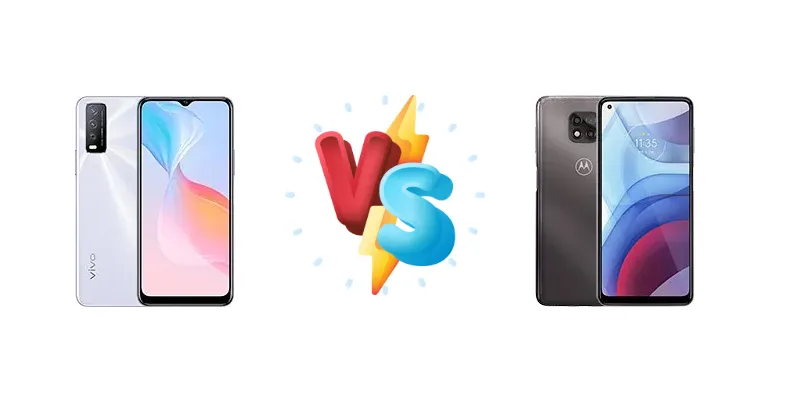
The sub-$200 smartphone market is fiercely competitive. The vivo Y30g and Motorola Moto G Power (2021) both aim to deliver essential features and reliable performance without breaking the bank. However, they take different approaches, with the Y30g leveraging MediaTek’s Helio P65 while the Moto G Power opts for Qualcomm’s Snapdragon 662. This comparison dissects these key differences to determine which device offers the best value.
🏆 Quick Verdict
For the average user prioritizing consistent performance and efficiency, the Motorola Moto G Power (2021) is the better choice. Its Snapdragon 662, built on an 11nm process, offers a more refined experience than the Helio P65, despite the Y30g’s slightly faster clock speeds. The difference in charging speed is minimal, and the overall user experience benefits from Qualcomm’s optimizations.
| Network |
|---|
| 2G bands | GSM 850 / 900 / 1800 / 1900 | GSM 850 / 900 / 1800 / 1900 |
| 3G bands | HSDPA 850 / 900 / 2100 | HSDPA 850 / 900 / 1700(AWS) / 1900 / 2100 |
| 4G bands | 1, 3, 5, 8, 34, 38, 39, 40, 41 | 1, 2, 3, 4, 5, 7, 8, 12, 13, 14, 17, 25, 26, 29, 30, 38, 41, 66, 71 |
| Speed | HSPA, LTE | HSPA, LTE |
| Technology | GSM / CDMA / HSPA / LTE | GSM / CDMA / HSPA / EVDO / LTE |
| | CDMA 800 & TD-SCDMA | CDMA2000 1xEV-DO |
| Launch |
|---|
| Announced | 2021, March 30 | 2021, January 08 |
| Status | Available. Released 2021, March 30 | Available. Released 2021, January 14 |
| Body |
|---|
| Build | Glass front, plastic back, plastic frame | Glass front, plastic back, plastic frame |
| Dimensions | 164.4 x 76.3 x 8.4 mm (6.47 x 3.00 x 0.33 in) | 165.3 x 75.9 x 9.5 mm (6.51 x 2.99 x 0.37 in) |
| SIM | Nano-SIM + Nano-SIM | Nano-SIM |
| Weight | 191.4 g (6.77 oz) | 206.5 g (7.30 oz) |
| | - | Water-repellent coating |
| Display |
|---|
| Resolution | 720 x 1600 pixels, 20:9 ratio (~270 ppi density) | 720 x 1600 pixels, 20:9 ratio (~266 ppi density) |
| Size | 6.51 inches, 102.3 cm2 (~81.6% screen-to-body ratio) | 6.6 inches, 105.2 cm2 (~83.8% screen-to-body ratio) |
| Type | IPS LCD | IPS LCD |
| Platform |
|---|
| CPU | Octa-core (2x2.0 GHz Cortex-A75 & 6x1.7 GHz Cortex-A55) | Octa-core (4x2.0 GHz Kryo 260 Gold & 4x1.8 GHz Kryo 260 Silver) |
| Chipset | Mediatek MT6768 Helio P65 (12 nm) | Qualcomm SM6115 Snapdragon 662 (11 nm) |
| GPU | Mali-G52 MC2 | Adreno 610 |
| OS | Android 11, OriginOS 1.0 | Android 10 |
| Memory |
|---|
| Card slot | microSDXC | microSDXC (dedicated slot) |
| Internal | 128GB 8GB RAM | 32GB 3GB RAM, 64GB 4GB RAM |
| | eMMC 5.1 | eMMC 5.1 |
| Main Camera |
|---|
| Dual | 13 MP, f/2.2, (wide), PDAF
Auxiliary lens | - |
| Features | LED flash, panorama | LED flash, HDR, panorama |
| Single | 8 MP, f/1.8, (wide) | - |
| Triple | - | 48 MP, f/1.7, (wide), 1/2.0", 0.8µm, PDAF
2 MP (macro)
Auxiliary lens |
| Video | 1080p@30fps | 1080p@30/60fps, gyro-EIS |
| Selfie camera |
|---|
| Features | - | HDR |
| Single | 8 MP, f/1.8, (wide) | 8 MP, f/2.0, 1.12µm |
| Video | 1080p@30fps | 1080p@30fps, gyro-EIS |
| Sound |
|---|
| 3.5mm jack | Yes | Yes |
| 35mm jack | Yes | Yes |
| Loudspeaker | Yes | Yes |
| Comms |
|---|
| Bluetooth | 5.0, A2DP, LE, aptX HD | 5.0, A2DP, LE |
| NFC | No | No |
| Positioning | GPS, GLONASS, BDS, GALILEO, QZSS | GPS, GLONASS, GALILEO |
| Radio | Unspecified | FM radio |
| USB | microUSB 2.0, OTG | USB Type-C 2.0 |
| WLAN | Wi-Fi 802.11 a/b/g/n/ac, dual-band, Wi-Fi Direct | Wi-Fi 802.11 a/b/g/n/ac, dual-band, Wi-Fi Direct |
| Features |
|---|
| Sensors | Fingerprint (side-mounted), accelerometer, proximity, compass | Fingerprint (side-mounted), accelerometer, gyro, proximity, compass, barometer |
| Battery |
|---|
| Charging | 18W wired | 15W wired |
| Type | 5000 mAh | Li-Po 5000 mAh |
| Misc |
|---|
| Colors | Obsidian Black, Dawn White, Aqua Blue | Flash Gray, Polar Silver |
| Models | V2066BA | - |
| Price | About 200 EUR | About 60 EUR |
vivo Y30g
- Potentially higher peak CPU performance in short bursts.
- Slightly faster 18W charging.
- May offer a more vibrant color profile (depending on software tuning).
- Helio P65 prone to thermal throttling.
- Less efficient 12nm process.
- Potentially shorter battery life compared to the Moto G Power.
Motorola Moto G Power (2021)
- More efficient Snapdragon 662 chipset.
- Better sustained performance due to 11nm process.
- Likely superior battery life.
- Qualcomm ISP offers better image processing.
- Slower 15W charging.
- Potentially lower peak CPU performance.
- May have a less vibrant display (depending on panel).
Display Comparison
Neither device boasts a standout display. Both likely utilize LCD panels, common in this price bracket. The focus here isn't on visual fidelity, but rather on practicality. Without specific display specs, it's difficult to definitively declare a winner. However, Motorola often prioritizes color accuracy in its budget offerings, potentially giving it a slight edge in real-world viewing. Bezels are expected to be substantial on both devices, reflecting their cost.
Camera Comparison
Without detailed camera specs beyond the chipsets, a direct comparison is limited. Both phones likely feature a primary camera and several auxiliary lenses of questionable utility. The Snapdragon 662’s image signal processor (ISP) generally offers better image processing capabilities, resulting in more detailed and dynamic photos, particularly in challenging lighting conditions. Motorola’s software optimizations often prioritize natural-looking images, while vivo tends towards more saturated colors. The absence of Optical Image Stabilization (OIS) on either device suggests a reliance on software stabilization, where the Snapdragon 662’s ISP would again have an advantage.
Performance
The core difference lies in the chipsets. The Motorola Moto G Power (2021) features the Qualcomm Snapdragon 662 (11nm), while the vivo Y30g uses the MediaTek Helio P65 (12nm). While the Y30g’s Cortex-A75 cores reach 2.0 GHz, compared to the Snapdragon 662’s 2.0 GHz Kryo 260 Gold cores, the 11nm process node of the Snapdragon 662 provides a significant advantage in power efficiency. This translates to less heat generation and more sustained performance. The Snapdragon 662’s architecture, with its split core design, is also more efficient at task scheduling. The Helio P65, while capable, is known to throttle more aggressively under prolonged stress, impacting gaming and demanding applications.
Battery Life
The Motorola Moto G Power (2021) is named appropriately, and its battery life is a key selling point. While the exact battery capacity isn’t provided, Motorola’s G Power series is renowned for exceptional endurance. The Snapdragon 662’s efficiency further contributes to this longevity. The vivo Y30g’s 18W charging is marginally faster than the Moto G Power’s 15W charging, but the difference in 0-100% charge time will likely be minimal – perhaps 30-60 minutes. The more efficient chipset in the Moto G Power will offset the slower charging speed with significantly longer usage between charges.
Buying Guide
Buy the vivo Y30g if you prioritize a potentially higher peak CPU performance in short bursts and are comfortable with a chipset that may exhibit more thermal throttling under sustained load. Buy the Motorola Moto G Power (2021) if you value consistent, efficient performance for everyday tasks, longer battery life due to the more efficient chipset, and a smoother overall user experience, even if it means sacrificing a small amount of theoretical peak CPU speed.
Frequently Asked Questions
❓ Will the Helio P65 in the vivo Y30g struggle with graphically demanding games like PUBG Mobile?
The Helio P65 can run PUBG Mobile, but likely at lower settings to maintain a stable frame rate. The chipset is prone to thermal throttling, meaning performance will decrease over time during extended gaming sessions. The Snapdragon 662 in the Moto G Power will offer a more consistent and smoother gaming experience, even if the initial frame rates are similar.
❓ How much faster is the 18W charging on the vivo Y30g compared to the 15W charging on the Moto G Power?
The difference in charging speed is relatively small. Expect the vivo Y30g to charge approximately 30-60 minutes faster from 0-100%. However, the Moto G Power’s superior battery efficiency means you’ll likely need to charge it less frequently, mitigating the slower charging speed.
❓ Does the Snapdragon 662 in the Moto G Power support any advanced features like Wi-Fi 6?
The Snapdragon 662 supports Wi-Fi 5 (802.11ac), not Wi-Fi 6. While not the latest standard, Wi-Fi 5 is still widely used and provides ample bandwidth for most users. The vivo Y30g's Wi-Fi capabilities are likely similar, given its chipset.