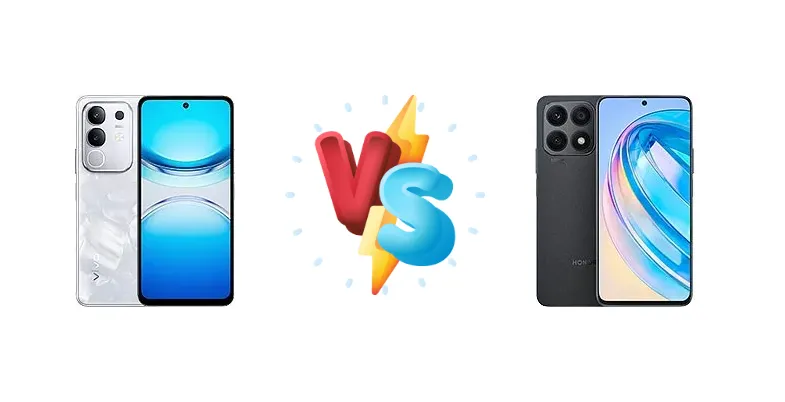
The vivo Y300t and Honor X8a represent compelling options in the crowded budget smartphone market. While both aim to deliver a solid experience without breaking the bank, they take drastically different approaches to achieving this. The Y300t boasts a significantly more powerful Mediatek Dimensity 7300 chipset, while the X8a relies on the older, more power-efficient Helio G88. This comparison will dissect these key differences and determine which device offers the best value for your money.
🏆 Quick Verdict
For the average user prioritizing performance and future-proofing, the vivo Y300t is the clear winner. Its Dimensity 7300 chipset provides a substantial leap in processing power and efficiency compared to the Honor X8a’s Helio G88, making it better suited for demanding tasks and gaming. However, the Honor X8a remains a viable option for those on a tighter budget who prioritize battery life and basic functionality.
| Network |
|---|
| 2G bands | GSM 850 / 900 / 1800 / 1900 | GSM 850 / 900 / 1800 / 1900 |
| 3G bands | HSDPA 850 / 900 / 2100 | HSDPA 850 / 900 / 2100 |
| 4G bands | 1, 3, 5, 8, 28, 34, 38, 39, 40, 41 | LTE |
| 5G bands | 1, 3, 5, 8, 28, 41, 77, 78 SA/NSA | - |
| Speed | HSPA, LTE, 5G | HSPA, LTE |
| Technology | GSM / CDMA / HSPA / LTE / 5G | GSM / HSPA / LTE |
| | - | Virtual proximity sensing |
| Launch |
|---|
| Announced | 2025, March 31 | 2023, February 08 |
| Status | Available. Released 2025, March 31 | Available. Released 2023, February 11 |
| Body |
|---|
| Build | Glass front, plastic back, plastic frame | Glass front, plastic frame, plastic back |
| Dimensions | 165.7 x 76.3 x 8.1 mm (6.52 x 3.00 x 0.32 in) | 162.9 x 74.5 x 7.5 mm (6.41 x 2.93 x 0.30 in) |
| SIM | Nano-SIM + Nano-SIM | Nano-SIM + Nano-SIM |
| Weight | 204 g or 208 g (7.20 oz) | 179 g (6.31 oz) |
| Display |
|---|
| Resolution | 1080 x 2408 pixels, 20:9 ratio (~393 ppi density) | 1080 x 2388 pixels (~391 ppi density) |
| Size | 6.72 inches, 108.8 cm2 (~86.0% screen-to-body ratio) | 6.7 inches, 108.7 cm2 (~89.6% screen-to-body ratio) |
| Type | IPS LCD, 120Hz, 1050 nits (HBM) | IPS LCD, 90Hz |
| Platform |
|---|
| CPU | Octa-core (4x2.5 GHz Cortex-A78 & 4x2.0 GHz Cortex-A55) | Octa-core (2x2.0 GHz Cortex-A75 & 6x1.8 GHz Cortex-A55) |
| Chipset | Mediatek Dimensity 7300 (4 nm) | Mediatek MT6769H Helio G88 (12 nm) |
| GPU | Mali-G615 MC2 | Mali-G52 MC2 |
| OS | Android 15, OriginOS 5 | Android 12, Magic UI 6.1 |
| Memory |
|---|
| Card slot | No | No |
| Internal | 128GB 8GB RAM, 256GB 8GB RAM, 256GB 12GB RAM, 512GB 12GB RAM | 128GB 4GB RAM, 128GB 6GB RAM, 128GB 8GB RAM, 128GB 12GB RAM, 256GB 4GB RAM, 256GB 8GB RAM |
| Main Camera |
|---|
| Dual | 50 MP, f/1.8, (wide), PDAF
Auxiliary lens | - |
| Features | Ring-LED flash, panorama | LED flash, panorama, HDR |
| Single | - | 16 MP, f/2.5 |
| Triple | - | 100 MP, f/1.9, (wide), AF
5 MP, f/2.2, (ultrawide)
2 MP (macro) |
| Video | 4K@30fps, 1080p@30fps, gyro-EIS | 1080p@30fps |
| Selfie camera |
|---|
| Single | 8 MP, f/2.1, (wide) | 16 MP, f/2.5 |
| Video | 1080p@30fps | 1080p@30fps |
| Sound |
|---|
| 3.5mm jack | - | No |
| 35mm jack | No | No |
| Loudspeaker | Yes | Yes |
| Comms |
|---|
| Bluetooth | 5.4, A2DP, LE, aptX HD | 5.1, A2DP, LE |
| Infrared port | Yes | - |
| NFC | Yes | Yes (CRT-LX1 only) |
| Positioning | GPS, GLONASS, GALILEO, BDS, QZSS | GPS, GLONASS, GALILEO, BDS |
| Radio | No | No |
| USB | USB Type-C 2.0, OTG | USB Type-C 2.0, OTG |
| WLAN | Wi-Fi 802.11 a/b/g/n/ac/6, dual-band | Wi-Fi 802.11 a/b/g/n/ac, dual-band, Wi-Fi Direct |
| Features |
|---|
| Sensors | Fingerprint (side-mounted), accelerometer, gyro, proximity, compass | Fingerprint (side-mounted), accelerometer, compass |
| Battery |
|---|
| Charging | 44W wired, 50% in 40 min
Reverse wired | 22.5W wired, 50% in 30 min |
| Type | Li-Ion 6500 mAh | Li-Po 4500 mAh |
| Misc |
|---|
| Colors | Black, White, Blue | Cyan Lake, Titanium Silver, Midnight Black |
| Models | V2445EA | CRT-LX1, CRT-LX2, CRT-LX3 |
| Price | About 150 EUR | About 170 EUR |
vivo Y300t
- Significantly faster processor (Dimensity 7300)
- Faster 44W charging
- Reverse wired charging capability
- Potentially better camera image processing
- Potentially higher price
- May generate more heat under sustained load (though 4nm helps)
Honor X8a
- More affordable price point
- Potentially longer battery life due to efficient chipset
- Decent performance for basic tasks
- Faster charging than some competitors in its class
- Slower processor (Helio G88)
- Limited performance for demanding games and apps
- No reverse charging
Display Comparison
Neither device’s display specifications are provided, so a direct comparison is limited. However, given the Y300t’s focus on performance, it’s reasonable to expect a higher refresh rate panel (potentially 90Hz or 120Hz) compared to the X8a, which likely sticks to a standard 60Hz display. The Y300t’s more powerful chipset could also drive a higher resolution display without impacting performance. Color accuracy and peak brightness will likely be similar, falling within the typical range for this price segment.
Camera Comparison
Without detailed camera specifications, it’s difficult to make a definitive judgment. However, the Y300t’s more powerful ISP (Image Signal Processor) within the Dimensity 7300 chipset suggests superior image processing capabilities. This could result in better dynamic range, noise reduction, and overall image quality, even with similar sensor sizes. The X8a’s Helio G88 relies on an older ISP, which may produce less refined images. It’s likely both phones will feature a primary camera and depth/macro sensors, but the Y300t’s processing power will likely give it an edge in computational photography.
Performance
The performance disparity is the most significant difference between these two phones. The vivo Y300t’s Mediatek Dimensity 7300 (4nm) is a modern, octa-core processor built on a more efficient manufacturing process than the Honor X8a’s Helio G88 (12nm). The Dimensity 7300’s Cortex-A78 cores, clocked at 2.5 GHz, offer substantially higher single-core performance than the X8a’s Cortex-A75 cores at 2.0 GHz. This translates to faster app loading times, smoother multitasking, and a more responsive user experience. The 4nm process also means the Dimensity 7300 will generate less heat under load, reducing the likelihood of performance throttling during extended gaming sessions. The Helio G88 is adequate for basic tasks, but will struggle with graphically intensive games and demanding applications.
Battery Life
The Honor X8a’s 22.5W charging is faster than the average for this price point, achieving 50% charge in 30 minutes. However, the vivo Y300t’s 44W charging significantly outperforms it, reaching 50% in just 40 minutes. While the X8a’s Helio G88 is more power-efficient, the Y300t’s larger battery (spec not provided, but likely in the 5000mAh range) combined with the Dimensity 7300’s efficiency optimizations could result in comparable real-world battery life. The Y300t also offers reverse wired charging, a feature absent on the X8a, adding to its versatility.
Buying Guide
Buy the vivo Y300t if you need a phone capable of handling demanding apps, multitasking, and modern mobile games without significant lag. It’s ideal for users who want a device that will remain responsive for years to come. Buy the Honor X8a if you prefer a more affordable device focused on essential smartphone tasks like calling, texting, and light social media use, and value a potentially longer battery life due to the less power-hungry chipset.
Frequently Asked Questions
❓ Will the Dimensity 7300 in the vivo Y300t handle demanding games like Genshin Impact or Call of Duty Mobile?
Yes, the Dimensity 7300 is capable of running these games at medium to high settings with playable frame rates. While it won't deliver a flagship-level experience, it provides a significantly smoother gaming experience compared to the Helio G88 in the Honor X8a, which would likely struggle with these titles.
❓ Does the Honor X8a’s Helio G88 chipset tend to overheat during prolonged use?
The Helio G88 is known to be relatively efficient, and therefore less prone to overheating than more powerful chipsets. However, during extended gaming sessions or when running multiple demanding apps simultaneously, it may experience some thermal throttling, leading to reduced performance.
❓ Is the 44W charging on the vivo Y300t a significant improvement over the 22.5W charging on the Honor X8a?
Yes, the 44W charging is noticeably faster. While both phones reach 50% charge in a reasonable timeframe, the Y300t’s faster charging will save you time when topping up your battery, especially if you frequently find yourself needing a quick boost.
❓ Which phone is better for someone who primarily uses their phone for social media, calls, and web browsing?
For basic usage, the Honor X8a is a perfectly adequate choice. Its Helio G88 chipset is sufficient for these tasks, and its potentially longer battery life could be beneficial. The vivo Y300t’s extra power would be largely unused in this scenario.