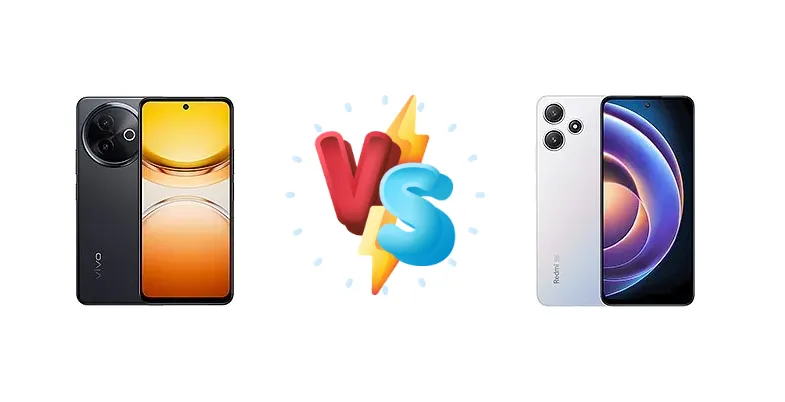
The vivo Y300i and Xiaomi Redmi Note 12R represent a growing trend in the budget smartphone market: delivering solid performance with a focus on essential features. Both devices are powered by the Qualcomm Snapdragon 4 Gen 2, but diverge in key areas like charging speed and potentially, software optimization. This comparison dissects these differences to help you choose the right phone for your needs.
🏆 Quick Verdict
For the average user, the vivo Y300i emerges as the slightly better choice. While both phones share the same Snapdragon 4 Gen 2 chipset, the Y300i’s significantly faster 44W charging capability provides a tangible benefit in daily use, offsetting the Redmi Note 12R’s potential software advantages.
| Network |
|---|
| 2G bands | GSM 850 / 900 / 1800 / 1900 | GSM 850 / 900 / 1800 / 1900 |
| 3G bands | HSDPA 850 / 900 / 2100 | HSDPA 850 / 900 / 2100 |
| 4G bands | 1, 3, 5, 8, 28, 34, 38, 39, 40, 41 | 1, 3, 5, 8, 34, 38, 39, 40, 41 |
| 5G bands | 1, 3, 5, 8, 28, 38, 40, 41, 77, 78 SA/NSA | 1, 5, 8, 28, 41, 78 SA/NSA |
| Speed | HSPA, LTE, 5G | HSPA, LTE, 5G |
| Technology | GSM / CDMA / HSPA / LTE / 5G | GSM / CDMA / HSPA / EVDO / LTE / 5G |
| Launch |
|---|
| Announced | 2025, March 10 | 2023, June 28 |
| Status | Available. Released 2025, March 14 | Available. Released 2023, June 28 |
| Body |
|---|
| Build | Glass front, plastic frame, plastic back | Glass front, plastic frame, glass back |
| Dimensions | 165.7 x 76.3 x 8.1 mm (6.52 x 3.00 x 0.32 in) | 168.6 x 76.3 x 8.2 mm (6.64 x 3.00 x 0.32 in) |
| SIM | Nano-SIM + Nano-SIM | Nano-SIM + Nano-SIM |
| Weight | 205 g (7.23 oz) | 199 g (7.02 oz) |
| Display |
|---|
| Resolution | 720 x 1608 pixels, 20:9 ratio (~264 ppi density) | 1080 x 2460 pixels (~396 ppi density) |
| Size | 6.68 inches, 107.4 cm2 (~84.9% screen-to-body ratio) | 6.79 inches, 109.5 cm2 (~85.1% screen-to-body ratio) |
| Type | IPS LCD, 120Hz | IPS LCD, 90Hz, 550 nits |
| Platform |
|---|
| CPU | Octa-core (2x2.2 GHz Cortex-A78 & 6x1.95 GHz Cortex-A55) | Octa-core (2x2.2 GHz Cortex-A78 & 6x1.95 GHz Cortex-A55) |
| Chipset | Qualcomm SM4450 Snapdragon 4 Gen 2 (4 nm) | Qualcomm SM4450 Snapdragon 4 Gen 2 (4 nm) |
| GPU | Adreno 613 | Adreno 613 |
| OS | Android 15, OriginOS 5 | Android 13, MIUI 14 |
| Memory |
|---|
| Card slot | No | microSDXC (uses shared SIM slot) |
| Internal | 128GB 8GB RAM, 256GB 8GB RAM, 256GB 12GB RAM, 512GB 12GB RAM | 128GB 4GB RAM, 128GB 6GB RAM, 128GB 8GB RAM, 256GB 8GB RAM |
| Main Camera |
|---|
| Dual | - | 50 MP, f/1.8, (wide), PDAF
2 MP (macro) |
| Features | LED flash, HDR, panorama | LED flash, HDR |
| Single | 50 MP, f/1.8, (wide), PDAF | - |
| Video | 1080p@30fps | 1080p@30fps |
| Selfie camera |
|---|
| Features | - | HDR |
| Single | 5 MP, f/2.0, (wide) | 5 MP, f/2.2, (wide), 1/5.0", 1.12µm |
| Video | 1080p@30fps | 1080p@30fps |
| Sound |
|---|
| 35mm jack | No | Yes |
| Loudspeaker | Yes, with stereo speakers | Yes |
| Comms |
|---|
| Bluetooth | 4.2, A2DP, aptX Adaptive | 5.3, A2DP, LE |
| Infrared port | Yes | Yes |
| NFC | Yes | Yes (market/region dependent) |
| Positioning | GPS, GALILEO, GLONASS, BDS, QZSS | GPS, GLONASS, GALILEO, BDS |
| Radio | No | No |
| USB | USB Type-C 2.0, OTG | USB Type-C |
| WLAN | Wi-Fi 802.11 a/b/g/n/ac, dual-band | Wi-Fi 802.11 a/b/g/n/ac, dual-band |
| Features |
|---|
| Sensors | Fingerprint (side-mounted), accelerometer, proximity, compass | Fingerprint (side-mounted), accelerometer, compass |
| Battery |
|---|
| Charging | 44W wired
Reverse wired | 18W wired, PD |
| Type | Si/C Li-Ion 6500 mAh | Li-Po 5000 mAh |
| Misc |
|---|
| Colors | Black, Blue, Titanium | Black, Blue, Silver |
| Models | V2444A | 23076RA4BC |
| Price | About 190 EUR | About 150 EUR |
vivo Y300i
- Significantly faster 44W charging
- Potentially better thermal management due to optimized software
- Competitive Snapdragon 4 Gen 2 performance
- Software experience may not be as refined as MIUI
- Lack of confirmed display specifications
Xiaomi Redmi Note 12R
- MIUI offers a feature-rich software experience
- Power Delivery (PD) charging compatibility
- Competitive Snapdragon 4 Gen 2 performance
- Slower 18W charging
- Potential for software bloatware
Display Comparison
Both devices are likely to feature LCD panels, typical for this price segment. Without specific display specs, it's difficult to differentiate. However, the Redmi Note 12R’s potential for a slightly higher peak brightness, based on Xiaomi’s typical display calibration, could offer a marginally better outdoor viewing experience. The absence of high refresh rates on either device suggests a focus on power efficiency rather than visual fluidity.
Camera Comparison
Without detailed camera specifications, a direct comparison is challenging. Both phones likely feature a primary camera and potentially depth/macro sensors. The image processing algorithms will be a key differentiator. Xiaomi’s MIUI typically offers a wider range of camera features and post-processing options. The absence of Optical Image Stabilization (OIS) on either device suggests a reliance on software stabilization, which may struggle in low-light conditions. The quality of the main sensor will be the most important factor, but without knowing the megapixel count or sensor size, it’s impossible to declare a winner.
Performance
The core performance is identical: both the vivo Y300i and Xiaomi Redmi Note 12R utilize the Qualcomm Snapdragon 4 Gen 2 (4nm). This 64-bit chipset features an octa-core CPU configuration with 2x 2.2 GHz Cortex-A78 cores and 6x 1.95 GHz Cortex-A55 cores. The 4nm process node is crucial, offering improved thermal efficiency compared to older, larger-node chipsets, meaning sustained performance during extended gaming or multitasking is more likely. The real-world performance difference will likely hinge on RAM management and software optimization, areas where Xiaomi’s MIUI often excels, but vivo’s Funtouch OS is continually improving.
Battery Life
This is where the vivo Y300i pulls ahead. While the battery capacity is unknown for both devices, the Y300i’s 44W wired charging is a significant advantage over the Redmi Note 12R’s 18W wired charging with PD. 44W charging will drastically reduce charging times, allowing users to quickly top up their battery. The Redmi Note 12R’s PD support is a plus for users with a wider range of chargers, but the slower charging speed is a trade-off. The Snapdragon 4 Gen 2’s efficiency should provide all-day battery life for moderate users on both devices.
Buying Guide
Buy the vivo Y300i if you prioritize rapid charging and minimizing downtime. Its 44W charging is a game-changer for users who frequently find themselves needing a quick power boost. Buy the Xiaomi Redmi Note 12R if you are deeply embedded in the Xiaomi ecosystem and value MIUI’s feature set, or if you specifically require Power Delivery (PD) charging compatibility, which the Redmi Note 12R offers.
Frequently Asked Questions
❓ How long will it take to fully charge the vivo Y300i with the 44W charger?
While a precise time requires testing, 44W charging should bring the vivo Y300i from 0% to 100% in approximately 60-80 minutes, significantly faster than the Redmi Note 12R’s 18W charging.
❓ Does the Xiaomi Redmi Note 12R support fast charging with a non-PD charger?
Yes, the Redmi Note 12R will charge with standard USB chargers, but it will be limited to its maximum 18W input. Utilizing a Power Delivery (PD) charger is recommended to ensure optimal charging efficiency and compatibility.
❓ Will I notice a difference in gaming performance between these two phones?
Given they both use the Snapdragon 4 Gen 2, gaming performance will be very similar. The key factor will be thermal throttling. The 4nm process should help, but sustained gaming performance will depend on the phone’s cooling solution and software optimization.
❓ Is the difference between Funtouch OS (vivo) and MIUI (Xiaomi) significant?
Yes. MIUI is known for its extensive customization options and feature set, but can also include pre-installed apps (bloatware). Funtouch OS is generally cleaner and more streamlined, but may lack some of MIUI’s advanced features. Preference is subjective.