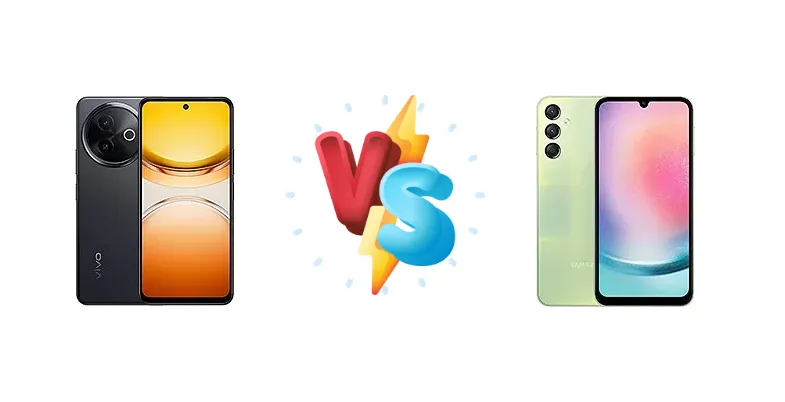
The sub-$200 smartphone market is fiercely competitive. The vivo Y300i, powered by Qualcomm’s Snapdragon 4 Gen 2, enters the arena against the established Samsung Galaxy A24 4G, which utilizes MediaTek’s Helio G99. This comparison dissects their key differences to determine which device delivers the best value for budget-conscious consumers.
🏆 Quick Verdict
For most users, the vivo Y300i emerges as the stronger contender. Its more efficient 4nm Snapdragon 4 Gen 2 chipset promises better sustained performance and thermal management, coupled with significantly faster 44W charging. While the Galaxy A24 boasts a brighter display, the Y300i’s overall package offers a more compelling experience.
| Network |
|---|
| 2G bands | GSM 850 / 900 / 1800 / 1900 | GSM 850 / 900 / 1800 / 1900 |
| 3G bands | HSDPA 850 / 900 / 2100 | HSDPA 850 / 900 / 2100 |
| 4G bands | 1, 3, 5, 8, 28, 34, 38, 39, 40, 41 | 1, 3, 5, 7, 8, 20, 28, 38, 40, 41 |
| 5G bands | 1, 3, 5, 8, 28, 38, 40, 41, 77, 78 SA/NSA | - |
| Speed | HSPA, LTE, 5G | HSPA, LTE |
| Technology | GSM / CDMA / HSPA / LTE / 5G | GSM / HSPA / LTE |
| Launch |
|---|
| Announced | 2025, March 10 | 2023, April 19 |
| Status | Available. Released 2025, March 14 | Available. Released 2023, May 05 |
| Body |
|---|
| Build | Glass front, plastic frame, plastic back | Glass front, plastic frame, plastic back |
| Dimensions | 165.7 x 76.3 x 8.1 mm (6.52 x 3.00 x 0.32 in) | 162.1 x 77.6 x 8.3 mm (6.38 x 3.06 x 0.33 in) |
| SIM | Nano-SIM + Nano-SIM | · Nano-SIM· Nano-SIM + Nano-SIM |
| Weight | 205 g (7.23 oz) | 195 g (6.88 oz) |
| Display |
|---|
| Resolution | 720 x 1608 pixels, 20:9 ratio (~264 ppi density) | 1080 x 2340 pixels, 19.5:9 ratio (~396 ppi density) |
| Size | 6.68 inches, 107.4 cm2 (~84.9% screen-to-body ratio) | 6.5 inches, 103.7 cm2 (~82.4% screen-to-body ratio) |
| Type | IPS LCD, 120Hz | Super AMOLED, 90Hz, 1000 nits (peak) |
| Platform |
|---|
| CPU | Octa-core (2x2.2 GHz Cortex-A78 & 6x1.95 GHz Cortex-A55) | Octa-core (2x2.2 GHz Cortex-A76 & 6x2.0 GHz Cortex-A55) |
| Chipset | Qualcomm SM4450 Snapdragon 4 Gen 2 (4 nm) | Mediatek Helio G99 (6 nm) |
| GPU | Adreno 613 | Mali-G57 MC2 |
| OS | Android 15, OriginOS 5 | Android 13, up to 4 major Android upgrades, One UI 6 |
| Memory |
|---|
| Card slot | No | microSDXC (dedicated slot) |
| Internal | 128GB 8GB RAM, 256GB 8GB RAM, 256GB 12GB RAM, 512GB 12GB RAM | 128GB 4GB RAM, 128GB 6GB RAM, 128GB 8GB RAM |
| Main Camera |
|---|
| Features | LED flash, HDR, panorama | LED flash, panorama, HDR |
| Single | 50 MP, f/1.8, (wide), PDAF | - |
| Triple | - | 50 MP, f/1.8, 27mm (wide), 1/2.76", 0.64µm, PDAF, OIS
5 MP, f/2.2, 17mm, 123˚ (ultrawide), 1/5.0", 1.12µm
2 MP (macro) |
| Video | 1080p@30fps | 1080p@30fps, gyro-EIS |
| Selfie camera |
|---|
| Single | 5 MP, f/2.0, (wide) | 13 MP, f/2.2, 25mm (wide), 1/3.06", 1.12µm |
| Video | 1080p@30fps | 1080p@30fps |
| Sound |
|---|
| 35mm jack | No | Yes |
| Loudspeaker | Yes, with stereo speakers | Yes |
| Comms |
|---|
| Bluetooth | 4.2, A2DP, aptX Adaptive | 5.3, A2DP, LE |
| Infrared port | Yes | - |
| NFC | Yes | Yes (market/region dependent) |
| Positioning | GPS, GALILEO, GLONASS, BDS, QZSS | GPS, GLONASS, GALILEO, BDS, QZSS |
| Radio | No | Unspecified |
| USB | USB Type-C 2.0, OTG | USB Type-C 2.0 |
| WLAN | Wi-Fi 802.11 a/b/g/n/ac, dual-band | Wi-Fi 802.11 a/b/g/n/ac, dual-band, Wi-Fi Direct |
| Features |
|---|
| Sensors | Fingerprint (side-mounted), accelerometer, proximity, compass | Fingerprint (side-mounted), accelerometer, gyro, compass |
| Battery |
|---|
| Charging | 44W wired
Reverse wired | 25W wired |
| Type | Si/C Li-Ion 6500 mAh | Li-Po 5000 mAh |
| Misc |
|---|
| Colors | Black, Blue, Titanium | Black, Lime Green, Blue gradient, Dark red |
| Models | V2444A | SM-A245F, SM-A245F/DS, SM-A245F/DSN, SM-A245M, SM-A245M/DS, SM-A245N |
| Price | About 190 EUR | About 150 EUR |
| SAR EU | - | 0.41 W/kg (head) 1.30 W/kg (body) |
vivo Y300i
- Faster 44W charging for quicker top-ups
- More efficient Snapdragon 4 Gen 2 chipset
- Potentially better sustained performance due to 4nm process
- Display brightness likely lower than Samsung A24
- Camera specs largely unknown
Samsung Galaxy A24 4G
- Brighter display (1012 nits) for outdoor visibility
- Established Samsung brand and software ecosystem
- Good battery endurance (141h rating)
- Less efficient Helio G99 chipset
- Slower 25W charging
- Potential for thermal throttling under heavy load
Display Comparison
The Samsung Galaxy A24 4G distinguishes itself with a measured peak brightness of 1012 nits, making it significantly more visible outdoors under direct sunlight. However, the vivo Y300i’s display specifications are not provided, so we can only assume it falls below this level. While the A24’s brightness is a clear advantage for outdoor use, the lack of information regarding panel technology (like LTPO) or refresh rate on either device means we can’t assess smoothness or power efficiency beyond peak brightness. Bezels and color accuracy are also unknown, making a definitive display judgement difficult without further testing.
Camera Comparison
Detailed camera analysis is hampered by a lack of specific sensor information for both devices. Both phones are advertised with 'Photo/Video' capabilities, but without knowing megapixel counts, sensor sizes, or aperture values, a direct comparison is impossible. The presence of Optical Image Stabilization (OIS) is also unknown. It’s safe to assume both phones include a standard set of lenses, but the usefulness of a 2MP macro camera (common in this segment) is questionable. Image processing algorithms will play a significant role, and brand preference (Samsung’s typically vibrant processing vs. vivo’s often more natural approach) may sway user preference.
Performance
The core of the difference lies in the chipsets. The vivo Y300i’s Qualcomm Snapdragon 4 Gen 2, fabricated on a 4nm process, offers a distinct advantage in power efficiency compared to the Samsung Galaxy A24 4G’s MediaTek Helio G99 (6nm). This smaller node translates to less heat generation under load, potentially mitigating performance throttling during extended gaming sessions. Both CPUs feature a similar core configuration – 2x high-performance cores (Cortex-A78 in the vivo, Cortex-A76 in the Samsung) and 6x efficiency cores (Cortex-A55 in both). However, the Snapdragon 4 Gen 2’s architecture and 4nm process give it an edge in sustained performance. The Y300i is likely to maintain higher frame rates for longer periods in demanding games.
Battery Life
The Samsung Galaxy A24 4G boasts an endurance rating of 141 hours, suggesting respectable battery life. However, this rating doesn’t tell the whole story. The vivo Y300i compensates for a potentially smaller battery (spec not provided) with significantly faster 44W wired charging, compared to the A24’s 25W. This means the Y300i can replenish its battery much quicker, minimizing downtime. A full charge from 0-100% is estimated to take considerably less time on the Y300i, a crucial advantage for users who need to quickly top up their device.
Buying Guide
Buy the vivo Y300i if you prioritize sustained performance for gaming or multitasking, and value faster charging speeds. This phone is ideal for users who frequently use demanding apps or play mobile games. Buy the Samsung Galaxy A24 4G if a brighter display is paramount, and you prefer the Samsung ecosystem and its associated software features. It’s a solid choice for media consumption and everyday tasks where peak brightness is beneficial.
Frequently Asked Questions
❓ Will the Helio G99 in the Samsung Galaxy A24 4G overheat during prolonged gaming sessions?
The 6nm Helio G99 is a capable chipset, but it's more prone to thermal throttling than the 4nm Snapdragon 4 Gen 2 in the vivo Y300i. Expect performance to dip after extended gaming, especially with demanding titles. The Y300i’s more efficient process should maintain higher frame rates for longer.
❓ How much faster is the 44W charging on the vivo Y300i compared to the 25W charging on the Samsung Galaxy A24 4G?
While exact charging times depend on battery capacity (which is unknown for the Y300i), 44W charging is significantly faster than 25W. Expect the Y300i to charge from 0-100% in approximately 60-75 minutes, while the A24 will likely take 90-120 minutes. This difference is substantial for users who need a quick power boost.
❓ Is the Samsung Galaxy A24 4G a good choice for watching videos outdoors?
Yes, the Galaxy A24 4G’s 1012 nits peak brightness makes it an excellent choice for viewing content outdoors, even in direct sunlight. This is a key advantage over the vivo Y300i, where display brightness is unknown but likely lower.