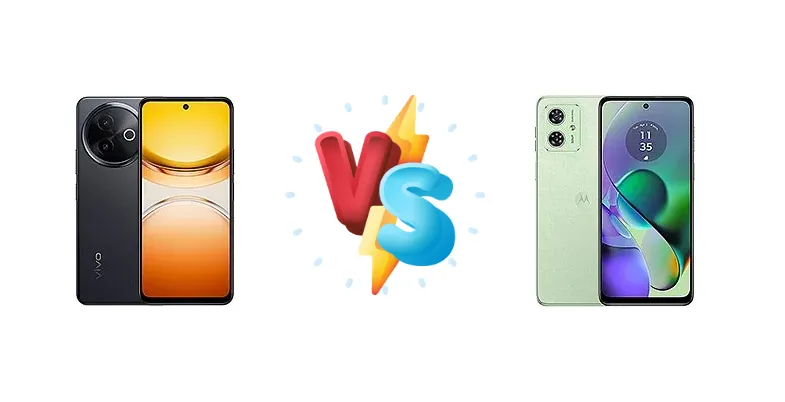
The sub-$200 smartphone market is fiercely competitive. The vivo Y300i and Motorola Moto G54 both aim to deliver 5G connectivity and a modern smartphone experience without breaking the bank. However, they take different approaches – the Y300i prioritizes charging speed and a newer process node, while the Moto G54 opts for a slightly higher clocked CPU and a more established brand reputation. This comparison dissects the key differences to determine which device offers the best value.
🏆 Quick Verdict
For the average user prioritizing fast charging and potentially better long-term efficiency, the vivo Y300i emerges as the winner. Its 44W charging significantly outperforms the Moto G54’s 15W, and the 4nm Snapdragon 4 Gen 2 offers a more efficient architecture. However, the Moto G54 remains a strong contender for those valuing brand recognition and a slightly higher CPU clock speed.
| Network |
|---|
| 2G bands | GSM 850 / 900 / 1800 / 1900 | GSM 850 / 900 / 1800 / 1900 |
| 3G bands | HSDPA 850 / 900 / 2100 | HSDPA 850 / 900 / 1900 / 2100 |
| 4G bands | 1, 3, 5, 8, 28, 34, 38, 39, 40, 41 | 1, 2, 3, 5, 7, 8, 20, 26, 28, 32, 38, 40, 41, 42 |
| 5G bands | 1, 3, 5, 8, 28, 38, 40, 41, 77, 78 SA/NSA | 1, 3, 5, 7, 8, 20, 26, 28, 38, 40, 41, 77, 78 SA/NSA |
| Speed | HSPA, LTE, 5G | HSPA, LTE, 5G |
| Technology | GSM / CDMA / HSPA / LTE / 5G | GSM / HSPA / LTE / 5G |
| Launch |
|---|
| Announced | 2025, March 10 | 2023, September 05 |
| Status | Available. Released 2025, March 14 | Available. Released 2023, September 05 |
| Body |
|---|
| Build | Glass front, plastic frame, plastic back | Glass front, plastic back or silicone polymer back (eco leather), plastic frame |
| Dimensions | 165.7 x 76.3 x 8.1 mm (6.52 x 3.00 x 0.32 in) | 161.6 x 73.8 x 8 mm (6.36 x 2.91 x 0.31 in) |
| SIM | Nano-SIM + Nano-SIM | · Nano-SIM + eSIM· Nano-SIM + Nano-SIM |
| Weight | 205 g (7.23 oz) | 177 g (6.24 oz) |
| Display |
|---|
| Resolution | 720 x 1608 pixels, 20:9 ratio (~264 ppi density) | 1080 x 2400 pixels, 20:9 ratio (~405 ppi density) |
| Size | 6.68 inches, 107.4 cm2 (~84.9% screen-to-body ratio) | 6.5 inches, 102.0 cm2 (~85.5% screen-to-body ratio) |
| Type | IPS LCD, 120Hz | IPS LCD, 120Hz |
| Platform |
|---|
| CPU | Octa-core (2x2.2 GHz Cortex-A78 & 6x1.95 GHz Cortex-A55) | Octa-core (2x2.2 GHz Cortex-A78 & 6x2.0 GHz Cortex-A55) |
| Chipset | Qualcomm SM4450 Snapdragon 4 Gen 2 (4 nm) | Mediatek Dimensity 7020 (6 nm) |
| GPU | Adreno 613 | IMG BXM-8-256 |
| OS | Android 15, OriginOS 5 | Android 13, upgradable to Android 15 |
| Memory |
|---|
| Card slot | No | microSDXC (dedicated slot) - InternationalmicroSDXC (uses shared SIM slot) - China |
| Internal | 128GB 8GB RAM, 256GB 8GB RAM, 256GB 12GB RAM, 512GB 12GB RAM | 128GB 4GB RAM, 128GB 8GB RAM, 256GB 4GB RAM, 256GB 8GB RAM, 256GB 12GB RAM |
| Main Camera |
|---|
| Dual | - | 50 MP, f/1.8 (wide), 0.61µm, PDAF, OIS
2 MP (macro) |
| Features | LED flash, HDR, panorama | Dual-LED dual-tone flash, HDR, panorama |
| Single | 50 MP, f/1.8, (wide), PDAF | - |
| Video | 1080p@30fps | 1080p@30/60fps |
| Selfie camera |
|---|
| Features | - | HDR |
| Single | 5 MP, f/2.0, (wide) | 16 MP, f/2.4, (wide), 1.0µm |
| Video | 1080p@30fps | 1080p@30fps |
| Sound |
|---|
| 35mm jack | No | Yes |
| Loudspeaker | Yes, with stereo speakers | Yes, with stereo speakers |
| Comms |
|---|
| Bluetooth | 4.2, A2DP, aptX Adaptive | 5.3, A2DP, LE |
| Infrared port | Yes | - |
| NFC | Yes | Yes |
| Positioning | GPS, GALILEO, GLONASS, BDS, QZSS | GPS, GLONASS, GALILEO, BDS, QZSS |
| Radio | No | FM radio (market/region dependent) |
| USB | USB Type-C 2.0, OTG | USB Type-C 2.0, OTG |
| WLAN | Wi-Fi 802.11 a/b/g/n/ac, dual-band | Wi-Fi 802.11 a/b/g/n/ac, dual-band |
| Features |
|---|
| Sensors | Fingerprint (side-mounted), accelerometer, proximity, compass | Fingerprint (side-mounted), accelerometer, gyro, proximity, compass |
| Battery |
|---|
| Charging | 44W wired
Reverse wired | 15W wired
Reverse wired |
| Type | Si/C Li-Ion 6500 mAh | Li-Po 5000 mAh |
| Misc |
|---|
| Colors | Black, Blue, Titanium | Midnight blue, Indigo blue, Glacier blue, Mint green |
| Models | V2444A | XT2343-1, XT2343-2 |
| Price | About 190 EUR | € 147.00 / $ 189.99 / £ 161.57 |
vivo Y300i
- Significantly faster 44W charging
- More efficient 4nm Snapdragon 4 Gen 2 chipset
- Potentially better sustained performance due to thermal efficiency
- Less established brand recognition
- Camera specs are currently unknown
Motorola Moto G54
- Well-known Motorola brand
- Slightly higher CPU clock speed on efficiency cores
- Potentially better software support and updates
- Significantly slower 15W charging
- Less efficient 6nm Dimensity 7020 chipset
Display Comparison
Neither device boasts a standout display. While specific display specs (resolution, panel type) are missing, both likely utilize LCD panels common in this price bracket. The key difference lies in the underlying chipsets, which influence display processing. The Y300i’s newer Snapdragon 4 Gen 2 may offer slightly improved image processing for smoother scrolling and potentially better color reproduction, but without detailed display specs, this remains speculative. Bezels are likely comparable, and color accuracy will be typical for budget devices.
Camera Comparison
Camera performance is difficult to assess without detailed sensor information. Both phones likely feature a multi-camera setup, but the emphasis will be on the main sensor. The Y300i’s chipset may offer slightly better image signal processing (ISP) capabilities due to its newer architecture, potentially resulting in improved dynamic range and noise reduction. The presence of a 2MP macro camera on both devices is largely a marketing tactic, offering limited practical benefit. The aperture and sensor size of the main cameras will be the determining factors in low-light performance, but this information is currently unavailable.
Performance
The core battleground is the chipset. The Motorola Moto G54’s MediaTek Dimensity 7020 (6nm) and the vivo Y300i’s Qualcomm Snapdragon 4 Gen 2 (4nm) both feature an octa-core configuration with 2x Cortex-A78 cores for performance and 6x Cortex-A55 cores for efficiency. While the Moto G54 has a slightly higher clock speed on its efficiency cores (2.0 GHz vs 1.95 GHz), the Snapdragon 4 Gen 2 benefits from a more advanced 4nm manufacturing process. This translates to improved thermal efficiency and potentially sustained performance under load, reducing throttling during extended gaming sessions. The 4nm node allows for more transistors in the same area, potentially leading to better overall performance despite the similar core configuration. RAM speed (LPDDR4x vs LPDDR5x) is not specified, but the Y300i's newer chipset is more likely to support faster RAM, further enhancing performance.
Battery Life
The battery capacity is not specified for either device, but the charging speed is a significant differentiator. The vivo Y300i’s 44W wired charging is a substantial advantage over the Moto G54’s 15W charging. This means the Y300i can replenish its battery much faster, minimizing downtime. While a larger battery capacity on the Moto G54 could partially offset this difference, the convenience of 44W charging is a major benefit for users who frequently need to top up their battery. Both phones support reverse wired charging, a useful feature for charging accessories.
Buying Guide
Buy the vivo Y300i if you need rapid charging capabilities and anticipate heavy daily usage, benefiting from the more efficient 4nm chipset. This phone is ideal for users who frequently top up their battery throughout the day and want to minimize downtime. Buy the Motorola Moto G54 if you prefer a well-known brand with a proven track record, and a slightly higher CPU clock speed is more important than charging speed or long-term efficiency. This is a good choice for users who prioritize software stability and a familiar user experience.
Frequently Asked Questions
❓ Will the Snapdragon 4 Gen 2 in the vivo Y300i struggle with demanding games like PUBG Mobile?
While not a flagship chipset, the Snapdragon 4 Gen 2 is capable of running PUBG Mobile at medium settings. The 4nm process and optimized architecture should provide a reasonably smooth experience, though you may encounter some frame drops during intense firefights. The Moto G54's Dimensity 7020 will offer similar performance, but may throttle more quickly under sustained load.
❓ How long will it take to fully charge the Motorola Moto G54 with its 15W charging?
With 15W charging, a full charge from 0% on the Moto G54 will likely take between 2 to 3 hours, depending on battery capacity. This is considerably slower than the vivo Y300i’s 44W charging, which can potentially achieve a full charge in under an hour.
❓ Does the vivo Y300i support 5G connectivity, and which bands are compatible?
Yes, the vivo Y300i supports 5G connectivity. However, specific 5G band compatibility varies by region. You'll need to check with your carrier to ensure the Y300i is compatible with their 5G network in your area. The Moto G54 also supports 5G, and band compatibility should be verified with your carrier as well.