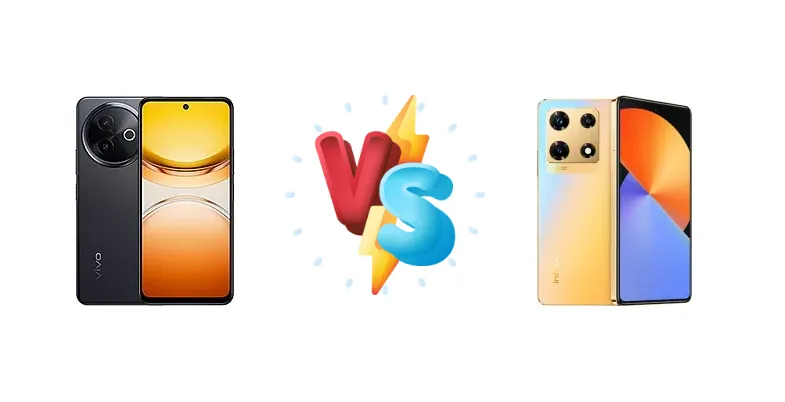
The sub-$200 smartphone market is fiercely competitive. The vivo Y300i, powered by Qualcomm’s efficient Snapdragon 4 Gen 2, aims for a balance of performance and battery life. Meanwhile, the Infinix Note 30 Pro leverages MediaTek’s Helio G99 and boasts significantly faster charging capabilities. This comparison dissects these two contenders to determine which offers the best overall experience.
🏆 Quick Verdict
For the average user prioritizing rapid charging and a more versatile charging ecosystem (including wireless), the Infinix Note 30 Pro is the clear winner. Its 68W charging and wireless charging support outweigh the Y300i’s slightly more modern chipset in everyday use. However, the Y300i remains a strong contender for those focused on raw efficiency.
| Network |
|---|
| 2G bands | GSM 850 / 900 / 1800 / 1900 | GSM 850 / 900 / 1800 / 1900 |
| 3G bands | HSDPA 850 / 900 / 2100 | HSDPA 850 / 900 / 1700(AWS) / 1900 / 2100 |
| 4G bands | 1, 3, 5, 8, 28, 34, 38, 39, 40, 41 | 1, 2, 3, 4, 5, 7, 8, 12, 17, 20, 28, 38, 40, 41, 66 |
| 5G bands | 1, 3, 5, 8, 28, 38, 40, 41, 77, 78 SA/NSA | - |
| Speed | HSPA, LTE, 5G | HSPA, LTE |
| Technology | GSM / CDMA / HSPA / LTE / 5G | GSM / HSPA / LTE |
| Launch |
|---|
| Announced | 2025, March 10 | 2023, May 22 |
| Status | Available. Released 2025, March 14 | Available. Released 2023, May 22 |
| Body |
|---|
| Build | Glass front, plastic frame, plastic back | Glass front, plastic frame, glass back |
| Dimensions | 165.7 x 76.3 x 8.1 mm (6.52 x 3.00 x 0.32 in) | 162.7 x 76 x 8.2 mm (6.41 x 2.99 x 0.32 in) |
| SIM | Nano-SIM + Nano-SIM | Nano-SIM + Nano-SIM |
| Weight | 205 g (7.23 oz) | 203 g (7.16 oz) |
| | - | IP53 |
| Display |
|---|
| Resolution | 720 x 1608 pixels, 20:9 ratio (~264 ppi density) | 1080 x 2400 pixels, 20:9 ratio (~395 ppi density) |
| Size | 6.68 inches, 107.4 cm2 (~84.9% screen-to-body ratio) | 6.67 inches, 107.4 cm2 (~86.9% screen-to-body ratio) |
| Type | IPS LCD, 120Hz | AMOLED, 1B colors, 120Hz, 900 nits (peak) |
| | - | * the display diagonal size and resolution is unconfirmed |
| Platform |
|---|
| CPU | Octa-core (2x2.2 GHz Cortex-A78 & 6x1.95 GHz Cortex-A55) | Octa-core (2x2.2 GHz Cortex-A76 & 6x2.0 GHz Cortex-A55) |
| Chipset | Qualcomm SM4450 Snapdragon 4 Gen 2 (4 nm) | Mediatek Helio G99 (6 nm) |
| GPU | Adreno 613 | Mali-G57 MC2 |
| OS | Android 15, OriginOS 5 | Android 13, XOS 13 |
| Memory |
|---|
| Card slot | No | microSDXC (dedicated slot) |
| Internal | 128GB 8GB RAM, 256GB 8GB RAM, 256GB 12GB RAM, 512GB 12GB RAM | 256GB 8GB RAM |
| Main Camera |
|---|
| Features | LED flash, HDR, panorama | Quad-LED flash, HDR, panorama |
| Single | 50 MP, f/1.8, (wide), PDAF | - |
| Triple | - | 108 MP, (wide), 1/1.67", PDAF
2 MP (macro)
Auxiliary lens |
| Video | 1080p@30fps | 1440p@30fps, 1080p@30fps |
| Selfie camera |
|---|
| Features | - | LED flash, HDR |
| Single | 5 MP, f/2.0, (wide) | 32 MP, f/2.0, (wide), 1/2.8" |
| Video | 1080p@30fps | 1080p@30fps |
| Sound |
|---|
| 3.5mm jack | - | Yes |
| 35mm jack | No | Yes |
| Loudspeaker | Yes, with stereo speakers | Yes, with dual speakers |
| | - | Sound by JBL
24-bit/192kHz audio |
| Comms |
|---|
| Bluetooth | 4.2, A2DP, aptX Adaptive | Yes |
| Infrared port | Yes | - |
| NFC | Yes | Yes (market/region dependent) |
| Positioning | GPS, GALILEO, GLONASS, BDS, QZSS | GPS |
| Radio | No | FM radio |
| USB | USB Type-C 2.0, OTG | USB Type-C 2.0, OTG |
| WLAN | Wi-Fi 802.11 a/b/g/n/ac, dual-band | Wi-Fi 802.11 a/b/g/n/ac, dual-band, Wi-Fi Direct |
| Features |
|---|
| Sensors | Fingerprint (side-mounted), accelerometer, proximity, compass | Fingerprint (side-mounted), accelerometer, gyro, proximity, compass |
| Battery |
|---|
| Charging | 44W wired
Reverse wired | 68W wired, PD3.0, 80% in 30 min
15W wireless
Reverse wireless |
| Type | Si/C Li-Ion 6500 mAh | 5000 mAh |
| Misc |
|---|
| Colors | Black, Blue, Titanium | Magic Black, Variable Gold |
| Models | V2444A | X678B |
| Price | About 190 EUR | - |
vivo Y300i
- More efficient Snapdragon 4 Gen 2 chipset
- Potentially better sustained performance
- Reverse wired charging
- Slower 44W charging
- Lacks wireless charging
- Potentially lower peak performance compared to Helio G99
Infinix Note 30 Pro
- Significantly faster 68W wired charging
- Convenient 15W wireless charging
- Reverse wireless charging
- Less power-efficient Helio G99 chipset
- Potential for more thermal throttling
- May not maintain peak performance as long
Display Comparison
Neither device boasts a standout display. While specific panel details (like peak brightness or color gamut coverage) are absent, the focus here is on the underlying processors. Display quality will likely be similar, leaning towards adequate for the price point. Bezels are expected to be comparable, and both will likely utilize IPS LCD technology. The absence of high refresh rates on either device suggests a focus on battery conservation.
Camera Comparison
Without detailed camera specs, a direct comparison is difficult. Both phones likely feature a multi-camera setup, but the quality will heavily depend on the main sensor and image processing algorithms. The absence of information suggests neither phone will excel in low-light photography. The 2MP macro cameras commonly found in this segment are unlikely to deliver significant detail. The Infinix Note 30 Pro might have a slight advantage if it incorporates larger sensor sizes or optical image stabilization (OIS), but this is speculative.
Performance
The chipset battle is intriguing. The vivo Y300i’s Snapdragon 4 Gen 2, fabricated on a 4nm process, theoretically offers superior power efficiency compared to the Infinix Note 30 Pro’s 6nm Helio G99. However, the Helio G99 utilizes Cortex-A76 cores, which are architecturally more powerful than the A78 cores in the Snapdragon 4 Gen 2, potentially leading to better single-core performance. The Snapdragon’s advantage lies in sustained performance due to better thermal management. Both phones feature 8GB of RAM, which is sufficient for smooth multitasking. Real-world performance differences will likely be noticeable in demanding games, where the Helio G99 might offer a slight edge in initial frame rates, but the Snapdragon could maintain those rates for longer.
Battery Life
The Infinix Note 30 Pro’s 68W wired charging is a significant advantage, promising an 80% charge in just 30 minutes. This is substantially faster than the vivo Y300i’s 44W charging. The addition of 15W wireless charging on the Infinix Note 30 Pro further enhances its convenience. While battery capacity isn’t specified, the faster charging speeds of the Infinix Note 30 Pro mitigate any potential disadvantage from a slightly smaller battery. The Y300i’s reverse wired charging is a useful feature, but the Infinix Note 30 Pro’s reverse *wireless* charging offers greater flexibility.
Buying Guide
Buy the vivo Y300i if you need a phone that prioritizes sustained performance and power efficiency for all-day use, and aren't concerned with the latest charging technologies. It's ideal for users who primarily browse, use social media, and make calls. Buy the Infinix Note 30 Pro if you prefer a phone that can quickly top up its battery, offers wireless charging convenience, and provides a more feature-rich charging experience, even if it means slightly less peak efficiency.
Frequently Asked Questions
❓ Will the Helio G99 in the Infinix Note 30 Pro overheat during prolonged gaming sessions?
The Helio G99 is known to generate more heat than the Snapdragon 4 Gen 2. While the Infinix Note 30 Pro likely incorporates thermal management solutions, extended gaming at high settings could lead to noticeable throttling. Expect performance to dip slightly after prolonged use, but it shouldn't render the phone unusable.
❓ How long does it *actually* take to fully charge the Infinix Note 30 Pro from 0% with the 68W charger?
Infinix claims 80% charge in 30 minutes. A full 0-100% charge is likely to take around 45-50 minutes, depending on background processes and battery temperature. This is still significantly faster than the vivo Y300i.
❓ Is the reverse charging feature on either phone useful for more than just emergencies?
While primarily for emergencies, the reverse charging feature can be useful for topping up accessories like wireless earbuds or smartwatches. The Infinix Note 30 Pro’s reverse *wireless* charging offers greater convenience for compatible devices.
❓ Does the Snapdragon 4 Gen 2 in the vivo Y300i offer a noticeable improvement in battery life compared to older Snapdragon 4 series chips?
Yes, the 4nm fabrication process of the Snapdragon 4 Gen 2 results in significantly improved power efficiency compared to previous generations. You can expect a noticeable increase in battery life, especially during light to moderate usage.