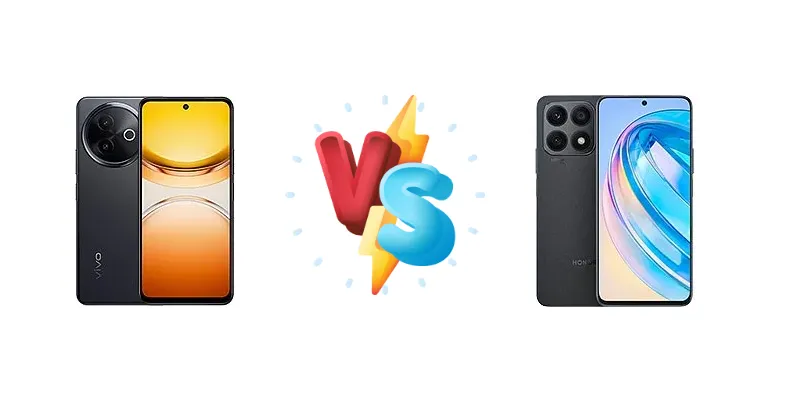
The sub-$200 smartphone market is fiercely competitive. The vivo Y300i and Honor X8a represent compelling options, but cater to slightly different priorities. The Y300i leverages Qualcomm's newer, more efficient Snapdragon 4 Gen 2, while the X8a relies on MediaTek's Helio G88. This comparison dissects their key differences to determine which device offers the best overall experience.
🏆 Quick Verdict
For most users, the vivo Y300i emerges as the stronger choice. Its Snapdragon 4 Gen 2 chipset, built on a 4nm process, provides a noticeable performance and efficiency advantage over the Honor X8a’s 12nm Helio G88. While the X8a’s 22.5W charging is faster to 50%, the Y300i’s 44W charging offers a more complete solution.
| Network |
|---|
| 2G bands | GSM 850 / 900 / 1800 / 1900 | GSM 850 / 900 / 1800 / 1900 |
| 3G bands | HSDPA 850 / 900 / 2100 | HSDPA 850 / 900 / 2100 |
| 4G bands | 1, 3, 5, 8, 28, 34, 38, 39, 40, 41 | LTE |
| 5G bands | 1, 3, 5, 8, 28, 38, 40, 41, 77, 78 SA/NSA | - |
| Speed | HSPA, LTE, 5G | HSPA, LTE |
| Technology | GSM / CDMA / HSPA / LTE / 5G | GSM / HSPA / LTE |
| | - | Virtual proximity sensing |
| Launch |
|---|
| Announced | 2025, March 10 | 2023, February 08 |
| Status | Available. Released 2025, March 14 | Available. Released 2023, February 11 |
| Body |
|---|
| Build | Glass front, plastic frame, plastic back | Glass front, plastic frame, plastic back |
| Dimensions | 165.7 x 76.3 x 8.1 mm (6.52 x 3.00 x 0.32 in) | 162.9 x 74.5 x 7.5 mm (6.41 x 2.93 x 0.30 in) |
| SIM | Nano-SIM + Nano-SIM | Nano-SIM + Nano-SIM |
| Weight | 205 g (7.23 oz) | 179 g (6.31 oz) |
| Display |
|---|
| Resolution | 720 x 1608 pixels, 20:9 ratio (~264 ppi density) | 1080 x 2388 pixels (~391 ppi density) |
| Size | 6.68 inches, 107.4 cm2 (~84.9% screen-to-body ratio) | 6.7 inches, 108.7 cm2 (~89.6% screen-to-body ratio) |
| Type | IPS LCD, 120Hz | IPS LCD, 90Hz |
| Platform |
|---|
| CPU | Octa-core (2x2.2 GHz Cortex-A78 & 6x1.95 GHz Cortex-A55) | Octa-core (2x2.0 GHz Cortex-A75 & 6x1.8 GHz Cortex-A55) |
| Chipset | Qualcomm SM4450 Snapdragon 4 Gen 2 (4 nm) | Mediatek MT6769H Helio G88 (12 nm) |
| GPU | Adreno 613 | Mali-G52 MC2 |
| OS | Android 15, OriginOS 5 | Android 12, Magic UI 6.1 |
| Memory |
|---|
| Card slot | No | No |
| Internal | 128GB 8GB RAM, 256GB 8GB RAM, 256GB 12GB RAM, 512GB 12GB RAM | 128GB 4GB RAM, 128GB 6GB RAM, 128GB 8GB RAM, 128GB 12GB RAM, 256GB 4GB RAM, 256GB 8GB RAM |
| Main Camera |
|---|
| Features | LED flash, HDR, panorama | LED flash, panorama, HDR |
| Single | 50 MP, f/1.8, (wide), PDAF | 16 MP, f/2.5 |
| Triple | - | 100 MP, f/1.9, (wide), AF
5 MP, f/2.2, (ultrawide)
2 MP (macro) |
| Video | 1080p@30fps | 1080p@30fps |
| Selfie camera |
|---|
| Single | 5 MP, f/2.0, (wide) | 16 MP, f/2.5 |
| Video | 1080p@30fps | 1080p@30fps |
| Sound |
|---|
| 3.5mm jack | - | No |
| 35mm jack | No | No |
| Loudspeaker | Yes, with stereo speakers | Yes |
| Comms |
|---|
| Bluetooth | 4.2, A2DP, aptX Adaptive | 5.1, A2DP, LE |
| Infrared port | Yes | - |
| NFC | Yes | Yes (CRT-LX1 only) |
| Positioning | GPS, GALILEO, GLONASS, BDS, QZSS | GPS, GLONASS, GALILEO, BDS |
| Radio | No | No |
| USB | USB Type-C 2.0, OTG | USB Type-C 2.0, OTG |
| WLAN | Wi-Fi 802.11 a/b/g/n/ac, dual-band | Wi-Fi 802.11 a/b/g/n/ac, dual-band, Wi-Fi Direct |
| Features |
|---|
| Sensors | Fingerprint (side-mounted), accelerometer, proximity, compass | Fingerprint (side-mounted), accelerometer, compass |
| Battery |
|---|
| Charging | 44W wired
Reverse wired | 22.5W wired, 50% in 30 min |
| Type | Si/C Li-Ion 6500 mAh | Li-Po 4500 mAh |
| Misc |
|---|
| Colors | Black, Blue, Titanium | Cyan Lake, Titanium Silver, Midnight Black |
| Models | V2444A | CRT-LX1, CRT-LX2, CRT-LX3 |
| Price | About 190 EUR | About 170 EUR |
vivo Y300i
- More efficient Snapdragon 4 Gen 2 chipset
- Superior CPU architecture for better performance
- Faster overall charging with 44W support
- Potentially better image processing
- May be slightly more expensive than the X8a
- No specific display details available
Honor X8a
- Faster initial charging (50% in 30 minutes)
- Potentially lower price point
- Acceptable performance for basic tasks
- Widely available
- Less efficient Helio G88 chipset
- Inferior CPU architecture
- Likely shorter battery life
- Image quality may be less consistent
Display Comparison
Neither device boasts a standout display. Both likely utilize LCD panels, a common cost-saving measure in this segment. The focus here isn't on visual fidelity, but on basic usability. Without specific display specs, it's difficult to differentiate, but the Y300i's more powerful chipset *could* translate to smoother scrolling and animations, even on a similar panel. Bezels are likely comparable, and color accuracy will be standard for this price point.
Camera Comparison
Without detailed camera specs, a direct comparison is challenging. However, the market segment suggests both phones will rely on primary sensors for most image capture. The Y300i’s more powerful ISP (Image Signal Processor) within the Snapdragon 4 Gen 2 likely provides better image processing capabilities, potentially resulting in sharper images and improved low-light performance. The presence of a 2MP macro camera on the X8a is a common, but often underwhelming, feature in this price range; its utility is limited. We expect the Y300i to deliver more consistent and usable photos overall.
Performance
The core difference lies in the chipsets. The vivo Y300i’s Qualcomm Snapdragon 4 Gen 2 (4nm) is a significant upgrade over the Honor X8a’s MediaTek Helio G88 (12nm). The 4nm process node is far more efficient, resulting in lower heat generation and improved battery life. While both CPUs feature an octa-core configuration with similar core arrangements (2x high-performance, 6x efficiency), the Snapdragon’s Cortex-A78 cores are architecturally superior to the Helio’s Cortex-A75, offering better single-core performance. This translates to snappier app launches and a more responsive user experience. The Y300i will handle multitasking and moderately demanding apps with greater ease.
Battery Life
The Honor X8a advertises 50% charge in 30 minutes with its 22.5W charging, a quick initial boost. However, the vivo Y300i’s 44W charging offers a more complete solution, likely achieving a full charge in under an hour. While battery capacity isn’t specified, the Snapdragon 4 Gen 2’s superior efficiency means the Y300i will likely deliver longer real-world battery life despite potentially having a similar capacity. The efficiency gain is more impactful than the charging speed difference over the entire usage cycle.
Buying Guide
Buy the vivo Y300i if you prioritize sustained performance, efficient power usage for longer battery life, and a future-proofed chipset. This phone is ideal for users who multitask, enjoy casual gaming, and want a device that won’t slow down quickly. Buy the Honor X8a if you absolutely need the fastest possible initial charge time and are primarily focused on basic smartphone tasks like calling, texting, and light social media browsing. It’s a good fit for users on a very tight budget who don’t demand high performance.
Frequently Asked Questions
❓ Will the Snapdragon 4 Gen 2 in the vivo Y300i handle popular games like PUBG Mobile?
While not a gaming powerhouse, the Snapdragon 4 Gen 2 is capable of running PUBG Mobile at medium settings with acceptable frame rates. The 4nm process will help mitigate throttling during extended gaming sessions, providing a more consistent experience than the Helio G88 in the Honor X8a.
❓ How much faster is the 44W charging on the vivo Y300i compared to the 22.5W charging on the Honor X8a for a full charge?
While the Honor X8a gets to 50% faster, the Y300i’s 44W charging will likely complete a full 0-100% charge in under an hour, whereas the X8a will likely take closer to 1.5 - 2 hours. The Y300i provides a more complete and efficient charging experience.
❓ Is the difference in chipset performance between the Snapdragon 4 Gen 2 and Helio G88 noticeable in everyday use?
Yes, the difference is noticeable. The Snapdragon 4 Gen 2 offers smoother app launches, faster multitasking, and a more responsive user interface. The Helio G88 is adequate for basic tasks, but will exhibit more lag and slowdowns when handling multiple apps or demanding processes.