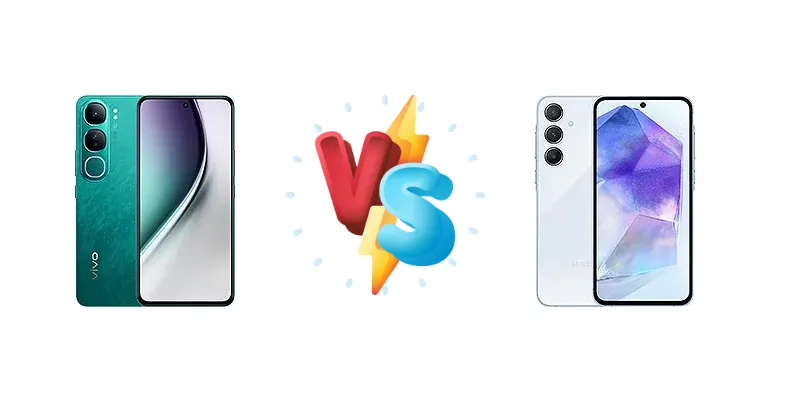
The mid-range smartphone market is fiercely competitive, and the vivo Y300 and Samsung Galaxy A55 represent compelling options. The Y300 aggressively targets fast charging and a newer Snapdragon chipset, while the A55 focuses on a refined user experience and proven battery endurance. This comparison dissects their key differences to help you choose the right device.
🏆 Quick Verdict
For the average user prioritizing all-day battery life and a polished software experience, the Samsung Galaxy A55 is the stronger choice. Its 13:27h active use score significantly outperforms what we'd expect from the Y300, and the brighter display enhances usability. However, the vivo Y300's 80W charging is a game-changer for those who value speed.
| Network |
|---|
| 2G bands | GSM 850 / 900 / 1800 / 1900 | GSM 850 / 900 / 1800 / 1900 |
| 3G bands | HSDPA 850 / 900 / 2100 | HSDPA 850 / 900 / 1700(AWS) / 1900 / 2100 |
| 4G bands | 1, 3, 5, 8, 28, 38, 40, 41 | 1, 2, 3, 4, 5, 7, 8, 12, 17, 20, 25, 26, 28, 32, 38, 40, 41, 66 |
| 5G bands | 1, 3, 5, 8, 28, 40, 77, 78 SA/NSA | 1, 3, 5, 7, 8, 20, 28, 38, 40, 41, 66, 77, 78 SA/NSA/Sub6 |
| Speed | HSPA, LTE, 5G | HSPA, LTE, 5G |
| Technology | GSM / HSPA / LTE / 5G | GSM / HSPA / LTE / 5G |
| Launch |
|---|
| Announced | 2024, November 21 | 2024, March 11 |
| Status | Available. Released 2024, November 26 | Available. Released 2024, March 15 |
| Body |
|---|
| Build | Glass front, plastic back, plastic frame | Glass front (Gorilla Glass Victus+), glass back (Gorilla Glass), aluminum frame |
| Dimensions | 163.2 x 75.9 x 7.8 mm or 8.0 mm | 161.1 x 77.4 x 8.2 mm (6.34 x 3.05 x 0.32 in) |
| SIM | Nano-SIM + Nano-SIM | · Nano-SIM· Nano-SIM + eSIM· Nano-SIM + Nano-SIM· Nano-SIM + Nano-SIM + eSIM (max 2 at a time) |
| Weight | 188 g or 190 g (6.63 oz) | 213 g (7.51 oz) |
| Display |
|---|
| Protection | - | Corning Gorilla Glass Victus+ |
| Resolution | 1080 x 2400 pixels, 20:9 ratio (~395 ppi density) | 1080 x 2340 pixels, 19.5:9 ratio (~390 ppi density) |
| Size | 6.67 inches, 107.4 cm2 (~86.7% screen-to-body ratio) | 6.6 inches, 106.9 cm2 (~85.8% screen-to-body ratio) |
| Type | AMOLED, 1B colors, 120Hz, 1200 nits (HBM), 1800 nits (peak) | Super AMOLED, 120Hz, HDR10+, 1000 nits (HBM) |
| Platform |
|---|
| CPU | Octa-core (2x2.2 GHz Cortex-A78 & 6x1.95 GHz Cortex-A55) | Octa-core (4x2.75 GHz Cortex-A78 & 4x2.0 GHz Cortex-A55) |
| Chipset | Qualcomm SM4450 Snapdragon 4 Gen 2 (4 nm) | Exynos 1480 (4 nm) |
| GPU | Adreno 613 | Xclipse 530 |
| OS | Android 14, Funtouch 14 | Android 14, up to 4 major Android upgrades, One UI 6.1 |
| Memory |
|---|
| Card slot | microSDXC (uses shared SIM slot) | microSDXC (uses shared SIM slot) |
| Internal | 128GB 8GB RAM, 256GB 8GB RAM | 128GB 6GB RAM, 128GB 8GB RAM, 256GB 6GB RAM, 256GB 8GB RAM, 256GB 12GB RAM |
| Main Camera |
|---|
| Dual | 50 MP, f/1.8, (wide), 1/1.95", 0.8µm, PDAF
Auxiliary lens | - |
| Features | Ring-LED flash, panorama, HDR | LED flash, panorama, HDR |
| Triple | - | 50 MP, f/1.8, (wide), 1/1.56", 1.0µm, PDAF, OIS
12 MP, f/2.2, 123˚ (ultrawide), 1/3.06", 1.12µm
5 MP (macro) |
| Video | 1080p@30fps | 4K@30fps, 1080p@30/60fps, gyro-EIS |
| Selfie camera |
|---|
| Single | 32 MP, f/2.5, (wide) | 32 MP, f/2.2, 26mm (wide), 1/2.74", 0.8µm |
| Video | 1080p@30fps | 4K@30fps, 1080p@30/60fps |
| Sound |
|---|
| 35mm jack | No | No |
| Loudspeaker | Yes, with stereo speakers | Yes, with stereo speakers |
| Comms |
|---|
| Bluetooth | 5.0, A2DP, LE | 5.3, A2DP, LE |
| NFC | No | Yes (market/region dependent) |
| Positioning | GPS, GALILEO, GLONASS, QZSS, BDS, NavIC | GPS, GALILEO, GLONASS, BDS, QZSS |
| Radio | No | No |
| USB | USB Type-C 2.0, OTG | USB Type-C 2.0, OTG |
| WLAN | Wi-Fi 802.11 a/b/g/n/ac, dual-band | Wi-Fi 802.11 a/b/g/n/ac/6, dual-band, Wi-Fi Direct |
| Features |
|---|
| Sensors | Fingerprint (under display, optical), accelerometer, gyro, proximity, compass | Fingerprint (under display, optical), accelerometer, gyro, compass |
| Battery |
|---|
| Charging | 80W wired, 80% in 30 min
Reverse wired | 25W wired |
| Type | Li-Ion 5000 mAh | Li-Ion 5000 mAh |
| Misc |
|---|
| Colors | Titanium Silver, Carbon Black, Emerald Green | Iceblue, Lilac, Navy, Lemon |
| Models | V2416 | SM-A556V, SM-A556B, SM-A556B/DS, SM-A556E, SM-A556E/DS, SM-A5560 |
| Price | About 250 EUR | $ 324.99 / £ 251.50 / € 319.99 / ₹ 23,998 |
| SAR | 0.99 W/kg (head) 0.99 W/kg (body) | - |
| SAR EU | - | 0.68 W/kg (head) 1.04 W/kg (body) |
vivo Y300
- Blazing-fast 80W charging
- Newer Snapdragon 4 Gen 2 chipset
- Reverse wired charging capability
- Likely shorter battery life compared to A55
- Display brightness likely lower than A55
Samsung Galaxy A55
- Exceptional 13:27h active use battery life
- Brighter 1010 nit display
- More powerful Exynos 1480 processor
- Slower 25W charging
- Potentially less future-proof chipset
Display Comparison
The Samsung Galaxy A55 boasts a significantly brighter display, reaching a measured 1010 nits. This translates to superior visibility outdoors and a more engaging viewing experience. While the vivo Y300’s display specs are not provided, it’s unlikely to match the A55’s peak brightness. The A55’s panel likely benefits from Samsung’s color science, offering more accurate and vibrant colors. The absence of LTPO technology on either device suggests both will rely on adaptive refresh rates to conserve battery, but the A55’s brighter panel will consume more power at maximum brightness.
Camera Comparison
Without detailed camera specifications for the vivo Y300, a direct comparison is challenging. However, Samsung typically prioritizes image processing and sensor quality in its A-series devices. The A55 likely features a more sophisticated image signal processor (ISP) within the Exynos 1480, resulting in better dynamic range and low-light performance. The inclusion of Optical Image Stabilization (OIS) on the A55 (a common feature in this range) would further enhance image clarity and stability, particularly in video recording. We can assume the Y300 will rely more heavily on software processing to compensate for potentially less capable hardware.
Performance
Both phones utilize 4nm chipsets, but the Samsung Galaxy A55’s Exynos 1480 features a more powerful CPU configuration: 4x2.75 GHz Cortex-A78 cores versus the vivo Y300’s 2x2.2 GHz Cortex-A78 cores. This suggests the A55 will deliver noticeably better performance in CPU-intensive tasks like video editing and demanding applications. The Y300’s Snapdragon 4 Gen 2, while efficient, is positioned as a step below the Exynos 1480 in raw processing power. Both utilize Cortex-A55 cores for efficiency, but the A55’s higher clock speed on its performance cores provides a clear advantage. The A55’s GPU is also expected to be more capable, offering a smoother gaming experience.
Battery Life
The Samsung Galaxy A55’s standout feature is its exceptional battery life, achieving 13 hours and 27 minutes of active use. This demonstrates excellent power efficiency from the Exynos 1480 and optimized software. The vivo Y300, while potentially having a smaller battery capacity (spec not provided), compensates with an incredibly fast 80W wired charging capability, reaching 80% charge in just 30 minutes. This is a significant advantage over the A55’s 25W charging. The Y300’s reverse wired charging is also a useful feature for topping up accessories, something the A55 lacks.
Buying Guide
Buy the vivo Y300 if you absolutely need the fastest possible charging and prioritize a newer chipset for potential future software support. This phone is ideal for users who frequently find themselves needing a quick power boost. Buy the Samsung Galaxy A55 if you value long-lasting battery life, a brighter and more vibrant display, and Samsung’s established ecosystem and software features. It’s the better choice for users who want a reliable daily driver.
Frequently Asked Questions
❓ Does the Exynos 1480 in the Galaxy A55 tend to overheat during prolonged gaming sessions?
The Exynos 1480 is generally well-managed in the Galaxy A55, with Samsung’s thermal solutions preventing significant overheating. While some warmth is expected during extended gaming, it shouldn’t lead to substantial performance throttling. The 4nm process contributes to improved thermal efficiency compared to older Exynos chips.
❓ Is the 80W charging on the vivo Y300 compatible with Power Delivery (PD) chargers?
While the vivo Y300 supports 80W charging, it's crucial to use a compatible charger to achieve those speeds. It likely utilizes vivo’s proprietary fast charging protocol, meaning a standard Power Delivery (PD) charger may charge at a slower rate. Using the included charger is recommended for optimal charging speed.
❓ How does the Snapdragon 4 Gen 2 handle graphically demanding games like PUBG Mobile?
The Snapdragon 4 Gen 2 can run PUBG Mobile, but you'll likely need to compromise on graphics settings to maintain a stable frame rate. Expect to play at medium settings for a smooth experience. The Exynos 1480 in the A55 will offer a noticeably smoother experience at higher graphics settings.
❓ Does the Samsung Galaxy A55 support software updates for how many years?
Samsung typically provides four years of OS updates and five years of security updates for its A-series devices, including the A55. This is a significant advantage over many competitors, ensuring your phone remains secure and up-to-date for a longer period.