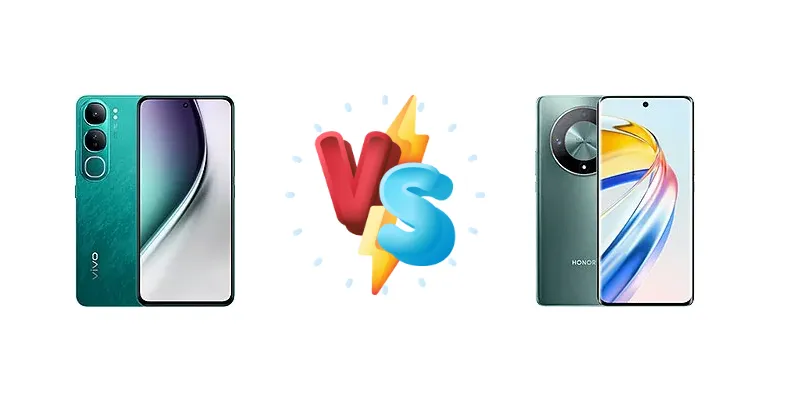
The vivo Y300 and Honor X9b represent compelling options in the increasingly competitive budget smartphone space. Both leverage Qualcomm's Snapdragon series, but target slightly different priorities. The Y300 emphasizes blazing-fast 80W charging, while the X9b opts for a more powerful, though less aggressively charged, Snapdragon 6 Gen 1. This comparison dissects these key differences to determine which device best suits your needs.
🏆 Quick Verdict
For the average user prioritizing rapid replenishment and a slightly more efficient processor, the vivo Y300 emerges as the winner. Its 80W charging significantly reduces downtime, and the Snapdragon 4 Gen 2, while not as powerful as the 6 Gen 1, offers a solid balance of performance and power efficiency for everyday tasks.
| Network |
|---|
| 2G bands | GSM 850 / 900 / 1800 / 1900 | GSM 850 / 900 / 1800 / 1900 |
| 3G bands | HSDPA 850 / 900 / 2100 | HSDPA 850 / 900 / 1900 / 2100 |
| 4G bands | 1, 3, 5, 8, 28, 38, 40, 41 | 1, 2, 3, 4, 5, 7, 8, 20, 28, 32, 38, 40, 41 |
| 5G bands | 1, 3, 5, 8, 28, 40, 77, 78 SA/NSA | 1, 3, 7, 8, 20, 28, 38, 40, 41, 77, 78 SA/NSA |
| Speed | HSPA, LTE, 5G | HSPA, LTE, 5G |
| Technology | GSM / HSPA / LTE / 5G | GSM / HSPA / LTE / 5G |
| Launch |
|---|
| Announced | 2024, November 21 | 2023, October 18 |
| Status | Available. Released 2024, November 26 | Available. Released 2023, October |
| Body |
|---|
| Build | Glass front, plastic back, plastic frame | - |
| Dimensions | 163.2 x 75.9 x 7.8 mm or 8.0 mm | 163.6 x 75.5 x 8 mm (6.44 x 2.97 x 0.31 in) |
| SIM | Nano-SIM + Nano-SIM | Nano-SIM + Nano-SIM |
| Weight | 188 g or 190 g (6.63 oz) | 185 g (6.53 oz) |
| Display |
|---|
| Resolution | 1080 x 2400 pixels, 20:9 ratio (~395 ppi density) | 1220 x 2652 pixels, 19.5:9 ratio (~431 ppi density) |
| Size | 6.67 inches, 107.4 cm2 (~86.7% screen-to-body ratio) | 6.78 inches, 112.6 cm2 (~91.2% screen-to-body ratio) |
| Type | AMOLED, 1B colors, 120Hz, 1200 nits (HBM), 1800 nits (peak) | AMOLED, 1B colors, 120Hz, 1200 nits (peak) |
| Platform |
|---|
| CPU | Octa-core (2x2.2 GHz Cortex-A78 & 6x1.95 GHz Cortex-A55) | Octa-core (4x2.2 GHz Cortex-A78 & 4x1.8 GHz Cortex-A55) |
| Chipset | Qualcomm SM4450 Snapdragon 4 Gen 2 (4 nm) | Qualcomm SM6450 Snapdragon 6 Gen 1 (4 nm) |
| GPU | Adreno 613 | Adreno 710 |
| OS | Android 14, Funtouch 14 | Android 13, Magic OS 7.2 |
| Memory |
|---|
| Card slot | microSDXC (uses shared SIM slot) | No |
| Internal | 128GB 8GB RAM, 256GB 8GB RAM | 256GB 8GB RAM, 256GB 12GB RAM, 512GB 8GB RAM, 512GB 12GB RAM |
| Main Camera |
|---|
| Dual | 50 MP, f/1.8, (wide), 1/1.95", 0.8µm, PDAF
Auxiliary lens | - |
| Features | Ring-LED flash, panorama, HDR | LED flash, panorama, HDR |
| Triple | - | 108 MP, f/1.8, (wide), 1/1.67", PDAF
5 MP, f/2.2, (ultrawide)
2 MP (macro) |
| Video | 1080p@30fps | 4K@30fps, 1080p@30fps |
| Selfie camera |
|---|
| Single | 32 MP, f/2.5, (wide) | 16 MP, f/2.5, (wide) |
| Video | 1080p@30fps | 1080p@30fps |
| Sound |
|---|
| 35mm jack | No | No |
| Loudspeaker | Yes, with stereo speakers | Yes |
| Comms |
|---|
| Bluetooth | 5.0, A2DP, LE | 5.1, A2DP, LE |
| Infrared port | - | Yes |
| NFC | No | Yes (market/region dependent) |
| Positioning | GPS, GALILEO, GLONASS, QZSS, BDS, NavIC | GPS, GLONASS, GALILEO, BDS |
| Radio | No | No |
| USB | USB Type-C 2.0, OTG | USB Type-C 2.0, OTG |
| WLAN | Wi-Fi 802.11 a/b/g/n/ac, dual-band | Wi-Fi 802.11 a/b/g/n/ac, dual-band, Wi-Fi Direct |
| Features |
|---|
| Sensors | Fingerprint (under display, optical), accelerometer, gyro, proximity, compass | Fingerprint (under display, optical), accelerometer, gyro, proximity, compass |
| Battery |
|---|
| Charging | 80W wired, 80% in 30 min
Reverse wired | 35W wired
Reverse wired |
| Type | Li-Ion 5000 mAh | Li-Po 5800 mAh |
| Misc |
|---|
| Colors | Titanium Silver, Carbon Black, Emerald Green | Sunrise Orange, Midnight Black, Emerald Green |
| Models | V2416 | ALI-NX1 |
| Price | About 250 EUR | About 970 EUR |
| SAR | 0.99 W/kg (head) 0.99 W/kg (body) | - |
vivo Y300
- Blazing-fast 80W charging
- Efficient Snapdragon 4 Gen 2 processor
- Reverse wired charging capability
- Potentially less powerful GPU than the X9b
- Camera performance may be limited by ISP
Honor X9b
- More powerful Snapdragon 6 Gen 1 processor
- Potentially better image processing
- Reverse wired charging capability
- Significantly slower 35W charging
- May experience more thermal throttling under sustained load
Display Comparison
Neither device's display specifications are provided, so a direct comparison is limited. However, given their price points, we can anticipate both utilizing LCD panels. The Honor X9b, historically, has focused on durable displays, potentially featuring a strengthened glass. The vivo Y300, leaning into value, may prioritize cost-effectiveness over premium display features. Color accuracy and peak brightness will likely be comparable, falling within the typical range for this segment.
Camera Comparison
Without specific camera sensor details, analysis is limited. Both brands typically employ a multi-camera setup with a primary sensor, ultrawide, and potentially a macro lens. The absence of sensor size information makes it difficult to assess image quality. However, the Snapdragon 6 Gen 1’s ISP (Image Signal Processor) is generally more advanced than the 4 Gen 2’s, potentially leading to better dynamic range and noise reduction in the Honor X9b’s photos. We anticipate both phones will struggle in low-light conditions without dedicated night modes.
Performance
The core difference lies in the chipsets. The Honor X9b’s Snapdragon 6 Gen 1 (4nm) features 4x Cortex-A78 cores clocked at 2.2 GHz, alongside 4x Cortex-A55 cores at 1.8 GHz. The vivo Y300 utilizes the Snapdragon 4 Gen 2 (4nm) with 2x Cortex-A78 cores at 2.2 GHz and 6x Cortex-A55 cores at 1.95 GHz. While both are 4nm chips, the 6 Gen 1’s more numerous A78 cores provide a theoretical advantage in multi-threaded workloads and sustained performance. However, the Y300’s higher clock speed on its A78 cores could offer a slight edge in single-core tasks. The X9b will likely handle graphically intensive games with slightly smoother frame rates, but the Y300’s efficiency could translate to better battery life during less demanding use.
Battery Life
The vivo Y300’s 80W wired charging is a significant advantage. Achieving 80% charge in 30 minutes drastically reduces downtime compared to the Honor X9b’s 35W charging. While battery capacity isn’t specified, the faster charging of the Y300 effectively mitigates any potential capacity disadvantage. The Y300’s charging speed is a clear win for users who prioritize convenience and quick top-ups, even if the X9b might offer slightly longer overall battery life due to the more efficient Snapdragon 6 Gen 1.
Buying Guide
Buy the vivo Y300 if you need consistently fast charging and prioritize minimizing time tethered to a wall outlet. This phone is ideal for users who frequently find themselves with low battery and need a quick boost. Buy the Honor X9b if you prefer a slightly more capable processor for demanding applications and don't mind a slower charging speed. This is the better choice for users who occasionally engage in more intensive tasks like mobile gaming or video editing.
Frequently Asked Questions
❓ Will the Snapdragon 4 Gen 2 in the vivo Y300 struggle with demanding games like Genshin Impact?
While the Snapdragon 4 Gen 2 isn't a gaming powerhouse, it can handle less graphically intensive games smoothly. Genshin Impact may require lower graphics settings and potentially experience some frame drops during intense scenes. The Honor X9b’s Snapdragon 6 Gen 1 will offer a noticeably better gaming experience, but both phones are best suited for casual gaming.
❓ How much faster is the 80W charging on the vivo Y300 compared to the 35W charging on the Honor X9b in real-world use?
The 80W charging on the Y300 can realistically take a phone from 0% to 80% in around 30-35 minutes, while the X9b’s 35W charging will likely take over an hour to reach the same level. This difference is substantial for users who frequently need a quick battery boost.
❓ Does either phone support 5G connectivity?
Both the Snapdragon 4 Gen 2 and Snapdragon 6 Gen 1 support 5G connectivity, meaning both the vivo Y300 and Honor X9b are capable of connecting to 5G networks, provided your carrier and region support it.