
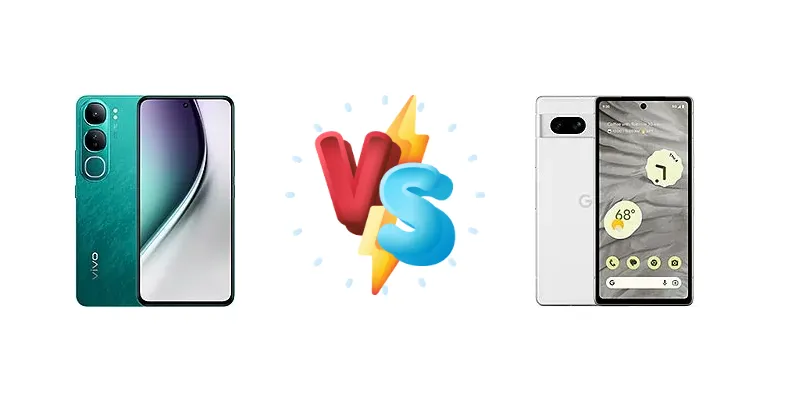
vivo Y300 vs. Google Pixel 7a: A Detailed Comparison of Performance, Camera, and Value
| Phones Images | |||||
|---|---|---|---|---|---|
|
🏆 Quick Verdict
For the average user prioritizing camera quality and software experience, the Google Pixel 7a is the superior choice. However, the vivo Y300’s blazing-fast 80W charging and efficient Snapdragon 4 Gen 2 chipset make it a compelling option for those who value speed and battery convenience above all else.
| PHONES | ||
|---|---|---|
| Phone Names | vivo Y300 | Google Pixel 7a |
| Network | ||
|---|---|---|
| 2G bands | GSM 850 / 900 / 1800 / 1900 | GSM 850 / 900 / 1800 / 1900 |
| 3G bands | HSDPA 850 / 900 / 2100 | HSDPA 800 / 850 / 900 / 1700(AWS) / 1900 / 2100 |
| 4G bands | 1, 3, 5, 8, 28, 38, 40, 41 | 1, 2, 3, 4, 5, 7, 8, 12, 13, 14, 17, 20, 25, 26, 28, 29, 30, 38, 40, 41, 48, 66, 71 - GWKK3, G0DZQ |
| 5G bands | 1, 3, 5, 8, 28, 40, 77, 78 SA/NSA | 1, 2, 3, 5, 7, 8, 12, 14, 20, 25, 28, 30, 38, 41, 48, 66, 71, 77, 78 SA/NSA/Sub6 - GWKK3 |
| Speed | HSPA, LTE, 5G | HSPA, LTE, 5G |
| Technology | GSM / HSPA / LTE / 5G | GSM / HSPA / LTE / 5G |
| - | 1, 2, 3, 5, 7, 8, 12, 20, 25, 28, 38, 40, 41, 66, 75, 76, 77, 78, 79 SA/NSA/Sub6 - GHL1X, G82U8 | |
| Launch | ||
|---|---|---|
| Announced | 2024, November 21 | 2023, May 10 |
| Status | Available. Released 2024, November 26 | Available. Released 2023, May 10 |
| Body | ||
|---|---|---|
| Build | Glass front, plastic back, plastic frame | Glass front (Gorilla Glass 3), aluminum frame, plastic back |
| Dimensions | 163.2 x 75.9 x 7.8 mm or 8.0 mm | 152 x 72.9 x 9 mm (5.98 x 2.87 x 0.35 in) |
| SIM | Nano-SIM + Nano-SIM | Nano-SIM + eSIM |
| Weight | 188 g or 190 g (6.63 oz) | 193.5 g (6.84 oz) |
| - | IP67 dust/water resistant (up to 1m for 30 min) | |
| Display | ||
|---|---|---|
| Protection | - | Corning Gorilla Glass 3 |
| Resolution | 1080 x 2400 pixels, 20:9 ratio (~395 ppi density) | 1080 x 2400 pixels, 20:9 ratio (~429 ppi density) |
| Size | 6.67 inches, 107.4 cm2 (~86.7% screen-to-body ratio) | 6.1 inches, 90.7 cm2 (~81.8% screen-to-body ratio) |
| Type | AMOLED, 1B colors, 120Hz, 1200 nits (HBM), 1800 nits (peak) | OLED, HDR, 90Hz |
| - | Always-on display | |
| Platform | ||
|---|---|---|
| CPU | Octa-core (2x2.2 GHz Cortex-A78 & 6x1.95 GHz Cortex-A55) | Octa-core (2x2.85 GHz Cortex-X1 & 2x2.35 GHz Cortex-A78 & 4x1.80 GHz Cortex-A55) |
| Chipset | Qualcomm SM4450 Snapdragon 4 Gen 2 (4 nm) | Google Tensor G2 (5 nm) |
| GPU | Adreno 613 | Mali-G710 MP7 |
| OS | Android 14, Funtouch 14 | Android 13, upgradable to Android 15, up to 5 major Android upgrades |
| Memory | ||
|---|---|---|
| Card slot | microSDXC (uses shared SIM slot) | No |
| Internal | 128GB 8GB RAM, 256GB 8GB RAM | 128GB 8GB RAM |
| - | UFS 3.1 | |
| Main Camera | ||
|---|---|---|
| Dual | 50 MP, f/1.8, (wide), 1/1.95", 0.8µm, PDAF Auxiliary lens | 64 MP, f/1.9, 26mm (wide), 1/1.73", 0.8µm, dual pixel PDAF, OIS 13 MP, f/2.2, 120˚ (ultrawide), 1.12µm |
| Features | Ring-LED flash, panorama, HDR | Dual-LED flash, Pixel Shift, Auto-HDR, panorama |
| Video | 1080p@30fps | 4K@30/60fps, 1080p@30/60/120/240fps, OIS |
| Selfie camera | ||
|---|---|---|
| Features | - | HDR, panorama |
| Single | 32 MP, f/2.5, (wide) | 13 MP, f/2.2, 20mm (ultrawide), 1.12µm |
| Video | 1080p@30fps | 4K@30fps, 1080p@30fps |
| Sound | ||
|---|---|---|
| 3.5mm jack | - | No |
| 35mm jack | No | No |
| Loudspeaker | Yes, with stereo speakers | Yes, with stereo speakers |
| Comms | ||
|---|---|---|
| Bluetooth | 5.0, A2DP, LE | 5.3, A2DP, LE |
| NFC | No | Yes |
| Positioning | GPS, GALILEO, GLONASS, QZSS, BDS, NavIC | GPS, GLONASS, GALILEO, BDS, QZSS, NavIC |
| Radio | No | No |
| USB | USB Type-C 2.0, OTG | USB Type-C 3.2 |
| WLAN | Wi-Fi 802.11 a/b/g/n/ac, dual-band | Wi-Fi 802.11 a/b/g/n/ac/6e, tri-band |
| Features | ||
|---|---|---|
| Sensors | Fingerprint (under display, optical), accelerometer, gyro, proximity, compass | Fingerprint (under display, optical), accelerometer, gyro, proximity, compass, barometer |
| Battery | ||
|---|---|---|
| Charging | 80W wired, 80% in 30 min Reverse wired | 18W wired, PD3.0 7.5W wireless |
| Type | Li-Ion 5000 mAh | Li-Po 4385 mAh |
| Misc | ||
|---|---|---|
| Colors | Titanium Silver, Carbon Black, Emerald Green | Charcoal, Snow, Sea, Coral |
| Models | V2416 | GWKK3, GHL1X, G0DZQ, G82U8 |
| Price | About 250 EUR | € 179.90 / $ 150.00 / £ 170.00 / ₹ 25,980 |
| SAR | 0.99 W/kg (head) 0.99 W/kg (body) | - |
vivo Y300
- Blazing-fast 80W wired charging
- Efficient Snapdragon 4 Gen 2 chipset (4nm)
- Reverse wired charging capability
- Likely inferior camera performance
- Potentially less powerful processor for demanding tasks
Google Pixel 7a
- Exceptional camera quality and image processing
- Powerful Tensor G2 chipset with AI capabilities
- Long battery life (76h endurance rating)
- Slow 18W wired charging
- Higher price point
Display Comparison
The Pixel 7a boasts a brighter display, reaching a measured peak of 1070 nits, offering superior visibility in direct sunlight compared to the Y300 (brightness data unavailable). While the Y300’s panel specifics are unknown, the Pixel 7a’s OLED panel delivers vibrant colors and deep blacks. The Pixel 7a’s 90Hz refresh rate (assumed based on Pixel 7 series) provides smoother scrolling and animations, a feature likely absent on the Y300, contributing to a more fluid user experience.
Camera Comparison
The Pixel 7a’s camera system is a clear advantage. While specific sensor details are missing for the Y300, the Pixel 7a’s image processing, powered by the Tensor G2, delivers exceptional dynamic range, accurate colors, and impressive low-light performance. Google’s computational photography algorithms are a significant differentiator. The Pixel 7a excels in both photo and video capture, offering features like Magic Eraser and Photo Unblur. The Y300 likely relies more on hardware capabilities, which, given its price point, are unlikely to match the Pixel 7a’s software-driven enhancements.
Performance
The Google Pixel 7a’s Tensor G2 (5nm) chipset, with its Cortex-X1 prime core clocked at 2.85 GHz, significantly outperforms the vivo Y300’s Snapdragon 4 Gen 2 (4nm) in raw processing power. The Tensor G2’s architecture is geared towards AI tasks, enhancing features like voice recognition and image processing. While the Snapdragon 4 Gen 2 is efficient and capable for daily use, the Pixel 7a will handle demanding applications and multitasking with greater ease. The Y300’s Cortex-A78 cores offer a performance boost over the A55 cores, but cannot match the X1’s capabilities. The 5nm process of the Tensor G2 also contributes to better thermal management under sustained load.
Battery Life
The Pixel 7a’s endurance rating of 76 hours suggests excellent battery life, despite its slower 18W charging. The vivo Y300, however, compensates for a potentially smaller battery (capacity unknown) with its incredibly fast 80W wired charging, capable of reaching 80% charge in just 30 minutes. This drastically reduces downtime and is a major convenience factor. The Pixel 7a’s 7.5W wireless charging is a bonus, but significantly slower than the Y300’s wired charging speed.
Buying Guide
Buy the vivo Y300 if you need a phone that can rapidly replenish its battery – its 80W charging is a game-changer for power users. It’s ideal for those who frequently find themselves needing a quick top-up and appreciate a modern, efficient processor for everyday tasks. Buy the Google Pixel 7a if you prefer a best-in-class camera experience, seamless software updates, and the benefits of Google’s AI-powered features, even if it means slower charging and a slightly less powerful chipset.