
vivo Y300 Pro+ vs Google Pixel 7a: Which Mid-Range Champion Reigns Supreme?
| Phones Images | |||||
|---|---|---|---|---|---|
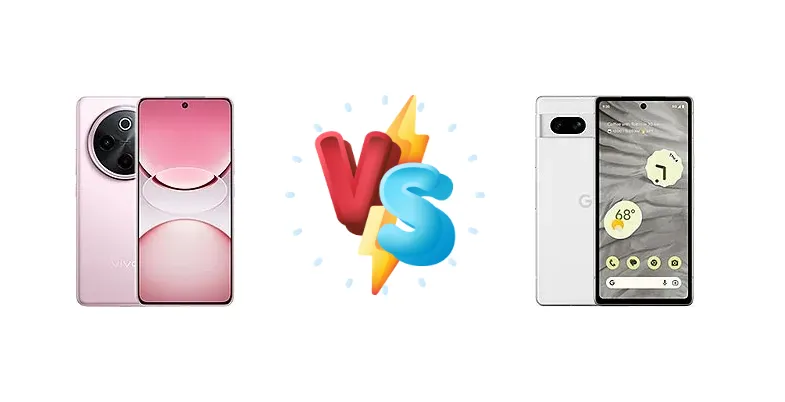
|
🏆 Quick Verdict
For the average user prioritizing camera quality and software experience, the Google Pixel 7a is the better choice. However, the vivo Y300 Pro+ offers significantly faster charging and potentially better sustained performance due to the Snapdragon 7s Gen 3’s 4nm process, making it ideal for power users and those frequently on the go.
| PHONES | ||
|---|---|---|
| Phone Names | vivo Y300 Pro+ | Google Pixel 7a |
| Network | ||
|---|---|---|
| 2G bands | GSM 850 / 900 / 1800 / 1900 | GSM 850 / 900 / 1800 / 1900 |
| 3G bands | HSDPA 800 / 850 / 900 / 2100 | HSDPA 800 / 850 / 900 / 1700(AWS) / 1900 / 2100 |
| 4G bands | 1, 3, 5, 8, 19, 28, 34, 38, 39, 40, 41, 42, 48 | 1, 2, 3, 4, 5, 7, 8, 12, 13, 14, 17, 20, 25, 26, 28, 29, 30, 38, 40, 41, 48, 66, 71 - GWKK3, G0DZQ |
| 5G bands | 1, 3, 5, 8, 28, 38, 40, 41, 48, 77, 78 SA/NSA | 1, 2, 3, 5, 7, 8, 12, 14, 20, 25, 28, 30, 38, 41, 48, 66, 71, 77, 78 SA/NSA/Sub6 - GWKK3 |
| Speed | HSPA, LTE, 5G | HSPA, LTE, 5G |
| Technology | GSM / HSPA / LTE / 5G | GSM / HSPA / LTE / 5G |
| - | 1, 2, 3, 5, 7, 8, 12, 20, 25, 28, 38, 40, 41, 66, 75, 76, 77, 78, 79 SA/NSA/Sub6 - GHL1X, G82U8 | |
| Launch | ||
|---|---|---|
| Announced | March 31 | 2023, May 10 |
| Status | Available. Released 2025, April 03 | Available. Released 2023, May 10 |
| Body | ||
|---|---|---|
| Build | - | Glass front (Gorilla Glass 3), aluminum frame, plastic back |
| Dimensions | 163.4 x 76.4 x 7.9 mm (6.43 x 3.01 x 0.31 in) | 152 x 72.9 x 9 mm (5.98 x 2.87 x 0.35 in) |
| SIM | Nano-SIM + Nano-SIM | Nano-SIM + eSIM |
| Weight | 199 g (7.02 oz) | 193.5 g (6.84 oz) |
| - | IP67 dust/water resistant (up to 1m for 30 min) | |
| Display | ||
|---|---|---|
| Protection | - | Corning Gorilla Glass 3 |
| Resolution | 1080 x 2392 pixels (~388 ppi density) | 1080 x 2400 pixels, 20:9 ratio (~429 ppi density) |
| Size | 6.77 inches, 110.9 cm2 (~88.8% screen-to-body ratio) | 6.1 inches, 90.7 cm2 (~81.8% screen-to-body ratio) |
| Type | AMOLED, 1B colors, 120Hz, 800 nits (typ), 1300 nits (HBM), 5000 nits (peak) | OLED, HDR, 90Hz |
| - | Always-on display | |
| Platform | ||
|---|---|---|
| CPU | Octa-core (1x2.5 GHz Cortex-A720 & 3x2.4 GHz Cortex-A720 & 4x1.8 GHz Cortex-A520) | Octa-core (2x2.85 GHz Cortex-X1 & 2x2.35 GHz Cortex-A78 & 4x1.80 GHz Cortex-A55) |
| Chipset | Qualcomm SM7635 Snapdragon 7s Gen 3 (4 nm) | Google Tensor G2 (5 nm) |
| GPU | Adreno 810 | Mali-G710 MP7 |
| OS | Android 15, OriginOS 5 | Android 13, upgradable to Android 15, up to 5 major Android upgrades |
| Memory | ||
|---|---|---|
| Card slot | No | No |
| Internal | 128GB 8GB RAM, 256GB 8GB RAM, 256GB 12GB RAM, 512GB 12GB RAM | 128GB 8GB RAM |
| - | UFS 3.1 | |
| Main Camera | ||
|---|---|---|
| Dual | 50 MP, f/1.8, (wide), 1/1.95", 0.8µm, PDAF, OIS Auxiliary lens | 64 MP, f/1.9, 26mm (wide), 1/1.73", 0.8µm, dual pixel PDAF, OIS 13 MP, f/2.2, 120˚ (ultrawide), 1.12µm |
| Features | LED flash, HDR, panorama | Dual-LED flash, Pixel Shift, Auto-HDR, panorama |
| Video | 4K@30fps, 1080p@30fps, gyro-EIS, OIS | 4K@30/60fps, 1080p@30/60/120/240fps, OIS |
| Selfie camera | ||
|---|---|---|
| Features | - | HDR, panorama |
| Single | 32 MP, f/2.0, (wide) | 13 MP, f/2.2, 20mm (ultrawide), 1.12µm |
| Video | 1080p@30fps | 4K@30fps, 1080p@30fps |
| Sound | ||
|---|---|---|
| 3.5mm jack | - | No |
| 35mm jack | No | No |
| Loudspeaker | Yes | Yes, with stereo speakers |
| Comms | ||
|---|---|---|
| Bluetooth | 5.2, A2DP, LE, aptX HD, aptX Adaptive | 5.3, A2DP, LE |
| Infrared port | Yes | - |
| NFC | Yes | Yes |
| Positioning | GPS (L1+L5), BDS (B1I+B1c+B2a), GALILEO (E1+E5a), QZSS (L1+L5), GLONASS | GPS, GLONASS, GALILEO, BDS, QZSS, NavIC |
| Radio | No | No |
| USB | USB Type-C 2.0, OTG | USB Type-C 3.2 |
| WLAN | Wi-Fi 802.11 a/b/g/n/ac/6, dual-band | Wi-Fi 802.11 a/b/g/n/ac/6e, tri-band |
| Features | ||
|---|---|---|
| Sensors | Fingerprint (under display, optical), accelerometer, gyro, proximity, compass | Fingerprint (under display, optical), accelerometer, gyro, proximity, compass, barometer |
| Battery | ||
|---|---|---|
| Charging | 90W wired, 55W PPS, 44W UFCS 7.5W reverse wired | 18W wired, PD3.0 7.5W wireless |
| Type | Si/C Li-Ion 7300 mAh | Li-Po 4385 mAh |
| Misc | ||
|---|---|---|
| Colors | Black, Silver, Pink | Charcoal, Snow, Sea, Coral |
| Models | V2456A | GWKK3, GHL1X, G0DZQ, G82U8 |
| Price | About 230 EUR | € 179.90 / $ 150.00 / £ 170.00 / ₹ 25,980 |
vivo Y300 Pro+
- Incredibly fast 90W charging
- More efficient Snapdragon 7s Gen 3 (4nm)
- Potentially better sustained performance
- Reverse wired charging
- Camera likely inferior to Pixel 7a
- Software updates may be less frequent
Google Pixel 7a
- Excellent camera quality and image processing
- Seamless software experience and updates
- Bright and vibrant display
- Google’s AI-powered features
- Slow 18W charging
- Tensor G2 may throttle under sustained load
Display Comparison
The Pixel 7a boasts a measured peak brightness of 1070 nits, ensuring excellent visibility outdoors. While the Y300 Pro+'s display specifications are not provided, it's likely to be a standard AMOLED panel. The Pixel 7a’s brightness advantage is significant for users who frequently use their phones in direct sunlight. The absence of LTPO technology on either device means neither offers adaptive refresh rates for power saving, but the Pixel 7a’s higher peak brightness is a clear win.
Camera Comparison
The Pixel 7a is renowned for its computational photography prowess, leveraging Google’s image processing algorithms. While specific sensor details for the Y300 Pro+ are missing, the Pixel 7a’s camera system is likely to deliver superior image quality, particularly in challenging lighting conditions. The Tensor G2’s dedicated image signal processor (ISP) plays a crucial role in this. The Pixel 7a’s video capabilities are also expected to be stronger, benefiting from Google’s advanced video stabilization and processing techniques. The Y300 Pro+ will likely offer a competent camera experience, but it won’t match the Pixel 7a’s consistently high quality.
Performance
The core difference lies in the chipsets: Qualcomm’s Snapdragon 7s Gen 3 (4nm) in the Y300 Pro+ versus Google’s Tensor G2 (5nm) in the Pixel 7a. While the Tensor G2 features higher clock speeds on its prime cores (2.85 GHz Cortex-X1 vs 2.5 GHz Cortex-A720), the Snapdragon 7s Gen 3 benefits from a more modern architecture and a smaller 4nm process. This translates to improved power efficiency and potentially less thermal throttling during prolonged intensive tasks. The Pixel 7a’s CPU configuration includes older Cortex-A78 cores, while the Y300 Pro+ utilizes the newer Cortex-A720. The Y300 Pro+’s CPU configuration (1x2.5 GHz Cortex-A720 & 3x2.4 GHz Cortex-A720 & 4x1.8 GHz Cortex-A520) suggests a focus on sustained multi-core performance.
Battery Life
The Pixel 7a has an endurance rating of 76 hours, indicating solid battery life. However, the Y300 Pro+’s 90W wired charging is a game-changer. This allows for incredibly fast top-ups, potentially mitigating the impact of a smaller battery capacity (if present). The Pixel 7a’s 18W charging is comparatively slow. The Y300 Pro+ also supports 55W PPS and 44W UFCS, offering broader compatibility with fast charging standards. The 7.5W reverse wired charging on the Y300 Pro+ is a useful addition for topping up accessories.
Buying Guide
Buy the vivo Y300 Pro+ if you need blazing-fast 90W charging, prioritize sustained performance during extended gaming sessions, and value a more efficient chipset. Buy the Google Pixel 7a if you prefer a superior camera experience, seamless software updates, and Google’s AI-powered features, even if it means slower charging and potentially more thermal throttling under heavy load.