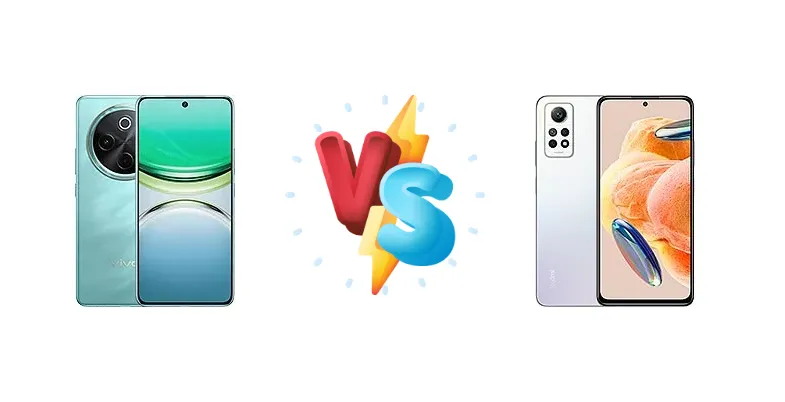
The vivo Y300 Pro and Xiaomi Redmi Note 12 Pro 4G represent compelling options in the competitive mid-range smartphone market. While both aim to deliver a solid experience without breaking the bank, they take different approaches, primarily centered around their chipsets and charging capabilities. This comparison dissects these key differences to determine which device offers the best value.
🏆 Quick Verdict
For the average user prioritizing sustained performance and faster charging, the vivo Y300 Pro emerges as the winner. Its Snapdragon 6 Gen 1, built on a more efficient 4nm process, offers a performance edge over the Redmi Note 12 Pro 4G’s Snapdragon 732G, despite the latter’s slightly older but still capable architecture.
| Network |
|---|
| 2G bands | GSM 850 / 900 / 1800 / 1900 | GSM 850 / 900 / 1800 / 1900 |
| 3G bands | HSDPA 850 / 900 / 2100 | HSDPA 850 / 900 / 1700(AWS) / 1900 / 2100 |
| 4G bands | 1, 3, 5, 8, 28, 38, 39, 40, 41 | 1, 2, 3, 4, 5, 7, 8, 20, 28, 38, 40, 41, 66 |
| 5G bands | 1, 3, 5, 8, 28, 38, 40, 41, 77, 78 SA/NSA | - |
| Speed | HSPA, LTE, 5G | HSPA, LTE |
| Technology | GSM / CDMA / HSPA / CDMA2000 / LTE / 5G | GSM / HSPA / LTE |
| Launch |
|---|
| Announced | 2024, September 05 | 2023, March 03 |
| Status | Available. Released 2024, September 14 | Available. Released 2023, April 11 |
| Body |
|---|
| Dimensions | 163.4 x 76.4 x 7.7 mm (6.43 x 3.01 x 0.30 in) | 164.2 x 76.1 x 8.1 mm (6.46 x 3.00 x 0.32 in) |
| SIM | Nano-SIM + Nano-SIM | Nano-SIM + Nano-SIM |
| Weight | 194 g (6.84 oz) | 201.8 g (7.13 oz) |
| Display |
|---|
| Resolution | 1080 x 2392 pixels (~388 ppi density) | 1080 x 2400 pixels, 20:9 ratio (~395 ppi density) |
| Size | 6.77 inches, 110.9 cm2 (~88.8% screen-to-body ratio) | 6.67 inches, 107.4 cm2 (~86.0% screen-to-body ratio) |
| Type | AMOLED, 1B colors, 120Hz, 5000 nits (peak) | AMOLED, 120Hz, Dolby Vision, 700 nits (HBM), 1100 nits (peak) |
| Platform |
|---|
| CPU | Octa-core (4x2.2 GHz Cortex-A78 & 4x1.8 GHz Cortex-A55) | Octa-core (2x2.2 GHz Kryo 470 Gold & 6x1.8 GHz Kryo 470 Silver) |
| Chipset | Qualcomm SM6450 Snapdragon 6 Gen 1 (4 nm) | Qualcomm SM7150 Snapdragon 732G (8 nm) |
| GPU | Adreno 710 | Adreno 618 |
| OS | Android 14, OriginOS 4 | Android 11, MIUI 13 |
| Memory |
|---|
| Card slot | No | microSDXC (uses shared SIM slot) |
| Internal | 128GB 8GB RAM, 256GB 8GB RAM, 256GB 12GB RAM, 512GB 12GB RAM | 128GB 6GB RAM, 128GB 8GB RAM, 256GB 8GB RAM |
| | - | UFS 2.2 |
| Main Camera |
|---|
| Dual | 50 MP, f/1.8, (wide), 1/1.95", 0.8µm, PDAF
Auxiliary lens | - |
| Features | LED flash, HDR, panorama | LED flash, HDR, panorama |
| Quad | - | 108 MP, f/1.9, (wide), 1/1.52", 0.7µm, PDAF
8 MP, 120˚, (ultrawide)
2 MP (macro)
Auxiliary lens |
| Video | 4K@30fps, 1080p@30fps, gyro-EIS | 4K@30fps, 1080p@30/60fps |
| Selfie camera |
|---|
| Single | 32 MP, f/2.0, (wide) | 16 MP, f/2.4, (wide) |
| Video | 1080p@30fps | 1080p@30fps |
| Sound |
|---|
| 3.5mm jack | - | Yes |
| 35mm jack | No | Yes |
| Loudspeaker | Yes | Yes, with stereo speakers |
| Comms |
|---|
| Bluetooth | 5.1, A2DP, LE, aptX HD, aptX Adaptive | 5.0, A2DP, LE |
| Infrared port | Yes | Yes |
| NFC | No | Yes (market/region dependent) |
| Positioning | GPS, GLONASS, GALILEO, BDS, QZSS | GPS, GLONASS, GALILEO, BDS |
| Radio | No | Unspecified |
| USB | USB Type-C 2.0, OTG | USB Type-C 2.0, OTG |
| WLAN | Wi-Fi 802.11 a/b/g/n/ac, dual-band | Wi-Fi 802.11 a/b/g/n/ac, dual-band |
| Features |
|---|
| Sensors | Fingerprint (under display, optical), accelerometer, gyro, proximity, compass | Fingerprint (side-mounted), accelerometer, gyro, compass |
| Battery |
|---|
| Charging | 80W wired
Reverse wired | 67W wired |
| Type | 6500 mAh | Li-Po 5000 mAh |
| Misc |
|---|
| Colors | Black, Ocean Blue, Titanium, White | Star Blue, Graphite Gray, Polar White, Ice blue |
| Models | V2410A | 2209116AG, 2209116AG |
| Price | About 230 EUR | About 150 EUR |
vivo Y300 Pro
- Faster 80W charging for quicker top-ups
- More efficient Snapdragon 6 Gen 1 (4nm) chipset
- Potentially better sustained performance due to thermal efficiency
- Brand recognition may be lower than Xiaomi
- Camera performance is unknown without further specs
Xiaomi Redmi Note 12 Pro 4G
- Proven Snapdragon 732G chipset with reliable performance
- Xiaomi’s established software ecosystem
- Potentially lower price point
- Slower 67W charging compared to the vivo Y300 Pro
- Less efficient 8nm chipset may lead to more throttling
Display Comparison
Neither device’s display specifications are provided, so a direct comparison is limited. However, given the price bracket, both likely feature AMOLED panels with FHD+ resolution. The Redmi Note 12 Pro 4G historically features high refresh rate displays (120Hz), which the Y300 Pro may or may not match. Color accuracy and peak brightness will be key differentiators, but without data, it’s impossible to determine a clear winner. Expect both to offer adequate viewing experiences for everyday use.
Camera Comparison
Without camera specifications, analysis is limited. However, both phones likely feature multi-camera setups with a primary sensor, ultrawide, and potentially macro/depth sensors. The image processing algorithms will be a key differentiator. Xiaomi’s Redmi Note series often emphasizes vibrant, saturated colors, while vivo tends towards a more natural look. Sensor size and aperture will be crucial for low-light performance, but without that data, it’s impossible to declare a winner. The presence or absence of Optical Image Stabilization (OIS) on the main sensor would also be a significant factor.
Performance
The core of the difference lies in the chipsets. The vivo Y300 Pro’s Snapdragon 6 Gen 1 (4nm) boasts a newer architecture and a smaller fabrication process compared to the Redmi Note 12 Pro 4G’s Snapdragon 732G (8nm). The 4nm process inherently leads to better power efficiency and thermal management, meaning the Y300 Pro is likely to sustain peak performance for longer periods without significant throttling. While the 732G features two Cortex-A78 cores for performance, the Y300 Pro’s four Cortex-A78 cores provide a potential advantage in multi-threaded tasks. The CPU clock speeds are identical at 2.2 GHz, but the architectural improvements and process node give the Snapdragon 6 Gen 1 the edge.
Battery Life
The vivo Y300 Pro’s 80W wired charging is a significant advantage over the Redmi Note 12 Pro 4G’s 67W charging. This translates to substantially faster charging times – potentially topping up from 0-100% in under 40 minutes for the Y300 Pro versus closer to 45-60 minutes for the Redmi Note 12 Pro 4G. While battery capacity isn’t specified, the more efficient Snapdragon 6 Gen 1 in the Y300 Pro could offset a potentially smaller battery size, resulting in comparable real-world battery life.
Buying Guide
Buy the vivo Y300 Pro if you need a phone that can handle demanding apps and multitasking with greater efficiency, and if 80W fast charging is a priority. This phone is ideal for users who frequently game, stream video, or run multiple applications simultaneously. Buy the Xiaomi Redmi Note 12 Pro 4G if you prefer a proven chipset with a strong track record and are less concerned with the absolute fastest charging speeds. It’s a solid all-rounder for everyday tasks and casual gaming.
Frequently Asked Questions
❓ Will the Snapdragon 6 Gen 1 in the vivo Y300 Pro handle demanding games like PUBG Mobile smoothly?
The Snapdragon 6 Gen 1 is a capable chipset for gaming. While it won't deliver flagship-level performance, it should handle PUBG Mobile at medium to high settings with stable frame rates. The 4nm process will help mitigate thermal throttling during extended gaming sessions, providing a more consistent experience than the Snapdragon 732G.
❓ How much faster is the 80W charging on the vivo Y300 Pro compared to the 67W charging on the Redmi Note 12 Pro 4G in real-world use?
Expect the vivo Y300 Pro to charge approximately 20-30% faster than the Redmi Note 12 Pro 4G. A full 0-100% charge could take around 35-40 minutes on the Y300 Pro, while the Redmi Note 12 Pro 4G might require 45-60 minutes. This difference is particularly noticeable when topping up the battery quickly during short breaks.
❓ Does the Snapdragon 6 Gen 1 offer noticeable improvements in app loading times and multitasking compared to the Snapdragon 732G?
Yes, the Snapdragon 6 Gen 1 should provide a noticeable improvement in app loading times and multitasking. The newer architecture and increased core count (four performance cores vs. two on the 732G) contribute to snappier performance when switching between apps and launching resource-intensive applications.